The infamous power of spectacle, Triumph of the Will, 1935
General Reviews
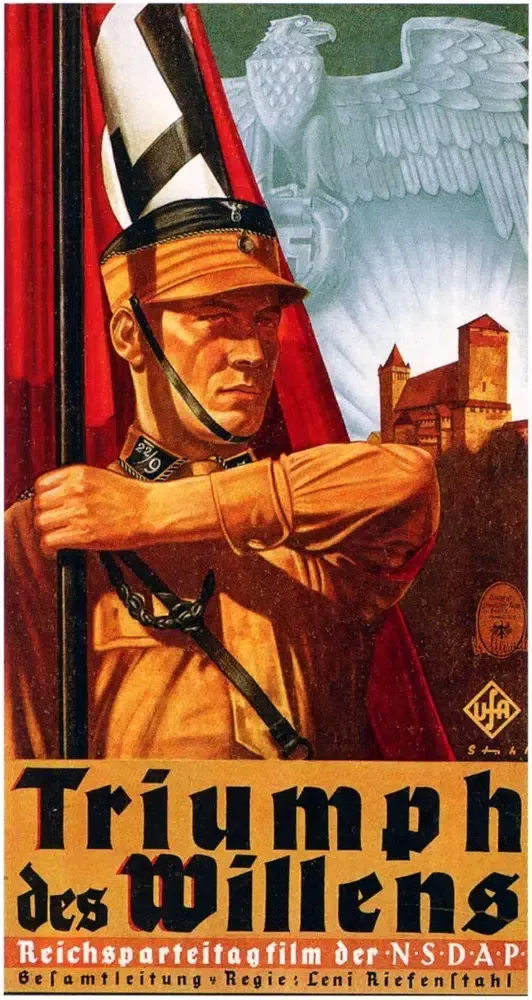 At one point in The Lord of the Rings: The Two Towers (2002) the sinister Grima Wormtongue - who conspired with the forces of darkness to hold the kingdom of Rohan subservient to the wishes of the dark lord Sauron - meets with the wizard Saruman, and comments to him that the humans have become aware of the conspiracy and anticipate that they will soon be attacked. “They are skilled warriors and they are numerous” he says... and then Saruman takes him to the highest balcony of his tower in Isengard, and shows him thousands upon thousands of orcs and Uruk-hai... a sight so impressive that the very sight of it brings tears to his eyes.
Something similar happens with Triumph of the Will.
Of course, the parallels between Tolkien's work and the events of World War II do not end there. After all Rohan is the only human kingdom that has decided to put up resistance - or at least, die with honor - against a gigantic and overpowering evil force... with no outside help, with limited resources, supported only by the fiery speeches of its king Theoden. Yes, it sounds like when Churchill sent the English language to war in 1940 with his famous “we will fight on the beaches” speech: when all seemed lost, Europe was in the hands of the Nazis, and England was the only nation with the courage to stand up to them. We will die but we will not be corrupted. We will fight to the end and, if necessary, we will leave in a blaze of glory.
But in 1935 the war had not broken out. Nazis have been in politics since the 1920s and, in the early 1930s, they finally come to power. With a fiery patriotic discourse combined with a toxic ideology, the German people voted them out of economic hardship and restored Germany's lost pride in being a European power that struck fear into the hearts of its enemies. Sure, there was a lot to dislike in the Nazi discourse but Hitler did things, he transformed the country... he was considered a necessary evil. When traditional politics does not generate the solutions that the people need, they end up appealing to outsiders who come up with radical solutions, even if it means paying a very high cost.
And that necessary evil one day built a bubble, enclosed the entire country inside it and began to bombard them with harmful ideas. If all the media are official, if the truth is managed by the State, if the messages are constant, there is no room for dissent, there is no way to discern what is true... It is a discourse of indoctrination that is repeated every day, 24 hours a day, by all the existing media of the time. Obviously, this has a cost: the first, the truth. The second, the lives of all opponents and dissident voices to the regime.
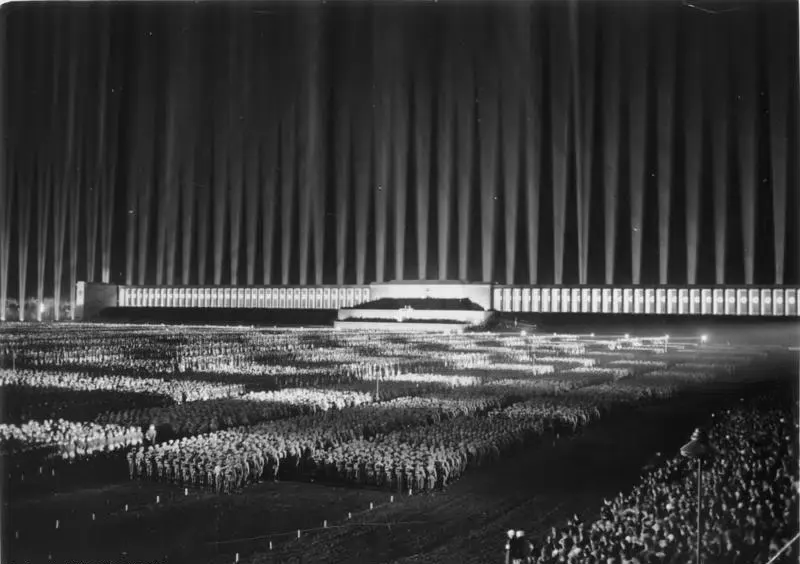
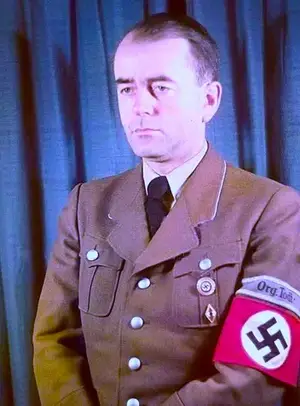
That is why Hitler orders a new party congress to be held in Nuremberg. The rallies have been held since 1923, but the 1934 edition is to be a message from the new Germany to the whole world. And the director Leni Riefenstahl will be in charge of documenting it. In the middle of it all is Albert Speer, Hitler's favorite architect and a member of his inner circle. Speer will create monumental spectacles - like the Cathedral of Light, a show with hundreds of anti-aircraft searchlights pointed vertically into the sky - that dazzle rally attendees... and audiences watching Riefenstahl's film in German cinemas.
The problem, of course, is that Triumph of the Will is a fascinating spectacle... but how to admit it without having to make a disclaimer?. Every frame is shocking and designed for maximum impact: the arrival of the messianic leader from the skies, the shadow of his plane reflected on the buildings of Nuremberg, the massive mobilizations... the iconography declaring the Third Reich as the valid heir to the Roman Empire... and, above all, the tableaux of hundreds, sometimes thousands of people, perfectly formed in giant stadiums and campuses, and moving in a perfectly synchronized manner. That's not CGI. That's not a Hollywood blockbuster plagued with thousands of paid extras. Nor is it a massive gathering of crazies. One of the biggest mistakes modern commentators make is to call Nazi Germany a nation of fanatics, or Hitler a crackpot. Never disparage someone brilliant. Evil, but brilliant. No idiot is capable of amassing so much power.
What one sees in Triumph of the Will is, in simple terms, a glimpse of what humanity can be like in times of radicalization of ideology... which, unfortunately, we are living through. Russia and China act as if the Cold War is not over, and stage endless military parades. North Korea may have a people starved by their pathetic leader, but he loves to show off his latest military toys for hours on end in the streets of Pyongyang. Donald Trump's rallies occupy entire avenues, hordes of exultant fanatics clamoring for their leader in a quasi-religious manner. There are more and more Far Right and Far Left governments. The cult of personality is no longer something reserved for banana republic dictatorships. These are sad times for Democracy where more and more popular mobilizations are taken as demonstrations of legitimate power, carried out by a people intoxicated by terrible ideas and leaders who know how to stir up the masses.
If Mussolini is the first modern dictator, Adolf Hitler is the one who brings the model to its zenith. And a lot of propaganda tools that he and his PR team implement will have influence - or be imitated - to this day. If you have time and search YouTube, you will find Nicolae Ceausescu's visit to North Korea in 1971. A limousine takes him from the airport to the government house where Kim Il-Sung awaits him. The trip takes 20 minutes and in between, the entire city of Pyongyang is organized into crowds dressed in traditional costumes and dancing and singing in synchronized fashion all the way. 20 minutes of watching an endless succession of people occupying blocks and blocks and celebrating a guy (who they don't even know) as if he were the Pope. Then, at the reception set up on a huge campus, there is a massive spectacle with people mounting monumental living posters in Romanian and Korean languages, giving messages of cordiality between the two countries. A show that leaves you with your mouth open, a huge demonstration of power for power's sake.
And possibly among the crowd there were thousands of soldiers in costume, watching over the people's compliance with such a human display.
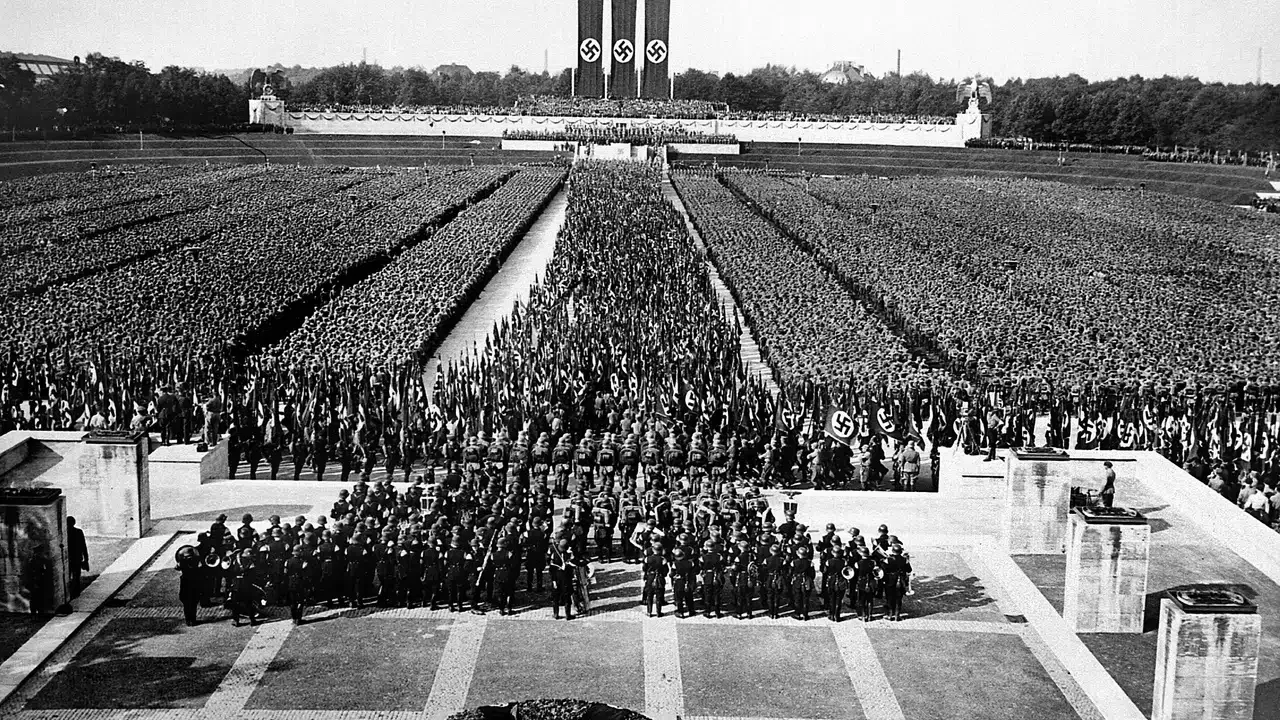
But that doesn't seem to happen at the 1934 Nuremberg Rally, which is all the more chilling. The thousands of people in the stands are there of their own free will. The people who flood the streets to see their leader do so spontaneously. On the gigantic playground in front of the platform from where Hitler will speak to the crowd there is a huge number of people, who belong to divisions of the party - brown shirts, Hitler Youth, etc. - and move in cadres in an organized manner. Thousands and thousands of people convinced that their leader is magnificent and that he must be gratified with a glorious spectacle since he is the one who rescued Germany from the ruins of the post-war period, and from the oppression of the Allies who defeated it in the First World War.
It is an impressive demonstration. The power of the Nazi party transcends the screen. People chant and shout synchronized proclamations. People in the street rush into the procession carrying the Führer. Riefenstahl's work borders on a masterpiece - the panoramic shots, the theatricality of the mise-en-scène, the Wagnerian music -.
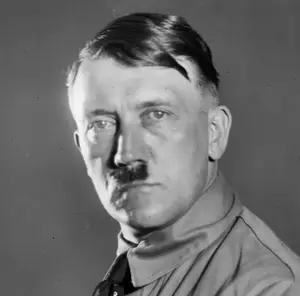
And, of course, Hitler's oratory. The studied pauses - that discipline the audience -, the fiery speeches, the way Hitler gets hot and ends up exalted to the fullest. It is a chilling sight, because that man is admirable as a master manipulator of the masses, and possibly the best orator in history, even when tons of toxic ideas and distorted concepts come out of his mouth.
But where is the ethical limit in admiring Triumph of the Will?. If I like it… am I a Nazi?. Should I automatically dismiss it because it is a piece of propaganda for a genocidal regime?. Or can one separate the message from the spectacle, study the artistic aspect and distinguish its intrinsic qualities?
While one wrestles with these issues, here is an example: at the end of Star Wars (1977) Luke, Han Solo, Chewbacca are awarded for their heroism in a ceremony organized by Princess Leia. The huge hall, illuminated by gigantic columns of light, occupied by hundreds of people... is directly inspired by the aesthetics of Riefenstahl's film. So… George Lucas is a Nazi?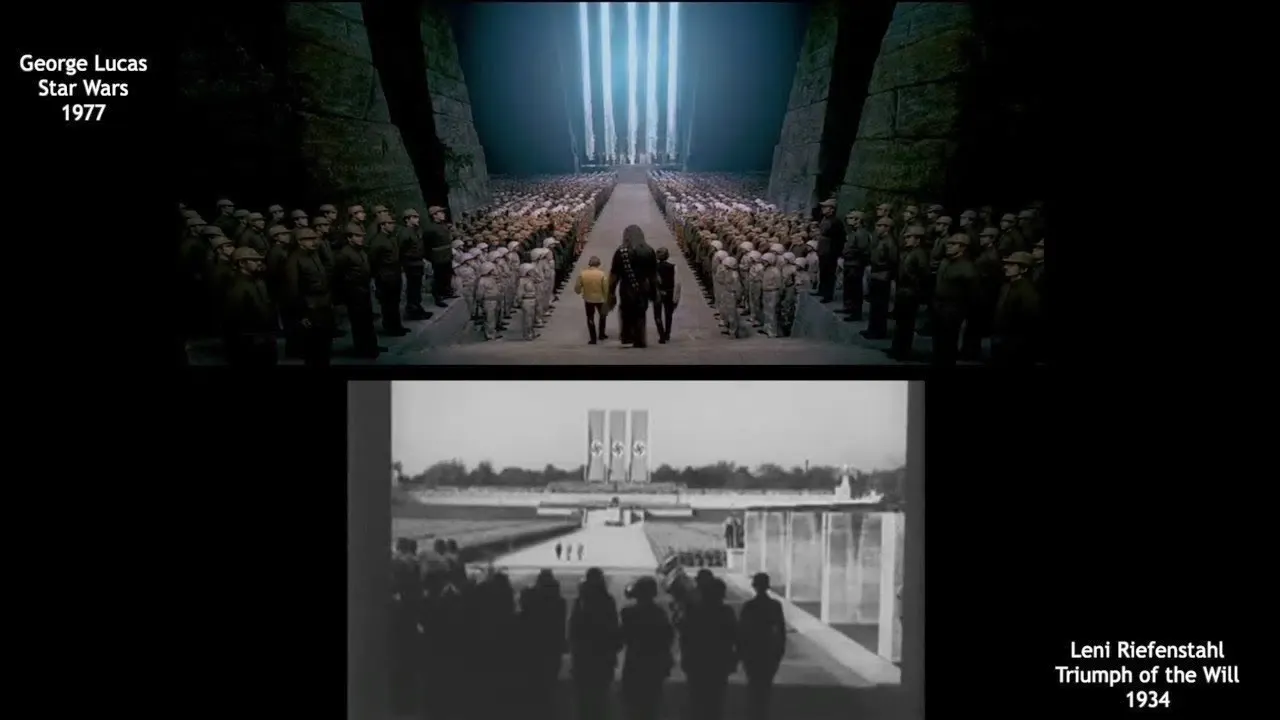
If there is one thing that is clear and without a doubt, it is that the images of Triumph of the Will transcend the screen, overwhelm the viewer, make him feel its power. It is the perfect propaganda film, even if its origin is spurious. Mass mobilizations impress, they show the masses as a single living being and, in the case of Riefenstahl's documentary, it is Hitler who dominates them as if he were their giant puppet master. All those thousands of people you see on screen, they worship their leader... and that is a brutal image. The power of one over an entire nation. But it's also the glorification of a mass movement and, most disturbingly, it leads one to wonder whether - if one lived in Germany in the 1930s - whether one wouldn't want to be part of something as massive, euphoric and extremely nationalistic as such a party seems. Perhaps therein lies the poison of its message: an open invitation to a celebration full of joy and merriment - which is not forced or feigned - and which promises a fabulous future for the members of the great Germanic nation. In less than 15 years most of all the jubilant demonstrators would be dead on the battlefields of Europe, or buried under the ruins of German cities bombed by the Allies. A moment of ecstasy before the Apocalypse is unleashed and the veil of lies is lifted once and for all.
P.S.: Peter Jackson, George Lucas and Ridley Scott have all admitted to having studied the film to learn how to impressively capture mass mobilizations. In Star Wars: Episode VII, The Force Awakens (2015), the influence of Riefenstahl's film is notable during the scenes leading up to the destruction of the New Republic's capital, in which General Hux's fiery speech to his troops directly channels the tone of Adolf Hitler's harangue to the crowds at Nuremberg (and, lest there be any doubt, check out the German version of that scene on YouTube).
Other articles this month, January 2025:
- The infamous power of spectacle: Triumph of the Will (1935) - in english, challenge Red Flag Films
- How to create a great cult movie from a ridiculous idea: The Car (1977) - in english, challenge My Guilty Pleasure on Screen
- From Roger Moore with Love (2024): Icon on and off the screen - in english, challenge Fresh Film Focus
- Casablanca (1942) and the dilemma of whether the classics need to be reevaluated - in spanish, Overrated classics challenge








Comments 17
Thanks for the comment and support!