Do Not Look Back: Why Armageddon Time is my Generation's Stand by Me
Sociocultural
There’s a scene in Stephen King’s 1982 novella The Body where thirteen-year-old Gordie Lachance washes caked mud off his body. He heads to the kitchen and scrambles some eggs. He has just completed a four-day-long adventure in the backwoods of Maine with his three best friends, searching for the dead body of a missing local boy. He never told his parents what he was doing. His mother enters the kitchen. She greets him with a resigned “Where have you been?”
I almost laughed when I read that part.
The Body looks a little weird to younger generations. It’s hard for us to relate to an adult-free adventure in the woods. Although the novella was published in 1982, it is set in 1960. It was a different time for parents and kids. It seems absurd, sixty-five years later, for a parent to have such a muted reaction to not hearing from her kid for four days.
The Body was adapted into a movie called Stand by Me in 1986. The new title came from a 1961 Ben E. King song, which plays over the end credits. The title change alerts audiences that this is not going to be your typical Stephen King horror.
My dad saw Stand by Me in theatres. He was living in the city twelve hours by car away from the Canadian Pacific Railway town where he grew up. He saw the movie alone, on a weeknight, in a theatre that has since shuttered. He still calls Stand by Me one of his favourite movies.
I first saw Stand by Me a little over ten years ago, when I was a teenager. This was when Netflix was new, cheap, and full of cult classic movies. It was one of the first movies I’d streamed on the service. I liked it, but somehow it didn’t live up to the hype for me. I have a strong preference for the novella, which I read over a decade later. Maybe it’s an age thing.

I recently found a companion movie for both The Body and Stand by Me. Armageddon Time (2022) written and directed by journeyman filmmaker James Gray, stars Academy Award winners Anthony Hopkins and Anne Hathaway, Emmy and Tony winner Jeremy Strong, and child actors Banks Repeta and Jaylin Webb as the two leads. Like many movies about kids, the adults in supporting roles get top billing. The film’s IMDb synopsis keeps it vague: “A deeply personal coming-of-age story about the strength of family and the generational pursuit of the American Dream.” I think the movie works best if you go in knowing its themes before you know its plot. I’d recommend a double-feature with Stand by Me, but double-features work best if you pair a light movie with a heavy movie. I recently double-featured The Devil Wears Prada and Spotlight- two very different sides of Stanley Tucci, both fantastic. Stand by Me and Armageddon Time are both heavy movies. You’ve been warned.
Armageddon Time first screened at the Cannes Film Festival on May 19, 2022. It competed for the Palme d’Or and other prizes but won none. Its wide release came on October 28, 2022.

I think for a lot of people, 2022 represents their gradual return to movie theatres after the pandemic. Spiderman: No Way Home, Top Gun: Maverick, and Avatar: The Way of the Water, colon-loving movies all released within the same twelve-month period, drew audiences back to cinemas throughout 2022. Of course, these are all effects-heavy action films. Armageddon Time, a coming-of-age story, is a harder sell for the post-pandemic theatrical experience. The movie had a production budget of approximately $15 million. The small film’s total box office gross was $6.6 million. It's a film so small, I couldn't find a JPEG image to use as this article's thumbnail. I had to convert one.
Three years after its Cannes debut, Armageddon Time has yet to make its big impact. It’s currently streaming on Netflix in Canada. That’s where I watched it with my mom. As far as I know, it’s yet to develop any sort of cult following. I predict that will come later, as more people watch the film on streaming services. I predict that with time, it will become the Stand by Me of the 2020s.
The film’s title refers to the 1979 song “Armagideon Time” by Jamaican reggae musician Willi Williams. The song was covered later in 1979 by The Clash. The band’s bassist, Paul Simonon famously loved and was inspired by reggae. Many Clash songs make reference to Jamaica. The band’s “Armagideon Time” cover was released as a B-side on their legendary London Calling album.
Here are some of the lyrics in Willi Williams’ version:
A lotta people won't get no justice tonight
So a lot of people going to have to stand up and fight, yeah
Here are some lyrics from the Clash’s version:
A lotta people won't get no supper tonight
A lotta people won't get no justice tonight
The battle is getting harder
In this iration, Armagideon time
Something that stands out to me is that Williams’ original lyrics include a call to “stand up and fight” whereas The Clash’s revised lyrics are more of a passive observation about an ongoing fight. Williams’ version also includes religious references, like a reminder to “praise Jahovia.”
I couldn’t find anything to explain why the lyric is “Armagideon” and not “Armageddon.” It seems to come down to regional dialect. “Armageddon” renders James Gray’s movie title more marketable to people unfamiliar with reggae and The Clash B-sides.
Armageddon Time joins the ranks of other movies named after songs including Pretty in Pink, Some Kind of Wonderful, and, of course, Stand by Me. All four of these movies are about youth. Music is inherently a youth-oriented art form. Scientific studies show that the music one loves in adolescence is almost always the music that will speak to them for the rest of their life.
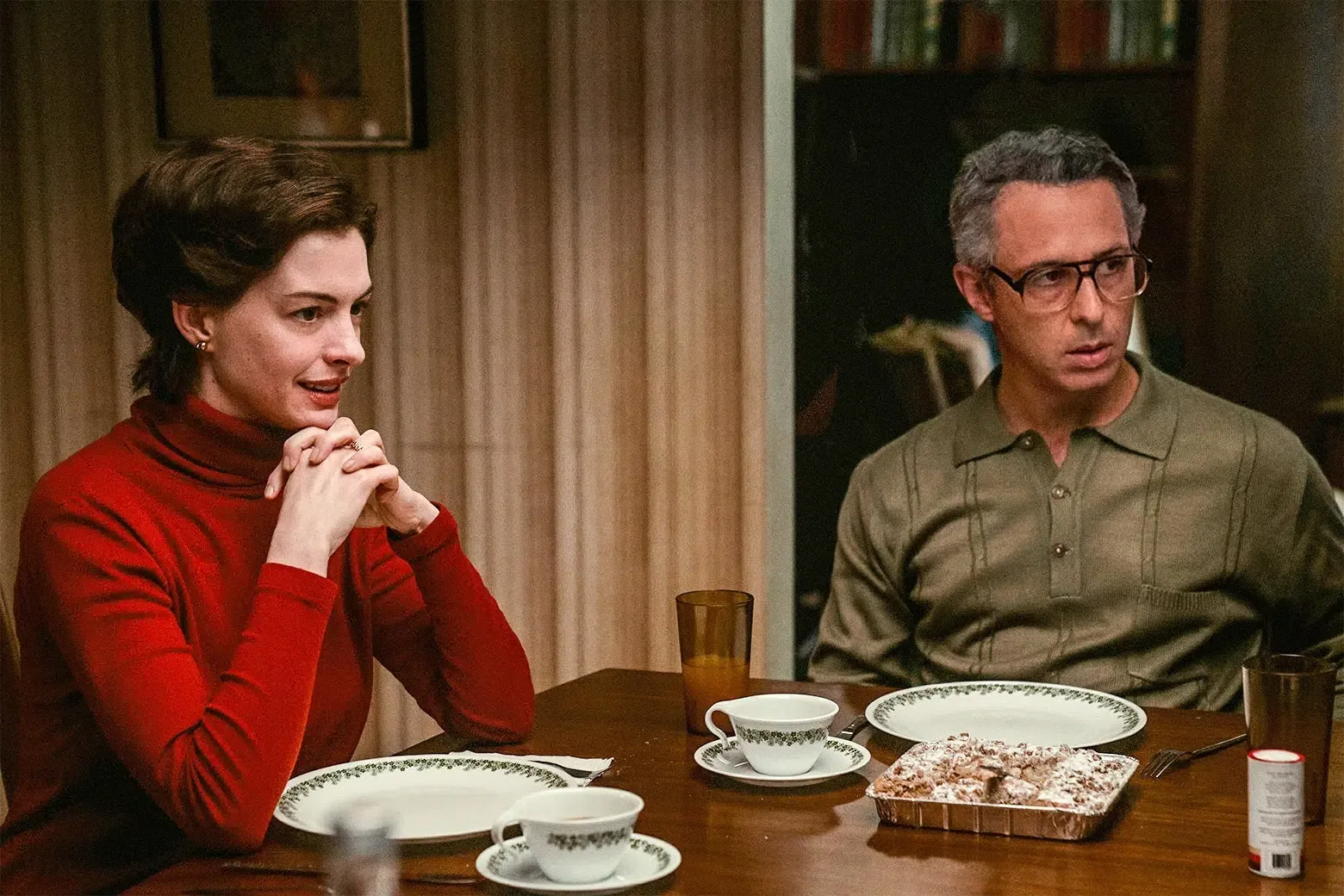
Armageddon Time opens in Queens, New York in 1980, a year after both versions of “Armagideon Time” were released. James Gray has stated that his film is named after The Clash cover, but the title has a double meaning. Gray says that Ronald Reagan, first elected as US President in 1980, often spoke about Armageddon. The film’s tagline is “The end of an era. The beginning of everything.” Reagan’s Presidency is sometimes cited as a watershed moment that shifted The United States into conservatism after the relative progressivism of the 60s and 70s, particularly regarding issues of race and sexuality.
This transition period is alluded to early in the movie. Paul Graff (Banks Repeta) and Johnny Davis (Jaylin Webb) bond in detention. They agree that “disco sucks.” Disco Demolition Night and “The Year that Disco Died” came just one year earlier. Some scholars and artists have attributed the mass rejection of disco at the end of the 1970s to systemic racism and homophobia. Johnny introduces Paul to early hip-hop as Paul expresses hope that the Beatles might get back together.
Unlike Stand by Me, Armageddon Time takes place in urban, supervised settings- home, school, the arcade, the subway. Its 1980 setting is still an era of more permissive parenting than 2025, but no kid goes days without seeing an adult. There is a scene early in the film where Paul and Johnny sneak away from a museum field trip to visit an arcade and a record store. It offers a two-hour diversion from school. I was born more than ten years after 1980, and while I was never in a situation where I would have been able to ditch a school field trip, many scenes in Armageddon Time remind me of my own experiences at home, school, and extracurricular activities.
Stand by Me is about neglected kids trying to escape from their parents and teachers. Armageddon Time is about learning to understand your parents and teachers.
The film opens in a sixth-grade class at a Queens public school. Two boys take on the role of class clown- Jewish American Paul Graff and Johnny Davis, a black boy being raised by his ailing grandmother. Throughout the first act, teacher Mr. Turkeltaub (Andrew Polk) disciplines both boys, but he’s harsher towards Johnny.
Unlike his friend, Paul enjoys a full extended family at home- an older brother (Ryan Sell), a grandmother (Tovah Feldshuh), a grandfather (Anthony Hopkins), and two strict, but loving parents, Esther (Anne Hathaway) and Irving (Jeremy Strong).
Jeremy Strong plays Paul’s disciplinarian father, Irving Graff. Strong adopts a regional accent for the role. My mom wondered if he was Ray Romano. I shook my head. “Nah, he’s too young.” Neither of us was familiar with Strong or Succession at the time.
Jeremy Strong is known for taking acting seriously. The “Ray Romano” accent is an example. Romano’s distinctive voice is a Queens, New York accent. He grew up there.
Jeremy Strong has a history of learning accents. When he was a working theatre actor in New York City he worked as an assistant to Pulitzer-winning playwright Wendy Wasserstein while he moonlighted playing an Irishman in a one-man stage show. He often talked to Wasserstein’s Irish doorman, studying his accent. Wasserstein considered writing a play based on Strong called Enter Doorman. She passed away from lymphoma before the play could be realized.
Strong’s penchant for tenacity is echoed in his Armageddon Time character. We first meet Irving as he attempts to fix the furnace in the Graff household. The character, a contractor, starts a dinner table conversation about types of bridges. Thanks to the accent, it took me a minute to stop picturing the mammoth from Ice Age rambling about bridges. I love this dinner scene. The multi-generational dinner table offers numerous conversation snippets at once. Audience members can pick what to listen to among the cacophony. Every line reveals character.
After dinner, the Graffs watch Ronald Reagan’s Presidential campaign on the news. Irving calls him a “schmuck.” The family supports the Democrats while sending their oldest son (not Paul) to a conservative private school. They keep Paul at public school. They see their older son as more academically inclined than Paul. Paul spends most of his time in class goofing off or drawing. Paul prefers public school, anyway. His friend Johnny is there.
Grandpa Aaron (Anthony Hopkins) gifts Paul a paint set. He encourages Paul’s dreams of becoming an artist. Irving urges Paul to pursue the safer computer graphics field instead.
Paul and Johnny continue to bond at school. Johnny shares a cannabis cigarette with Paul in the boy’s restroom whilst cutting class. The boys are caught and sent to the principal’s office. Esther Graff is alerted. She disciplines Paul in the school hallway, then directs the matter to his father. At home, Irving Graff spanks a tearful Paul with his belt.
Let’s talk about Jeremy Strong. He came from a working-class family. His mother was a hospice nurse. His father worked in juvenile jails. The Strong family lived in the Jamaica Plain area of Boston. Strong has described it as a “rough neighbourhood.” The family could not afford to take vacations. They put a canoe on cinder blocks in the backyard. Strong and his brothers pretended to take trips in it.
Jeremy Strong worked many odd jobs as a struggling actor. He scored gigs as a production assistant on films including Steven Spielberg’s Amistad. He was uncredited for much of his PA work. He acted in theatre and film productions for nearly 15 years before he was cast as Kendall Roy in Succession. That changed the game for him. He won an Emmy for Outstanding Lead Actor in a Drama Series for the second season.
On Succession, Jeremy Strong colours his hair. He keeps his natural grey hair in Armageddon Time. There’s an indistinct quality to how he looks when he plays everyman Irving Graff. That might be why he could be mistaken for Ray Romano if you squint.

After the spanking, the Graffs elect to send Paul to private school. They agree he will benefit from his older brother’s stricter school. Paul protests to no avail.
That night, Johnny sneaks into the Graff backyard to meet his friend. Paul shows Johnny his playhouse. Johnny marvels at it. Paul reveals that his dad built it for him. “When he wasn’t in an asshole mood.”
Paul tells Johnny that he doesn’t want to attend private school, but he thinks that his grandpa will convince his parents to let him stay at the public school. Johnny reveals that he was moved to remedial classes. Offscreen, he drops out of school.
The next day, at breakfast, Grandpa Aaron tells Paul that private school was his idea. Grandpa Aaron’s mother escaped antisemitic hate in Ukraine. She fled to England, and later America. Aaron sees private school as a way for the Jewish family to join the upper classes.
Many students at Paul’s private school support Ronald Reagan. Some make racist comments. Mary Anne Trump (Jessica Chastain), a socialite and philanthropist who you might know better as someone’s mother, makes an appearance at a school assembly. She makes a speech, telling the students that she knows they will go far due to hard work, not due to handouts. Students erupt into chants. “Reagan! Reagan! Reagan!”
Still, Paul’s otherwise liberal parents love that he attends private school. Irving tells his son, “I want you to be a whole lot better than me.” Grandpa Aaron, of course, supports private school as well but urges Paul to stand up against racism.

Later, Grandpa Aaron passes away from bone cancer as his family surrounds him at the hospital. Irving suggests that Paul shouldn’t be in the room. Paul insists on staying.
Irving and his two sons watch Grandpa Aaron’s funeral from the family car. Irving grants his wife space to grieve her father. While in the car, Irving reveals to his sons that when he first met their mother, her family scoffed at him. His father was a plumber. They were more white-collar. Aaron, however, accepted Irving. He appreciated someone who had faced adversity. Irving shoves back tears in the car. Paul glances at his father while he pulls it together. The look on Paul’s face is everything. It screams, Dad never cries.
Jeremy Strong is known for intense methods for getting into character. He played Jerry Rubin in The Trial of the Chicago Seven (2020). The film depicts the events surrounding a protest against the Vietnam War at the 1968 Democratic National Convention in Chicago, Illinois. In real life, police used tear gas on protestors. Director Aaron Sorkin recounted a story for The New Yorker where Jeremy Strong wanted tear gas utilized on set. Sorkin refused. He’s quoted in The New Yorker, "I don't like saying no to Jeremy, but there were 200 people in that scene and another 70 on the crew, so I declined to spray them with poison gas."
Sorkin later clarified this statement in an open letter. "Let me be clear, Jeremy would never suggest endangering a member of the cast or crew or anyone else. It was something he mentioned in passing and I was telling the story affectionately and as a way of demonstrating his commitment."
Studios love to campaign for Oscars by having actors, screenwriters, and directors drop anecdotes in interviews about how their stars got into character for the movie in question. Daniel Day-Lewis famously refused to walk on the set of My Left Foot, when he played a man who could not. Critics applauded this commitment. They may not have realized that some crew members had to wheel Day-Lewis around unnecessarily. Daniel Day-Lewis won an Oscar for My Left Foot. Teenaged Jeremy Strong hung a My Left Foot poster in his room.
This refusal to break character is sometimes called method acting, a term that was originally coined by acting teacher Lee Strasburg in 1931. Strasburg’s original lesson was that actors should recall their own experiences and pull on the emotions they felt then and there when getting into character. An actor playing a grieving person may pull on memories of losing a loved one. They may recall a time someone did something that truly moved them. Strasberg did not suggest attempting to recreate a character’s experience. Whatever worked for Daniel Day-Lewis while making My Left Foot was not what Strasburg intended.
Grandpa Aaron’s funeral prompts Paul to hatch a plan to run away. He and Johnny had previously dreamed of running away to Disney World together. The then-upcoming Epcot theme park excited them. Paul could draw as a Disney Imagineer and Johnny could join his step-brother stationed with the Air Force in Florida. It would be a great stepping stone for Johnny’s NASA dreams.
The trope of “running away to Disney” comes up in movies sometimes, particularly movies set in America in the second half of the twentieth century. I was first made aware of the trope through Girl, Interrupted (1999). My Grade 8 art teacher had a poster for that movie in her classroom. She used it to teach us about how movie directors use eyes to convey character. I still have Angelina Jolie and Winona Ryder’s facial expressions from that poster burned in my mind. I didn’t watch the movie in Grade 8, but I did read the plot summary on Wikipedia. Much of the plot, set in a psychiatric hospital in Vietnam war-era America, went over my head at the time, but the mental image of Ryder and Jolie’s characters running away to work at the then brand-new Disney World as Disney Princesses stuck with me. I finally saw Girl, Interrupted this year. I love it.
Paul’s private school has computers- a rarity in 1980. He suggests to Johnny that they steal one to fund their trip. Johnny knows a pawn shop. They can sell the computer there. The plan comes together.
Johnny brings the stolen computer to the pawn shop because the owner knows him. Paul watches from afar. Paul fantasizes about painting on a beach in Florida. He mentally photoshops Johnny’s head onto Neil Armstrong’s body. His innocence falls as a police car pulls up to the pawn shop. An officer handcuffs Johnny and presses him onto the hood of the police cruiser.
Like Armageddon Time, Stand by Me is a fall from innocence story. Stephen King taglines The Body as such in his Different Seasons novella collection. Armageddon Time updates Stand by Me to reflect the social issues of today.
Art is about finding the universal in the specific. That’s why I can relate to Armageddon Time, a movie about a Jewish-American boy, despite having grown up as a Canadian girl with a Christian family. Like Paul, I got in trouble in middle school for being distracted in class. In my case, it was by reading and writing, not drawing. I resisted (unsuccessfully) my parents’ decision to move me from public school to Catholic school. I had a teacher select my art project for display at a school arts night after she gave me a bad mark on it. (What even was that? Mrs. Allwright-that’s not her real name, but she knows who she is-I just want you to know I still remember that. Don’t do that.)
This is the beauty of art. It’s also the downside to art. People can twist the meanings of stories, movies, and songs to fit an agenda.
Think of the complaints that Star Wars has gone “woke” for casting women and actors of colour, including Kelly Marie Tran; the original trilogy was meant as an allegory against the Vietnam War. Kelly Marie Tran’s parents were refugees from Vietnam. Think of the “red pill” metaphor prevalent in online misogynist communities; the screenwriters for The Matrix intended for the red pill to be a metaphor for breaking out of the socially constructed gender binary. They have since come out as trans women. Think of Bruce Springsteen’s recent statements against Donald Trump; some of The Boss’s original fans in his native New Jersey rejected him for going “woke”. Springsteen was always “woke”. “Born in the USA” is a criticism of the country’s treatment of Vietnam war vets, many of whom were poorer men of colour, suffering from PTSD and addiction.
Our favourite movies have been “woke” for a long time. They didn’t always star women and minorities, but as social issues evolve over time, the way we tell stories about them must as well.
There is a poignant scene in The Body, the novella that Stand by Me is based on, where the protagonist, Gordie, has a long conversation with his childhood friend Chris. Chris acknowledges that their friendship will change in high school. Gordie will take college-level courses. Chris, who comes from a poorer family, will take remedial classes. To me, the dialogue between the two boys captures something essential about being thirteen. You’re angry all the time. You understand the systems put in place by the adults around you. You can vocalize the injustices in the systems, but adults don’t take you seriously. Some lose this sense of justice as they age. Others hold onto it. Others leave it behind for a while but find their way back to it.
At the climax of Armageddon Time, Paul and Johnny end up at the police station. An officer asks Paul if there are problems at home. He doesn’t extend the same concern to Johnny. The police call the Graff household. Irving Graff answers the phone as Esther is sitting shiva for her father, Aaron. Irving attends the police station. An officer recognizes him. The two men have a conversation offscreen.
Johnny tells a police officer that stealing the computer was his idea. Paul tries to stop him, but Johnny refuses his help. A second officer escorts Paul to his father in the waiting room. Paul and Johnny say goodbye.
Irving drives Paul home. Paul anticipates his father will beat him again. Instead, his father reveals that he once fixed a hot water heater in the handling officer’s home and didn’t charge him. The officer returned the favour by overlooking Paul’s involvement in the computer theft.
Jeremy Strong as Irving Graff delivers a monologue that sends chills down my spine.
“It’s unfair that your friend is going to take the blame. Alright? It’s unfair. And- and I know it hurts you. But life is unfair. Sometimes, some people get a raw deal. And I hate that. It’s- it’s the worst thing in the world. But you have to survive so all you can do now is you make the most of your break. And do not look back. I don’t know. Maybe I have not done a good job. I’m not your grandfather. I don’t know. I don’t know how to... But I-I learned a long time ago you gotta be thankful when you’re given a leg up. Alright, let’s go inside. I don’t want to hear another word about this. And your mother doesn’t need to know anything about it. She’s already having a rough enough time lately. Alright?”
Jeremy Strong grew up with a father who worked in juvenile jails. His family was working class. They managed to move to a neighbourhood with better schools when Strong was an adolescent. It was at that better school that Strong discovered a youth theatre program. He fell in love with acting. As a teenager and young adult, Strong built connections as a production assistant on film sets. I think about Lee Strasberg’s original definition of method acting, and wonder what experiences Jeremy Strong was pulling on while delivering his Armageddon Time monologue.
In the falling action of Armageddon Time, the Graff family watches Ronald Reagan win the 1980 US election in a landslide victory. Irving quips that voters are “morons, from sea to shining sea.” Esther expresses fear of a nuclear war.
As the Graff family watches the election results, Paul completes homework in his room. His grandmother comments on how rare it is for him to be doing homework. She praises his private school.
The scene cuts to Paul at his desk. He stares at a blank worksheet. He thinks about the contrast between his father and his maternal grandfather. Grandpa Aaron believed in social justice, yet he supported private school. The more cynical Irving Graff is still hurt by injustice. His grandpa isn’t a hero. His father isn’t an asshole. They’re both just people. They’re both flawed.
Weeks later, Paul attends a Thanksgiving dance at his private school. The principal takes the stage and delivers a speech, marvelling at the future business leaders and politicians at that dance. Paul slowly leaves the dance. He thinks about his home and his former public school. Those are the places where he belongs. They are filled with flawed people like him. He hits the streets of Queens. The Clash’s “Armagideon Time” plays as the title card fades onto the screen.
The final shot of the movie is Paul walking down the street. He will find his way home eventually. He will grow up, and try to “make the most of his break.” The events of Armageddon Time mark the start of his journey to adulthood. He will pull on influences from both his father and his grandfather throughout his life. There will be some internal conflicts, and hard lines to straddle, but he will find his way back to his sense of justice. I think.

Armageddon Time lacks a happy ending, but I’d like to think that the film’s legacy will have one. It has two potential good luck charms in cast members Anne Hathaway and Jessica Chastain. They previously starred in Interstellar together. While Interstellar was initially met with mixed reviews, particularly for a Christopher Nolan film, love for it has grown in the past decade. It was re-released in IMAX theatres throughout North America on December 6, 2024, for its tenth anniversary. It became the highest-grossing IMAX re-release of all time. I hope that Armageddon Time follows a similar trajectory of early dismissal followed by status as a classic.
I’d like to think that Jeremy Strong got a happy ending as well. Some folks like to jab at his acting method, but he has a wife, three children, a great career, and friends and colleagues who have his back. Michelle Williams recently recounted a story on NPR’s Fresh Air podcast about how her friend Jeremy helped her and her daughter, Matilda Ledger after Heath passed away. She said Jeremy Strong was “serious enough to hold the weight of a child’s broken heart and sensitive enough to understand how to approach her through play and games and silliness,” Strong lived with Michelle and Matilda. He was a struggling actor at the time. He pulled on his childhood experiences and named the house “Fort Awesome”. He took the name from a place he created in his imagination as a child. As a boy, Jeremy Strong pretended to take trips with his siblings in a backyard canoe. As an adult, he applied this to tea parties with Matilda Ledger. Michelle Williams frequently recalls this story in interviews. It’s a reminder that we are all a product of where we came from, and whatever privileges and intersecting identities that come with it. What matters is what we do with that.
Sources:
Anthony, T. (2025, May 23). Bruce Springsteen’s lyrical view of America has long included politics - even more so as he ages. The Canadian Press. https://www.thecanadianpressnews.ca/entertainment/bruce-springsteens-lyrical-view-of-america-has-long-included-politics---even-more-so/article_dbfd92d0-92d7-53dd-86f1-93ac971b960a.html
Armageddon Time (2022). IMDb. https://www.imdb.com/title/tt10343028/?ref_=nv_sr_srsg_0_tt_8_nm_0_in_0_q_armageddon%2520time
Armageddon Time. Wikipedia. https://en.wikipedia.org/wiki/Armageddon_Time
Crowley, J. (2020, August 7). “The Matrix” Creator Explains What The Red Pill Really Is and Mens Rights Activists Aren’t Going to Be Happy. Newsweek. https://www.newsweek.com/matrix-creator-red-pill-trans-allegory-mens-rights-activists-1523669
Davis, C. (2022, September 26). ‘Armageddon Time’ Submits Anne Hathaway for Supporting Oscar Consideration, With Jeremy Strong and Anthony Hopkins (EXCLUSIVE). Variety. https://variety.com/2022/awards/awards/anne-hathaway-jeremy-strong-armageddon-time-oscars-campaign-1235384222/
Disco Demolition Night. Wikipedia. (n.d.-a). https://en.wikipedia.org/wiki/Disco_Demolition_Night
Dohms-Harter, E. (2020, September 11). How Reagan Helped Usher In A New Conservatism To American Politics. Wisconsin Public Radio. https://www.wpr.org/books/how-reagan-helped-usher-new-conservatism-american-politics
Forrest, B. (2023, December 18). A collection of The Clash bassist Paul Simonon’s favourite songs. Far Out. https://faroutmagazine.co.uk/clash-bassist-paul-simonon-favourite-songs/
Jeremy Strong. IMDb. (n.d.). https://www.imdb.com/name/nm0834989/
Lee, A. (2025, April 16). Kelly Marie Tran on How ‘Wedding Banquet’ Empowered Her to Come Out as Queer and Why ‘Star Wars’ Racism Is a ‘Microcosm for the Social Climate.’ Variety. https://variety.com/2025/film/features/the-wedding-banquet-kelly-marie-tran-coming-out-star-wars-1236369941/
Library of Congress. (2022, September 12). Racial, Ethnic, and Religious Minorities in the Vietnam War: A Resource Guide. Research Guides. https://guides.loc.gov/racial-ethnic-and-religious-minorities-in-the-vietnam-war#:~:text=Approximately%20300%2C000%20African%20Americans%20served,the%20general%20population%20was%2012%25.
Miller, L. (2023, December 18). Star Wars’ Vietnam War Allegory, Explained. The Escapist. https://www.escapistmagazine.com/star-wars-vietnam-war-allegory-explained/
My Left Foot (1989). IMDb. (n.d.-c). https://www.imdb.com/title/tt0097937/?ref_=nv_sr_srsg_0_tt_6_nm_2_in_0_q_my%2520left%2520foot
Schneider, J. (2025, May 22). N.J. bar cancels Springsteen cover band over Bruce’s anti-Trump comments: ‘Won’t stand for his bulls---.’ nj.com. https://www.nj.com/entertainment/2025/05/nj-bar-cancels-springsteen-cover-band-over-bruces-anti-trump-comments-wont-stand-for-his-bulls-.html
Schulman, M. (2021, December 5). On “Succession,” Jeremy Strong Doesn’t Get the Joke. The New Yorker. https://www.newyorker.com/magazine/2021/12/13/on-succession-jeremy-strong-doesnt-get-the-joke
Stand by Me (1986). IMDb. https://www.imdb.com/title/tt0092005/
Stern, M. J. (2014, August 12). Neural Nostalgia Why do we love the music we heard as teenagers?. Slate. https://slate.com/technology/2014/08/musical-nostalgia-the-psychology-and-neuroscience-for-song-preference-and-the-reminiscence-bump.html
What is Method Acting?. Strasberg.edu. (n.d.). https://strasberg.edu/about/what-is-method-acting/
White, A. (2021, December 11). Aaron Sorkin Defends Jeremy Strong Over “Distorted Picture” of the ‘Succession’ Actor in New Yorker Profile. The Hollywood Reporter. https://www.hollywoodreporter.com/movies/movie-news/aaron-sorkin-defends-jeremy-strong-new-yorker-succession-profile-1235061341/
Wikipedia. (n.d.-b). Armagideon Time. Wikipedia. https://en.wikipedia.org/wiki/Armagideon_Time


Comments 1