‘Fitzcarraldo’: Being with Cinematic Ghosts in a Decaying Jungle(Part 2)
Sociocultural
Micaela Saxer was born during the long and torturous filming of Werner Herzog’s movie “Fitzcarraldo.” Now, she and her father, Walter Saxer, who served as this film’s producer, have returned to the rainforest of Iquitos, Peru, where they run a small estate-like hotel named after the movie. After hearing many stories of the past in the jungle that houses the spirits of cinematic figures, I delved deeper into the Amazon, imagining the absurd scenes from Nobel laureate Vargas Llosa's novel “Captain Pantoja and the Special Service,”(which was inspired by this region) and appreciating the grandeur of “Fitzcarraldo” and the hardships of producing it.
(This long cinematic travel literature published in four parts. Below is the Part 2. And here is The Part 1)
Decline of the Jungle Estate
But the younger Saxer won’t always be around at the garden hotel to tell stories to her guests! In fact, she doesn’t even live in Iquitos most of the time.
Fortunately, during my brief overnight stay in this jungle city, she happened to be present and shared with me more stories than what Lonely Planet had managed to cover.
“This estate and garden were originally built by a Greek-American in the 1960s. It’s said that he was a drug lord, but he’s long dead, and we don’t know his name.” Saxer began to recount the past as she moved from the long table, where Kinski watched over us from the wall painting, to the bar adorned with a group photo of the “Fitzcarraldo” film crew when it was first created and a wood portrait carving of a rainforest native.

In 1976, when Herzog and the older Saxer were preparing to film “Fitzcarraldo,” the main crew members stayed there. Saxer, a Swiss, met Herzog when he was 20 years old. A few years later, he became the production manager for Herzog’s directorial debut “Even Dwarfs Started Small” (1970), and played a crucial production role in the next five Herzog films. “In 1982, after the film, which had taken six years to complete, was finally released, my father bought this property, and it became our private estate. About 30 years ago, he moved here permanently, and by 2007, he’d turned it into the small hotel it is today, with only six rooms,” the younger Saxer continued talking about their jungle home while her father took a nap.
“My mother, Gloria Gonzalez, is a native of Iquitos. She was born on a canoe near the town of Requena, on the banks of the Ucayali River, one of the main sources of the Amazon River. She studied forestry. She met my father during the early preparation of “Fitzcarraldo,” and I was born during the filming. Afterward, the three of us moved to Italy, where we lived for a long time. Because of my father’s work, my mother and I traveled the world with him, but for more than 20 years, Umbria, Italy was our base. Yes, my parents eventually separated—the European went to live in the Amazon, while the Amazonian went to live in Europe.”
Jungle plants always have vigorous vitality. Once the humanity takes its leave, the vines will come back, reclaiming their former territories. This is true of Casa de Fierro, the iron house said to have been remotely designed by the architect of the Eiffel Tower in Paris, and of La Casa Fitzcarraldo, where the film crew once lived. The vines are uncontainable. They added a touch of wildness to my temporary dwelling. The intentional or unintentional playing of “Una furtiva lagrima” from Gaetano Donizetti’s opera “L'elisir d'amore,” sung by Enrico Caruso, in “Fitzcarraldo” further enriched the mystical aura of this secret place in the jungle, tinged with an “old money” feel. Fortunately, the pool was still open to the public. A few attractive, young locals plunged into the water that was naturally kept tepid by the warm tropical weather, laughing and shooting videos. These youthful faces gave the “old money” a new life.

On this late August evening, I was the only guest at La Casa Fitzcarraldo. After the youngsters departed and the hotel staff knocked off work, the Saxers and I were the only ones remaining in the garden estate. They were going to play a card game meant only for close family, while I returned to Jagger’s Blue Room to rewatch the masterpiece, “Fitzcarraldo,” whose filming process was much grander than the final product.
Decline of a Filmmaking Technique
I’m sure the story of “Fitzcarraldo” is well-known among movie buffs. For those who aren’t familiar, let me briefly recount it:

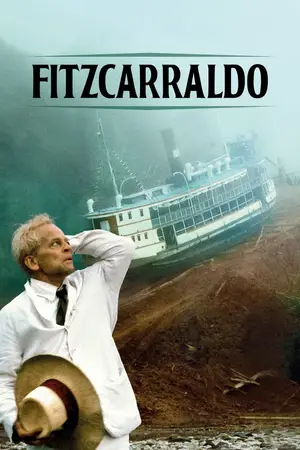
During the South American rubber boom in the early 20th century, a white man named Brian Sweeney Fitzgerald, obsessed with opera, attends a performance by the world-famous tenor Enrico Caruso at the Amazon Theatre in Manaus, Brazil. Afterward, he develops a wild idea of building a grand theater in Iquitos. To secure enough funds, he accepts the suggestion of a local rubber baron and purchases a steamship with the support of a brothel madam. He assembles a team and sets off upstream on the Amazon toward a piece of unclaimed land. However, they’re blocked by a stretch of rapids that are impossible to navigate and are forced to take a detour via another tributary. Fitzgerald finds a place to dock in a native territory along the tributary that is only a few hundred meters from a virgin forest on the parallel river. However, he has to drag the three-deck steamship weighing 320 tons up a muddy 40-degree mountain slope, move it down the descending slope, and get to the opposite side of the mountain where the parallel river is located to harvest rubber. Frenzied Fitzgerald successfully completes this mountainous task. But in an attempt to appease the river gods who've been disturbed, the native chieftain, who led his tribespeople in carrying the ship over the mountain under Fitzgerald’s orders, cuts the anchor rode, sending the ship careening into the rapids.
Unable to fulfill his dream of building an opera house, Fitzgerald could only use his meager initial funds to invite a European opera troupe stationed in Manaus. He and his team load the artists onto several small boats and bring opera to the waterways of Iquitos.
“Fitzcarraldo” was produced in the same absurdly impractical way of Fitzgerald's style. Through the 1982 documentary “Burden of Dreams”(which is hailed as the greatest documentary about filmmaking), we learn that the crew purchased and outfitted three identical steamships for use in different locations and scenes—one to be sailed normally, one to crash into the rapids, and one to be dragged up the muddy slope. Unlike Fitzgerald, the tyrannical Herzog didn’t go as far as to demand the ship be dragged over the mountain. However, in the pre-CGI era of the early 1980s, he replicated the scene using the same engineering method described in the story. Hundreds of extras and the actors painstakingly hauled the ship to the mountaintop using a complex system of pulleys and winches.

That said, we shouldn’t use the excuse of underdeveloped special effects to justify Herzog’s approach. During the lengthy production of “Fitzcarraldo” from 1976 to 1982, the world saw the explosive success of sci-fi movies like “Star Wars,” “Superman,” “Alien,” and “Close Encounters of the Third Kind.” The blame lied entirely with Herzog and his obstinate determination. After the film won him the Best Director award at the 1982 Cannes Film Festival, Herzog somewhat self-deprecatingly described himself as a “useless conqueror.”
The film's production didn’t take six years just because a ship had to be dragged over a mountain. From preparation to wrap-up, the entire process was fraught with challenges, and no one could endure six years of madness along with the creators. There were repeated changes in the lead actor; native laborers died; conflicts erupted between different ethnic groups; a small plane crashed; a lumberjack had to saw off his own leg after being bitten by a venomous snake. Any one of these disasters would have doomed any other film, but Herzog and Saxer persevered.

“Herzog was never a director who is good at storytelling,” concluded the younger Saxer. “Don’t you live in Argentina? Herzog and I shot “Scream of Stone” (1991) in Patagonia, and I wrote the script for that. Twenty minutes of the final film were shot entirely by me,” her father added.
On that long night in the jungle mansion, I still had plenty of time even after rewatching “Fitzcarraldo” in the room that houses the spirits of cinematic figures . Saxer offered a suggestion, “My dad later made a documentary that had a significant impact on the history of the Peruvian justice system, with Vargas Llosa providing the voiceover. I’ll send you the link; you can watch it tonight if you have nothing else to do. Before the travel agency picks you up tomorrow morning to take you deeper into the jungle, we can chat more over breakfast.”




Comments 0
No comments yet.