When History Closes Its Loop: On Julio Medem’s 8
General Reviews
How should one describe Julio Medem’s new film 8? It is at once deliberate and delicate; not quite a work of great art, but undeniably a work of exquisite craftsmanship. It reveals the director’s persistent yearning for Spain’s political reconciliation, yet at times, it also feels as simple and transparent as a children’s picture book.
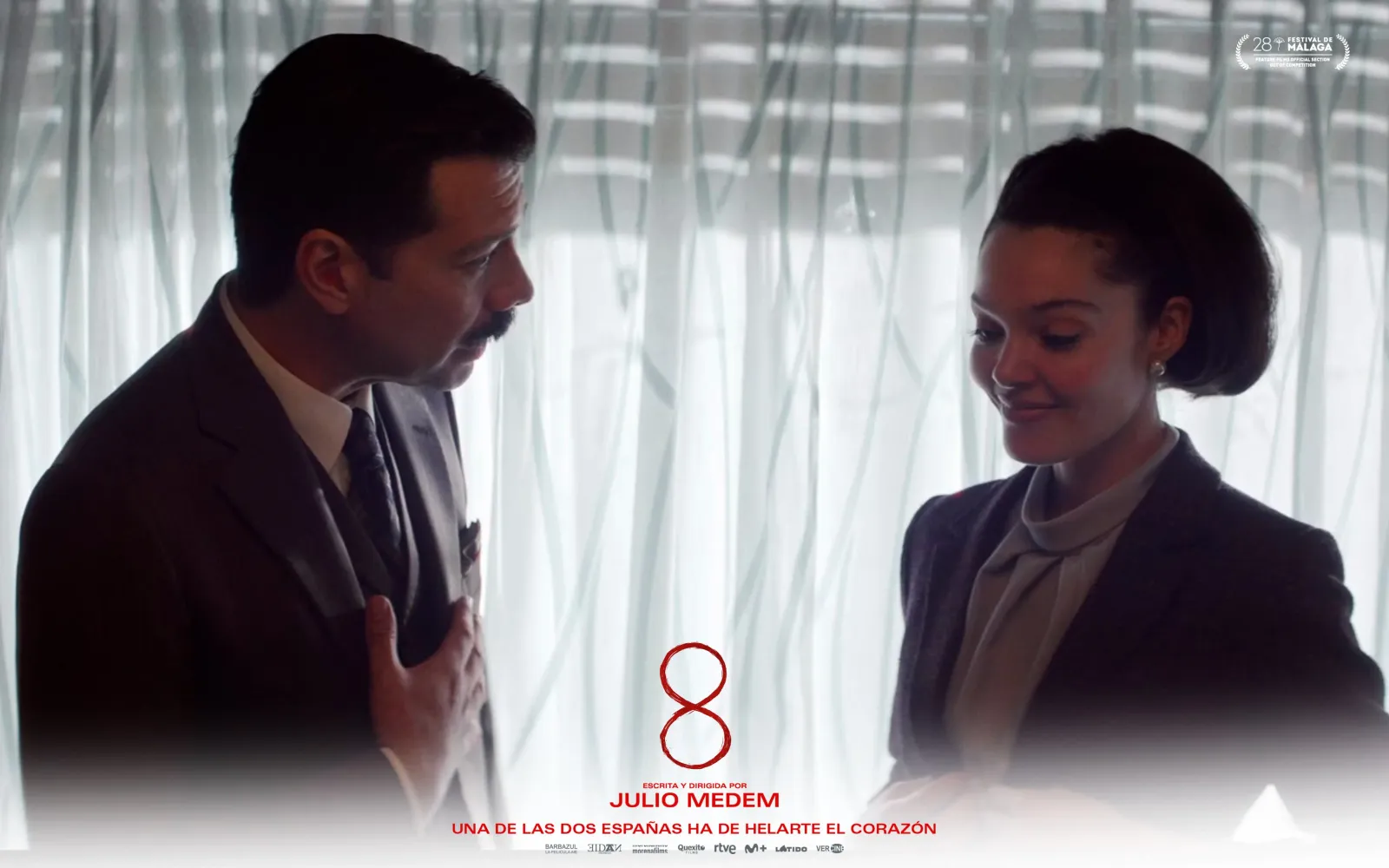
The entire story of 8 unfolds much like the shape of the number itself — looping, circling, and eventually closing upon itself. Its two protagonists, Octavio and Adela, are both born on the same night — April 14, 1931, the day the Second Spanish Republic was proclaimed — in a small northern village. Octavio’s father, a Nationalist, is executed on orders from Adela’s father, a Republican guerrilla. Years later, after the Civil War ends and Franco’s regime takes power, the adult Octavio, now a soldier, is commanded to execute Adela’s father, who has been imprisoned for years. In quick and dirty fashion, the feud between the two lifelong enemies from the same soil is set in motion.
After the war, as Europe’s economy took off, the two young people ended up in Madrid, pursuing studies, working, and starting their own families. By then, they had become strangers, no longer recognizing each other.
In the 1970s, swept up in the feminist movement, Adela leaves her husband and children, takes a taxi, and spends a night with the driver, who, by cruel fate, turns out to be none other than Octavio, the man who once killed her father. Drawn to each other yet destined to drift apart again, they do not meet once more until the 21st century, as frail elders who finally recognize one another and spend their final years together. The sins of their fathers, by then, have long dissolved into the river of history.

Seemingly to deepen the wounds of the Civil War , Medem goes further, weaving in regional and ethnic conflict. In one subplot, during a Clásico football match, Octavio’s son — a Real Madrid fan — accidentally kills a young man caught among FC Barcelona supporters, who turns out to be the illegitimate son of Octavio and Adela. Brother kills brother — the blood feud repeats itself, this time on the stadium.
With his contrived plotting, Medem seems to indulge his own desire to “talk politics” — only to caution the audience against getting too involved in politics through Adela’s lines to her children. Even if not outright self-contradiction, it does carry a faint whiff of didacticism.
It reminded me of a conversation years ago in northern Cantabria with a little-known local filmmaker. As he drove me to the Santander train station, he strongly recommended a film to me — Julio Medem’s The Basque Ball: Skin Against Stone.
“Different political parties and movements all have their voices represented,” he said. “I even think Spanish high schools should include this documentary in their curriculum, so that kids can get used to the diversity of our country early on, and avoid drifting toward extremist camps in the future.”
Indeed, Medem — once renowned for his uncanny atmospheres and enigmatic tales (Vacas, The Red Squirrel, Lovers of the Arctic Circle, Sex and Lucía) — has become increasingly absorbed by politics since the turn of the century, , especially the traumas of modern Spanish history and the question of national and regional reconciliation. As a result, films like The Basque Ball and now 8 feel almost like educational materials.

In addition to the deliberately symmertrical narrative of the two protagonists' fates, Medem refinforces the symbolic meaning of the figure "8" by creating a parallel visual architecture through production design and cinematography, corresponding to eight distinct eras in modern Spanish history. Working with cinematographer Rafael Reparaz, Medem defined a visual grammar for each chapter.
“Each section has its own image type, screen format, and cinematographic style,” Medem explains. “From the first chapter — an expressionist black-and-white inspired by Murnau’s Nosferatu, tinted with shades of blue, sepia, and pink — to the stark contrasts of the Civil War; to the first use of color in the postwar era; to the neorealist look of the 1960s; to the new optical techniques of 1977; to the pristine 35mm texture of 1992; to high-definition digital in 2008; and finally to 6K in 2021.”
But to be honest, perhaps it's because I'm not particularly attuned to aesthetic, or perhaps due to the mediocre projection quality of Screen 9 of the Príncipe cinema in San Sebastián — I didn’t really notice these supposedly striking stylistic transitions.
In the film’s final moments, the two elderly protagonists meet again and agree to walk together into their nineties. Adela returns to her still-standing childhood home in the northern countryside and lies down on the same bed where her mother once gave birth to her, ready to face the end of life. Octavio, swallowing a bottle of pills, stays by her side — his former enemy, now his wife — as the two, born on the same day, choose to die on the same day as well.
8 thus closes its loop perfectly: the two leave the battlefield that once divided Nationalists and Republicans, stepping into a quiet passage to another world. And yet, history always repeats itself — new wounds will surely emerge, and a new “8” is already beginning to take shape.




Comments 2