‘Fitzcarraldo’: Being with Cinematic Ghosts in a Decaying Jungle(Part 1)
Sociocultural
Micaela Saxer was born during the long and torturous filming of Werner Herzog’s movie “Fitzcarraldo.” Now, she and her father, Walter Saxer, who served as this film’s producer, have returned to the rainforest of Iquitos, Peru, where they run a small estate-like hotel named after the movie. After hearing many stories of the past in the jungle that houses the spirits of cinematic figures, I delved deeper into the Amazon, imagining the absurd scenes from Nobel laureate Vargas Llosa's novel “Captain Pantoja and the Special Service,”(which was inspired by this region) and appreciating the grandeur of “Fitzcarraldo” and the hardships of producing it.
(This long cinematic travel literature will be published in four parts.)
Eight years later, I returned to the Amazon rainforest, arriving in Iquitos, the largest city in the world consisting of islands that aren’t connected by road or rail.
Decline of the ‘Travel Bible’
My highly skilled driver took me on a bumpy tuk-tuk ride as he wove through traffic, resembling an ant traversing the rainforest. Despite the seeming chaos, there was a unique order to the flow of tuk-tuks. I gripped the handrail in nervous excitement as we navigated the unruly symphony composed of horns and birdsong, from the damp airport to the Belén slum market, which was filled with bizarre animal products. From there, we traveled from the market dock, which can only accommodate small boats during the dry season, through the remnants of the“old money” left behind after the decline of the rubber industry—rusty mansions—to a residential area in the northern suburbs of the city. On a white wall along the street, covered with bougainvillea and vines, were large letters spelling out“La Casa Fitzcarraldo.”This was where I stayed in Iquitos—a small estate-like hotel named after Werner Herzog's famous film “Fitzcarraldo.”

“I found you through Lonely Planet Peru and booked ahead by the primitive method of email,” I said to the lady of the house, Micaela Saxer, who happened to be in the dining area. On the wall across the long table, the star of“Fitzcarraldo,” German actor Klaus Kinski, and a jaguar on a tree trunk stared at us with glowing eyes.

“Lonely Planet recommended us?” quizzed the hostess in surprise. Her elderly father, sitting beside her, was none other than Walter Saxer, the producer of this crazy film.
“It isn't just a recommendation; it practically dedicated an entire chapter to knowledge about Iquitos,” I further explained. You see, as the “travel bible,” Lonely Planet emphasizes practical information concerning food, accommodation, and transportation. Any other content related to the destination is just decorative embellishment. In today’s age of ready access to information and mobile connectivity, where everyone travels light, the hefty Lonely Planet travel guidebooks have naturally fallen into decline, much like Iquitos and the estate-like hotel it houses.
Lonely Planet writes about the rise and fall of Iquitos: In the 1870s, a rubber boom caused the local population to grow 16-fold. Over the next 30 years, Iquitos became a place for rubber barons to flaunt their wealth. But by World War I, the rubber bubble burst as suddenly as it'd begun. A British businessman smuggled some rubber tree seeds from Brazil and planted them on the Malay Peninsula. Collecting rubber from orderly plantations was much cheaper and easier than from the Amazon rainforest. The economic decline of Iquitos followed soon after.
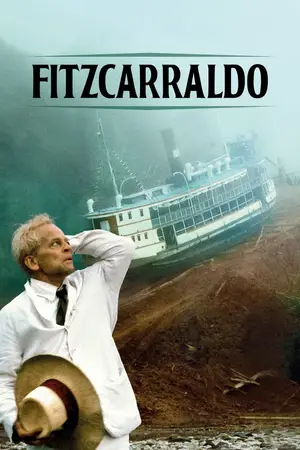
There are two large paragraphs about “Fitzcarraldo” on Lonely Planet. The first is titled “Herzog’s Amazon,” focusing on this obsessive German director, who was always filming “reality” itself, and his two famous works shot in the Peruvian jungle— “Aguirre, the Wrath of God”(1972) and “Fitzcarraldo” (1982). The guidebook suggests that these chaotic stories are more significant in film history than the films themselves. Kinski, who starred in both films, was also an obsessive and irritable genius. Near the end of filming for one of the movies, he had a dispute with the cinematographer and was about to leave the set by speedboat. Herzog then pulled out a rifle and threatened him to stay. In Herzog’s documentary “My Best Fiend,” he also mentioned trying to set off a firebomb in Kinski’s house, though others on set claimed he often exaggerated. Kinski, in his autobiography “Kinski Uncut,” portrayed Herzog as a clown who didn’t know how to make movies—although parts of the book were written by Herzog himself. Could it be that these artists already understood the dynamics of online controversies long before our time?
The guidebook writes that Jason Robards, who was initially selected as the lead actor of “Fitzcarraldo,” had to drop out after contracting malaria, and the second choice, Mick Jagger, had gone on tour with his band The Rolling Stones. Consequently, Herzog turned to Kinski, whom he'd previously fallen out with, for the role. The guidebook details many disputes and hiccups during the long production process, but perhaps fearing it might overwhelm readers, it then directs them to the second part—a recommendation of La Casa Fitzcarraldo as an accommodation option—where it is described as “a serene walled garden where Herzog and key crew members stayed while filming ‘Fitzcarraldo’.” Moving on, the guidebook recommends Jagger’s Blue Room with mahogany flooring, Kinski’s luxury Green Room, the rustic treehouse, the cute-looking swimming pool, and the sumptuous breakfast included in the room rate.

Keep in mind that Lonely Planet is just a travel guide, not a record of New German Cinema history. Such detailed descriptions can only satisfy avid film travelers like me. Given the current trend of quick recommendations of Instagrammable spots, the decline of La Casa Fitzcarraldo is inevitable.
The guidebook also adds: “The daughter of the producer of ‘Fitzcarraldo,’ who now runs the hotel, shall continue to share more untold stories.”




Comments 0
No comments yet.