Whiplash: that little indie film that became the pinnacle of elite music filmmaking
General Reviews
Three million dollars was all it took for David Chazelle to give a tremendous boost to his career, consolidate the actor who had been famous until then for playing J.J. Jameson in Sam Raimi's Spiderman trilogy, and discover for the world a young Hollywood promise like Miles Teller. The result of that investment was an admirable gross (for a film with this budget) of fifty million dollars and countless recognitions that positioned the film responsible for this feat, Whiplash, as one of the most outstanding releases of the past decade. All this on the basis of having a musical talent being trampled by his temperamental instructor.
But what is the real merit of Whiplash for it to endure in the collective imagination when other indie dramas were also praised and commented on during their release but disappear from memory the following year? For starters, Whiplash is a niche film. The music is not a character-building element or an addition to exercise a narrative language within the film. Instead, this is a film about music, and the two main characters revolve around it.
David Chazelle drew on his jazz band experience to adapt Andrew Neiman's (Teller) hellish training under tyrannical instructor Fletcher (JKK Simmons). He constructed the closed quasi-military music studio environment where the poor devils aspiring to become jazz musicians unwind with their instruments, listening to Fletcher's orders in a pristine musical language that delights music experts who look to the film to demonstrate the experience of what it's like to study this art in a musical setting.
Elegant musical treatment
Nor should those of us who have to google the word “tempo” to know what it means care about this technicality that governs the film's narrative. So should those of us who don't understand Fletcher's anger when he rudely disapproves of poor Andrew and his companions in rehearsals, even if we think Andrew plays decently. In that quest for musical excellence, Chazelle doesn't forget that this story also has to have emotions, something that is worked very well throughout the film. Here we are forced to see Fletcher's ruthless teaching method and the pressure the protagonist feels under to meet his teacher's expectations.
Whiplash takes a deep dive into the world of jazz, giving the audience an empathetic connection to the characters (including Fletcher), and that's why the film goes for less is more. It's all about the acting performances of Teller and Simmons who ride an emotional roller coaster. There are no other characters that stand out or imply significant relevance in the entire footage, only the two of them matter and it couldn't get any better.
Toxic teacher-student relationship
Anyone who has seen this film knows what an incredible boost this film gave J.K. Simmons. The incredible performance as this obsessive, wrathful music teacher that pierced the nerves of every soul who viewed this little masterpiece became its selling hook and the beacon of critical enlightenment to pay attention to this work. Simmons showed it all to take absolute favoritism in all the 2015 awards pools, the dialogue, the facial and hand gestures, his theatrical voice that made him sound convincing as he went from subtlety to anger in a matter of seconds, and most of all the superb chemistry with newcomer Miles Teller.
Even with all the recognition Whiplash has achieved, even long after its release, it still surprises me how hard it is to see its lead get the flowers he deserves for this work. Milles Teller was known for his appearances in teen films but when he entered David Chazelle's orders to sit in that drum kit, he proved he was a diamond in the rough carrying the full weight of Whiplash. Every scene in the eighty-minute feature film shows his character struggling to pursue his passion. Teller took on this role with dedication in showing how the competitive world of music can tear apart a dreamer who wants to make a living from it. I would say he even elevated Simmons' own performance quite a bit, both complemented each other well but in Whiplash Teller should be thought of more often as the main reason for his success.

The many faces of excellence
Although this, Damien Chazelle's second film is simple in nature, it explores themes in a very complex way. The plot has been praised for the protagonist's journey in pursuit of excellence in his art, and the final act is one of the most satisfying and spectacular in the history of cinema, perhaps the best musical sequence ever made to close a film. However, the events that occur to reach that end invite reflection on Fletcher's work ethic: was it necessary for Andrew Neiman to go through all that suffering and stress to become a magnificent jazz drummer, or are we being too permissive with artistic training that borders on abuse and psycho-terror?
The most memorable cinematic works are the ones that leave viewers thinking even long after the viewing has taken place. Whiplash lingers in the mind of the moviegoer because it has a story in which the American dream is possible but at the same time dares to question the methods to achieve it, and leaves you wondering if it is worth submitting to work that is more than hard, it is exhausting and heartbreaking to achieve success.
We have all had a teacher or a boss who resembles Terence Fletcher at some point in our lives, we have inevitably come across someone like that, and if you haven't had your turn yet, your time will come. And while such teaching methods are not celebrated here, the ambiguity of the meaning of success is something that comes through, because there are usually two sides to it. To achieve something, you have to lose something in return, and Andrew had to lose his innocence to exploit his full potential as a musician.
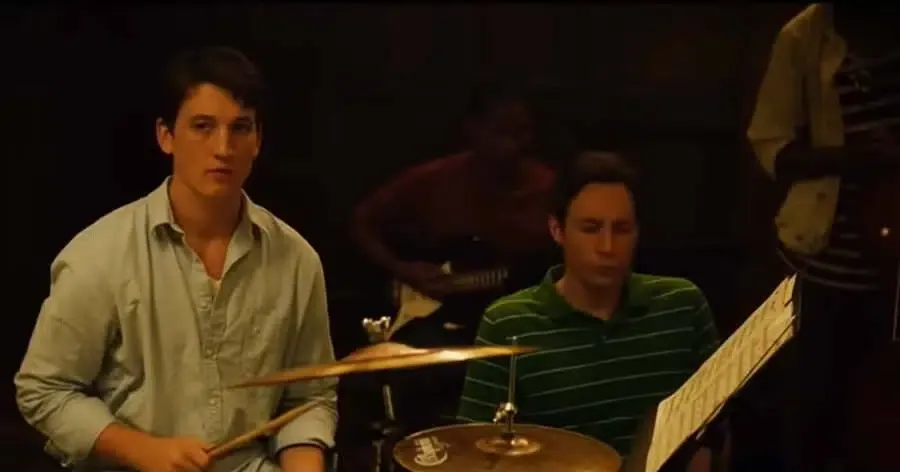
Whiplash is a celebration of resilience and the human spirit of self-improvement that is shaped by the blows of life that appear in the process of preparing to become the someone you are destined to be. And yet it does not try to leave moral teachings like Rocky or The Pursuit of Happines (2006), it is a much darker film than those, more direct, visceral and intimate. Chazelle, in making this film, left behind the demons that plagued him during his time as a musician, and it was not going to be a pleasant journey.
Damien Chazelle's sense of spectacle should not be overlooked. The final ten minutes and the musical samples beforehand hinted at his bombastic, unbridled but orderly and gimmicky vision that we would continue to see in later works such as La La Land (2016) and Babylon (2022). His intention to recreate his experience in the world of jazz through a film that gave free rein to his creativity devolved into an instant classic that will make audiences feel more respect for all the work and sacrifice it takes to excel in the world of elite music, regardless of the genre he plays. Whiplash will make you love this art and hate Fletcher even though he loves that art as well. One of those films you never forget, no matter how small.
Comments 1