Pirates of the Caribbean: A Philosophical Odyssey Between Curse and Freedom
General Reviews
Introduction: More Than Just a Maritime Adventure
When we talk about Pirates of the Caribbean, most people think of Jack Sparrow's swaggering gait, thrilling naval battles, and dazzling visual effects. However, beneath these surface elements, the series actually constructs a profound philosophical allegory about existentialism, free will versus destiny, and the boundaries between life and death.
This article will guide you through a fresh examination of the plot threads across all five films, revealing the philosophical propositions hidden behind the pirate legend: We are all prisoners bound by some form of "curse," and true freedom may never lie in escaping the curse, but in how we define ourselves within it.
Chapter One: The Curse of the Black Pearl — The Eternal Cycle of Desire

The Curse of Immortality: When Desire Loses Its Meaning
The Curse of the Black Pearl ostensibly tells the story of pirates cursed by Aztec gold coins due to their greed, but what is the essence of this curse? What they lost was not life itself, but the ability to feel life.

Barbossa and his crew can live forever, yet they cannot taste food, feel moonlight, or experience desire. This is the sharpest metaphor for modern consumerism—we frantically pursue material wealth, only to discover we've lost the ability to enjoy it. Barbossa's line "I feel nothing" is not merely a lament for physical sensation, but an indictment of spiritual numbness.
Philosophical Reflection: Schopenhauer believed that the satisfaction of desire brings only fleeting pleasure, followed by deeper emptiness. The pirates of the Black Pearl are trapped in this eternal cycle of "desire-satisfaction-emptiness." They possess everything, yet have nothing.
Will's Choice: The Binary Dilemma of Love and Duty
Will Turner represents traditional moral order—he is a blacksmith, a dutiful son, a loyal lover. But when he discovers his father is a pirate, his identity begins to crumble. This is a moment everyone must face in growing up: when we discover our parents aren't perfect, when we realize the world isn't black and white.
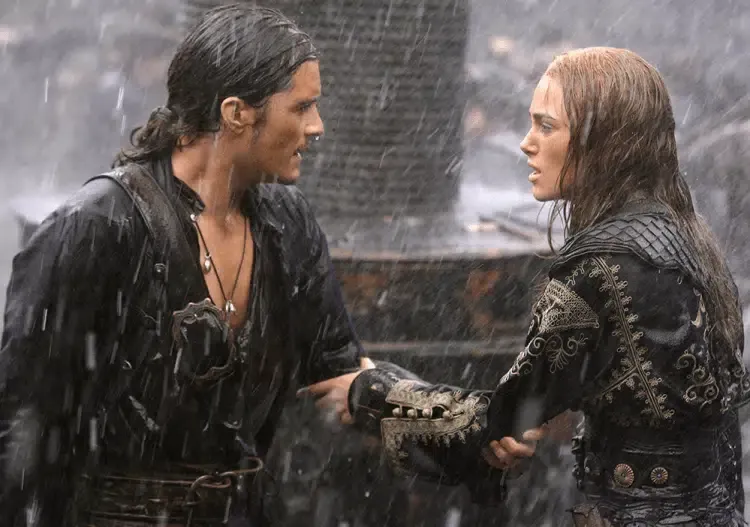
Will's ultimate choice to become a pirate isn't a betrayal of his values, but a transcendence of binary thinking. He learned to walk in the gray areas, finding balance between rules and freedom.
Jack's Compass: The Guide to Inner Truth
Jack's compass doesn't point north, but toward "what you want most." This is the series' most profound symbol—true direction lies not in the external world, but deep within.

But ironically, Jack himself often doesn't know what he truly wants. His compass points sometimes to the Black Pearl, sometimes to rum, sometimes to freedom itself. This reveals the existential dilemma of modern people: we have the freedom to choose, yet don't know what to choose.
Chapter Two: Dead Man's Chest and World's End — The Multiple Faces of Death
Davy Jones: The Trauma of Love and the Sealing of Emotion
If the first film explored material desire, the second and third delve into the realm of emotional trauma. Davy Jones cut out his own heart after being betrayed by his lover, locking it in the Dead Man's Chest. This is the most extreme metaphor for emotional self-protection mechanisms.

Psychologically, when we experience profound emotional trauma, we instinctively build defense mechanisms, "locking away" vulnerable parts. Davy Jones literally did this—he no longer has a heart, thus cannot be hurt, but the cost is losing the ability to feel love, gradually transforming into a half-human, half-octopus monster.
Deep Metaphor: When we close our hearts to avoid pain, we also gradually lose our humanity. Davy Jones' octopus tentacles aren't the result of a curse, but the external manifestation of emotional closure.

World's End: Death Is Not the End, But a Turning Point
In the third film, Jack is trapped in Davy Jones' Locker—a pure white void with only countless phantom selves. This is the most surreal presentation of the afterlife, and a visualization of identity crisis.
There, Jack faces not external enemies, but his own multiple personalities: greedy Jack, cowardly Jack, noble Jack. True hell is not external punishment, but endless dialogue with the self. Sartre said "hell is other people," but Pirates of the Caribbean tells us: the self can also be hell.
The Flying Dutchman: The Price of Immortality
Will ultimately becomes captain of the Flying Dutchman, gaining immortality, but at the cost of only being able to come ashore one day every ten years. This is the ultimate interrogation of the relationship between responsibility and freedom.

He chose responsibility (saving his father, guarding the seas), but lost freedom (daily life with Elizabeth). Yet is this truly tragic? Perhaps true freedom lies precisely in choosing to bear certain responsibilities. Existentialist philosopher Sartre believed that humans are free, but this freedom comes with heavy responsibility—we must be responsible for our choices.
Will's choice transforms him from a blacksmith passively accepting fate to a captain actively shaping destiny. His immortality is not a curse, but an embodiment of his free will.
Chapter Three: On Stranger Tides — The Paradox of Faith
The Fountain of Youth: The Vanity of Immortality
The fourth film centers on finding the Fountain of Youth, but the revealed truth is thought-provoking: the Fountain of Youth requires sacrificing others' lives to extend one's own. This is the sharpest critique of the desire for immortality.

Blackbeard represents extreme fear of death. He possesses great power, yet is haunted by prophesied death. This reveals a paradox: the more we fear death, the more enslaved we are by it.
In contrast, Jack's attitude toward the Fountain is contradictory—he both wants immortality and doubts its meaning. This contradiction is precisely an authentic portrayal of human nature: we all want to escape death, yet vaguely know that death is what gives life meaning.
The Mermaid and the Missionary: Dialogue Between Spirit and Flesh
The romance between mermaid Syrena and missionary Philip is the most underrated subplot in the entire series. One is a mythical creature, the other a devout believer; one represents natural instinct, the other spiritual faith.

Their love symbolizes the reconciliation of spirit and flesh. Philip initially tries to "save" Syrena's soul, but ultimately discovers that he himself needs saving—he needs to learn to accept nature, accept emotion, accept things that cannot be explained by doctrine.
Syrena's tear (the key ingredient for the Fountain) only falls in true love. This suggests: true immortality lies not in bodily continuation, but in the transmission of love.
Chapter Four: Dead Men Tell No Tales — Legacy and Redemption
Salazar's Revenge: The Ghost of the Past
The fifth film introduces Captain Salazar—a ghost trapped in the Devil's Triangle after being betrayed by Jack. He represents how past trauma haunts the present.
Psychology has the concept of "unfinished business": unprocessed emotional traumas return to our lives in various forms. Salazar is Jack's "unfinished business"—a decision from his youth returning years later in the form of vengeance.
This reminds us: we cannot truly escape the past, only face it and reconcile with it.
The Trident of Poseidon: Breaking All Curses
The Trident is set as an artifact that can break all sea curses. But the deeper meaning is: it symbolizes the possibility of breaking the bonds of fate.
Throughout the series, almost every character is troubled by some "curse": Barbossa's undeath, Davy Jones' heart, Will's immortality, Jack's debt. The Trident's appearance suggests: all curses can be broken, all fates can be rewritten.
But ironically, when the curse is truly broken (Will regains freedom), the story ends. Does this mean that it is precisely those bonds and curses that fill our lives with meaning?
Henry and Carina: The New Generation's Legacy
Will and Elizabeth's son Henry, and Barbossa's daughter Carina, represent the new generation. They are no longer bound by their parents' grudges, but forge new paths with science (Carina's astronomy) and courage (Henry's determination).
This is a metaphor for intergenerational trauma healing. Each generation inherits the previous generation's "curses" (family trauma, social expectations, historical baggage), but also has the opportunity to break these cycles through their own choices.
Barbossa's final sacrifice for his daughter is one of the most moving moments in the entire series. A selfish, greedy pirate ultimately learned unconditional love. This isn't a character mutation, but a return to humanity—in his final moments, he finally found his heart again.
Chapter Five: Jack Sparrow — A Postmodern Hero's Parable
The Eternal Outsider

Jack never belongs to any camp. He is neither a pure hero nor a complete villain. He navigates between order and chaos, thriving in moral gray areas.
This is a true reflection of postmodern society. We no longer live in a black-and-white world; we are all Jack Sparrow—wavering between various identities, values, and choices.
The "Captain" Obsession: Self-Definition of Identity
Jack always insists on "Captain Jack Sparrow," even when he's lost his ship. This seemingly ridiculous obsession actually reveals a profound truth: identity is not determined by external conditions, but constructed by self-perception.
Even without a ship, he remains a captain, because he chooses to define himself as such. This is a perfect interpretation of the existentialist concept "existence precedes essence"—we don't become someone because we possess certain things, but possess certain things because we choose to become someone.
Drunken Wisdom
Jack's drunkenness and madness are often seen as comic relief, but actually, this is a form of divine madness. In many cultural traditions, madmen and drunkards are considered closer to truth because they aren't bound by social norms.

Jack's "madness" allows him to see possibilities others cannot, make choices others dare not. His wisdom is not the product of reason, but the manifestation of intuition.
Conclusion: We Are All Searching for Our Own Black Pearl
The Pirates of the Caribbean series uses five films to tell a story about seeking, losing, and seeking again. Each character searches for something: Jack seeks the Black Pearl (freedom), Will seeks his father (identity), Elizabeth seeks her true self (breakthrough), Barbossa seeks redemption (humanity).
But ultimately they discover that the true treasure is not at World's End, not in the Dead Man's Chest, not in the Fountain of Youth, but in the journey itself.
This series resonates across cultures and generations because it touches on eternal human themes:
We are all bound by some "curse" (social expectations, past trauma, self-doubt)
We are all searching for a "compass" (life direction, inner truth)
We all fear "World's End" (death, the unknown, change)
We all yearn for the "Black Pearl" (freedom, belonging, meaning)
Next time you revisit this series, ask yourself:
What is my "curse"?
Where does my "compass" point?
What would I pay the price of "immortality" for?
Who is the "Salazar" in my life (unfinished past)?
Where is my "Black Pearl"?
Perhaps, like Jack Sparrow, the answer lies not in finding a definite direction, but in enjoying the swaying, stumbling voyage itself.
After all, the true pirate spirit has never been about the destination, but about the never-ending voyage.
"The problem is not the problem. The problem is your attitude about the problem." —— Captain Jack Sparrow
Comments 10