Back to School: The Breakfast Club and the legacy in teen cinema
General Reviews
There are films that seem small, almost minimal in plot, yet end up marking entire generations. The Breakfast Club is one of them. I’m always struck by how something so simple — five teenagers locked in a school library on a Saturday — can become such a powerful mirror. Because behind this minimal premise, John Hughes filmed far more than a teen comedy: he built a portrait of what it means to grow up under the gaze of others, carrying labels that weigh heavier than backpacks.


Childhood, with its innocent games and manageable problems, fades away. In its place emerges a new stage, more complex, where body and mind under go drastic changes, and the social world becomes a labyrinth of hierarchies and expectations. This is the territory of adolescence — a period cinema has tried to capture since its beginnings, often focusing on the most emblematic ritual of this new cycle: the return to school. Films like Grease (1978) or Rebel Without a Cause (1955) laid the groundwork, but it was in the 1980s that a subgenre emerged capable of analyzing not only the external events of high school, but also the emotional and existential storm brewing inside each teenager. In this context, one film would rise to become the absolute canon of this vision: The Breakfast Club (1985), directed by John Hughes

The Creation of an Archetype: John Hughes and the Renaissance of Teen Cinema
To understand the significance of The Breakfast Club, it’s essential to situate it within the career and vision of its director, John Hughes. Considered the king of 1980s teen films, Hughes didn’t just document school life — he invented a genre. His genius lay in his ability to project his own difficult, introspective youth onto the screen, giving his characters an authenticity and emotional depth that resonated with entire generations. Before becoming one of Hollywood’s most influential directors, Hughes worked as an advertising copywriter in Chicago, where he developed a sharp sense of pop culture and a talent for writing episodic scripts. His college years — abandoned after three — led him to settle in Chicago, where he found a fertile ground to explore themes of alienation and identity search.
Hughes embodied the archetype of the “eternal adolescent,” a figure who celebrates identity as difference and explores emotions deeper than mere teenage angst. His films — like Sixteen Candles (1984), Weird Science (1985), and Pretty in Pink (1986) — sensitively explored the dilemmas of puberty, from acne to first love, from a perspective rarely seen in commercial cinema. He himself described these experiences as the primary source of his creativity, using his own insecurities and reflections as the foundation for his scripts. This personal connection allowed him to create school worlds that weren’t mere sets, but symbolic environments of transformation, filled with rituals, hierarchies, and social pressures that reflected his audience’s reality with un canny precision.

Hughes’ filmography is rich with cultural references that fueled teen cinema. Films like Rebel Without a Cause became universal symbols of teenage rebellion, while more contemporary works like Gossip Girl (2007–2012) and series like Sex Education have demonstrated a direct lineage to his work. Later directors like Kevin Smith and Judd Apatow have explicitly acknowledged his influence, and recent films like The Perks of Being a Wallflower (2012) are considered direct descendants of his legacy. Hughes didn’t just define the tone and style of teen cinema in his era — he laid the groundwork for more complex and diverse narratives that would emerge decades later, including LGBTQ+ stories and feminist perspectives. His contribution was so significant that The Breakfast Club was selected for the National Film Registry by the Library of Congress in 2016 for its cultural, historical, and aesthetic importance. Analyzing his work, it becomes clear: Hughes wasn’t making films for teenagers. He was making films about the human experience at its most vulnerable and transformative moment — using the high school as his preferred laboratory.

Archetypes in Confinement: Characters and Their Social Deconstruction
The premise of The Breakfast Club is elegant in its simplicity: bring together five students from Shermer High School for weekend detention, forcing them to break down the social barriers that separate them. Hughes uses these five characters as vessels for the most recognizable and stereotyped archetypes of American teen culture. Each embodies a category instantly recognized by the audience, establishing a clear hierarchy within the educational institution. Yet the magic of the script lies in how it gradually dismantles these labels, revealing that beneath every stereotype hides a complex person — full of fears, traumas, and universal aspirations.
The characters are recognizable stereotypes: the jock (Andrew Clark, played by Emilio Estevez), the princess (Claire Standish, Molly Ringwald), the rebel (John Bender, played by Judd Nelson — the nerd (Brian Johnson by Anthony Michael Hall), and the outcast (Allison Reynolds by Ally Sheedy). And yet, what happens in that room is the unraveling of roles, the falling of masks, and the raw emergence of what lies beneath: fears, familial pressure, the pain of never feeling enough. I think of what Erving Goffman said — that everyday life functions as a stage where we perform roles before others. That’s exactly what we see here: five teenagers forced into proximity until they can no longer sustain the act, and reveal themselves in living flesh


Hughes filmed during the Reagan era, when American society glorified discipline, productivity, and the appearance of success. In that context, giving voice to teens and showing their wounds was almost an act of rebellion. That’s why the film transcended its local setting: because everyone has, at some point, felt reduced to a label, trapped in a mold too small to contain them.
In the first half of the film, these archetypes act as protective shields. Bender is aggressive and sarcastic; Claire is cold and haughty; Andrew is timid and submissive; Brian is hyperactive and nervous; Allison remains silent, hidden behind her hair. But the confinement and Mr. Vernon’s order to write an essay about who they are trigger a cascade of confessions. Here, Hughes reveals his dramatic genius. Conversations unfold slowly, shifting from jokes to sincere declarations. Andrew, the perfect athlete, breaks down crying as he speaks of his father’s cruelty and his frustration at being unable to be himself. This opens the door for the others to share their secrets. Claire admits she’s not a virgin — a revelation that shatters her public image. Brian confesses his shame over his dependence on his parents and his inability to handle stress. Allison, the “weirdo,” expresses her pain at being ignored and mistreated, declaring:
“When you grow up, your heart dies.”

This process of social deconstruction is fundamental. As the characters share their vulnerabilities, the stereotypes lose their power. It becomes clear: the princess is afraid, the rebel needs comfort, the jock is suffocating, the nerd is weak, and the outcast is deeply sensitive. The central message emerges with clarity: societal categories do not define individual identity. We all carry fragments of each of these archetypes within us. This revelation culminates in Bender’s famous monologue, where he declares they’re all “a brain, an athlete, a basket case, a princess, and a weirdo.” This collective cry is an affirmation of the shared humanity that exists beneath superficial labels. The film shows friendship can blossom under the most improbable conditions — but it also plants the seed of its own fragility, because they instinctively know this connection won’t survive Monday, when social forces will return them to their assigned places

Theoretical Foundations of the Genre: Identity, Society, and the School Space
The enduring success of the Club stems largely from its ability to function on multiple levels of interpretation, blending an accessible teen drama narrative with a solid dramatic structure and rich symbolism that invites deeper analysis. From a theoretical perspective, the film adheres to many principles of the coming-of-age subgenre — a cinematic form that explores the transition from childhood to adulthood. However, Hughes expands this concept, using the school space as a metaphor for society itself.
First, the film follows the classical unity of time, place, and action. The plot unfolds over a single day, in a single location (the library), creating intense dramatic tension and allowing exhaustive exploration of the characters. This forced confinement acts as a social laboratory, removing distractions and external support networks so the characters confront their deepest truths. This “incarceration” model has been used by other filmmakers to similar effect — like Peter Weir in Dead Poets Society (1989), though with a more academic focus. The choice of the library as setting is paradigmatic. Far from being a place of silence and learning, it becomes a secular altar where young people perform a ritual of purification and discovery. The sheer number of books used to decorate it — over 10,000, donated by the Chicago Public Library — symbolizes the accumulation of knowledge and perspective the characters begin to process.
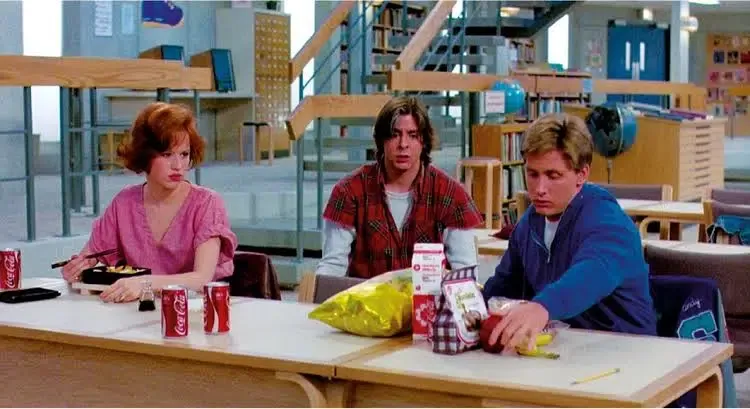
From a sociological and cinematographic standpoint, it’s the choice of space that makes the film unique. The library functions as a microcosm of American society — specifically, its class structure and power dynamics. At first, the camera distances them as if they were islands; later, to represent intimacy, close-ups dominate. There’s no artifice, no excess — just the raw force of dialogue. Bazin once said the most realistic cinema is that which leaves space for life itself to breathe — and I feel Hughes understood this perfectly.
Moreover, the five characters come from different socio-economic backgrounds, reflected in their struggles and perspectives. Andrew, the jock, belongs to a middle-to-upper-class family but is trapped under the pressure of his successful father. Claire, the princess, comes from a wealthy but cold and distant household. Brian, the nerd, lives in a luxurious home but under a glass ceiling of psychological control imposed by his perfectionist parents. Bender, the rebel, is the only character who seems to come from a modest or dysfunctional home. Allison, the outcast, is economically and socially marginalized. Through their conversations, the film indirectly critiques middle-class pressures and parental expectations, revealing how even the most privileged families can become forms of oppression.
Additionally, the film explores Erving Goffman’s theory of impression management — the idea that social life consists of performances designed to control how others perceive us. Each character arrives at the library with a well-practiced mask: Claire’s coldness, Bender’s arrogance, Andrew’s submission. Inside the library, these masks dissolve, revealing the uncomfortable truth beneath. The final essay — where they demand to be treated as individuals, not stereotypes — is the culmination of their struggle for dignity and self-authorization against a system (represented by Mr. Vernon) that sees only labels. The film also fits within the critical tradition of school-system critique, a lineage stretching from Hughes’ own Ferris Bueller’s Day Off to modern productions like Infiltrating Class (2012). While Ferris Bueller criticized the system from the outside, The Breakfast Club attacks it from within, arguing that the problem isn’t formal education — it’s how institutions socialize youth by imposing harmful norms. The film celebrates difference and individuality — a recurring theme in Hughes’ work, contrasting sharply with the homogenization promoted by conformity culture.

Cultural Legacy: Impact, Influence, and the Critical Voice of #MeToo
The impact of The Breakfast Club far exceeds its commercial success and critical acclaim. It marked an entire generation, providing them with language and visual reference to speak about their own experiences of loneliness, anguish, and identity-search. Thousands of letters from youths who felt represented flooded Universal Pictures after its release, testifying to the film’s power to validate deep, often solitary emotions. It has been called the greatest school movie of all time by outlets like Entertainment Weekly and dubbed “the Citizen Kane of teen cinema” for its influence and artistic quality. Its legacy span decades and formats, serving as the original blueprint for TV series and films exploring youth.
Several acclaimed series have paid explicit homage to its structure and spirit. Sex Education (Netflix, 2019–), in its Season 2 episode titled “The Breakfast Bunch,” recreates the five archetypes in a group therapy session. Community (NBC/Yahoo!, 2009–2015) repeatedly referenced the film in its Season 2 episode “Advanced Dungeons & Dragons.” Dawson’s Creek (The WB, 1998–2003) dedicated an entire episode to detention — “Detention” — in its second season. Moreover, its influence extends globally and across genres, inspiring episodes in shows like Victorious, Riverdale, and the book Bad Kids Go to Hell.
The original cast (except Emilio Estevez) reunited for a panel in 2023 to celebrate its enduring relevance — proof that the film remains a cultural touchstone.
Yet the legacy of The Breakfast Club isnt without controversy. The #MeToo era has demanded critical reassessments of decades-old artworks — and Hughes’ film is no exception. The dynamic between John Bender and Claire Standish has undergone rigorous scrutiny. Scenes that in 1985 could be interpreted as playful teenage flirtation now appear through a very different lens. The scene in which Bender crawls under Claire’s desk to look at her underwear is particularly problematic — made worse by the fact that an adult double was used for the shot, a decision that deeply upset Molly Ringwald and her mother. For Ringwald, this act constitutes clear sexual harassment — a behavior never properly apologized for or questioned within the film.
This reevaluation isn’t limited to one scene. Broader critiques point to the normalization of rape culture, the use of homophobic slurs like “fag” in the script, and the complete lack of racial diversity. Molly Ringwald, who starred in several Hughes films, has become a central voice in this debate. In a 2018 essay for The New Yorker, she reflected on the ambivalence of loving a work that also perpetuates attitudes of female subordination. She acknowledges the emotional value Hughes’ films offered adolescents, but insists it’s imperative to confront their ethical flaws. This critical revision is vital — it helps us measure social progress and understand how gender representation and consent have evolved over time.
Thus, Hughes’ and The Breakfast Club's legacy is dual: it is a masterpiece that offered a beacon of understanding to generations who saw themselves in it — but also a reminder of the problematic attitudes cinema often reflected, and sometimes normalized. The ongoing conversation about its content proves its enduring relevance and provocation — even after more than thirty years.
The Breakfast Club doesn’t offer an easy moral. It doesn’t say everything will be fixed, or that stereotypes will vanish. Instead, it shows how hard it is to maintain authenticity in a system that needs labels to function. But it also reminds us that even within rigid structures, there’s always a tiny space of resistance: a gesture, a confession, a shared moment.
And that space — even if it lasts only a Saturday afternoon — can be enough to change the way we see ourselves.



Comments 11