Mr. Robot – eps3.0_power-saver-mode.h: A Study on the Human Condition
Narrative

Somewhere in my subconscious, I was waiting for the moment to speak about this series. For me, Mr. Robot is the show that gave me a different perspective on a world consumed by information, consumed by immediate information everywhere. It is also the one that gave me my username: when, at the beginning of the first season, the question “Who is Mr. Robot?” is asked, it was the PERFECT moment to question my own identity. It wasn’t just a plot twist—it was a mirror reflecting back my own fragmentation.
There are episodes you don’t watch—you inhabit them. They settle in your chest, your throat, your memory. The premiere of Season 3—“eps3.0_power-saver-mode.h”—is one of those episodes that refuses distance. It is not merely a return to the plot; it is a return to an emotional terrain where the wound remains open and what was suspended from the previous season still pulses with force.

When I press “play,” I am not entering a fictional world—I am entering my own mind, my own doubts and fears. The screen illuminates the darkness of the room, and I feel the world we see on it overlapping with my own. New York City, corporate offices, the corridors of E Corp, the empty spaces where characters move—all are saturated with silence, anticipation, and a weight almost tangible. Sam Esmail’s narrative dos not seek only to tell what happens, but to show what occurs within bodies and minds—and how the external world reflects, amplifies, and threatens to destroy these fragile states.
The first thing that strikes me is the language of the series: Sam Esmail construct a hybrid idiombetween the technological, the intimate, and the political. The practice of titling each episode with file extensions is not mere aesthetic flair; it is a way of encoding the narrative as a program executing before our eyes. In this episode, “power-saver-mode” refers not only to software but to Elliot himself attempting to “save energy” retreating, shutting down parts of himself to survive. It reminds me of Deleuze’s concept of the “fold” of the subject: Elliot is a body that folds inward to resist the overload of the digital world and the weight of his fractured consciousness.
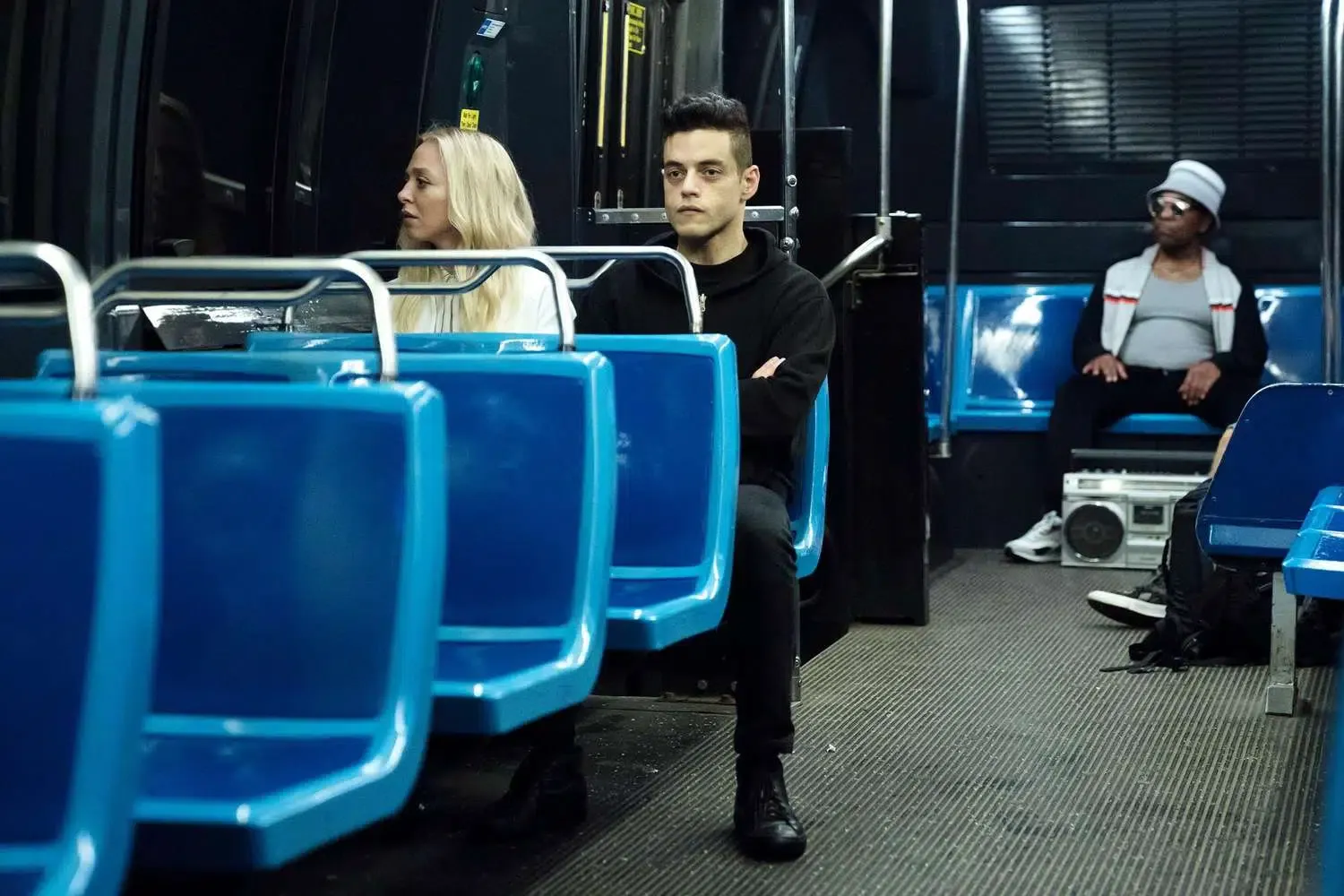
His visual aesthetics are an extension of his characters’ psychologies. The off-center framing—Elliot (Rami Malek) or Angela occupying barely a corner of the frame while emptiness dominates the rest—is not gratuitous formalism; it is a visual translation of alienation. Elliot is never at the center because his subjectivity isn’t either. As Guy Debord wrote in The Society of the Spectacle, the real shifts and becomes image, becomes distance. Mr. Robot reminds me, reminds us, through its form, that the society we live in has become a spectacle where absence weighs more than presence.
Returning to Mr. Robot in its third season—and especially to this inaugural episode—feels like re-entering an already infected operating system: we know everything is corrupted, we keep navigating menus, commands and cracks. It feels like waking up in the middle of a blackout in a city that never sleeps like New York or Buenos Aires. The episode “eps3.0_power-saver-mode.h” opens with that tension: Elliot survives Tyrell’s gunshot, but what matters is not merely his physical recovery, but the instability betwen his multiple selves and the fissure separating his paranoid vision from external reality.

The episode plunges us into that twilight, where reality and Elliot’s consciousness hang suspended in a state of power-saving mode—as if the entire world had paused in an uncomfortable breathh. Sam Esmail does not begin with a narrative explosion, but with an aesthetic and philosophical declaration: the contemporary condition is one of exhaustion, alienation, and suspension.
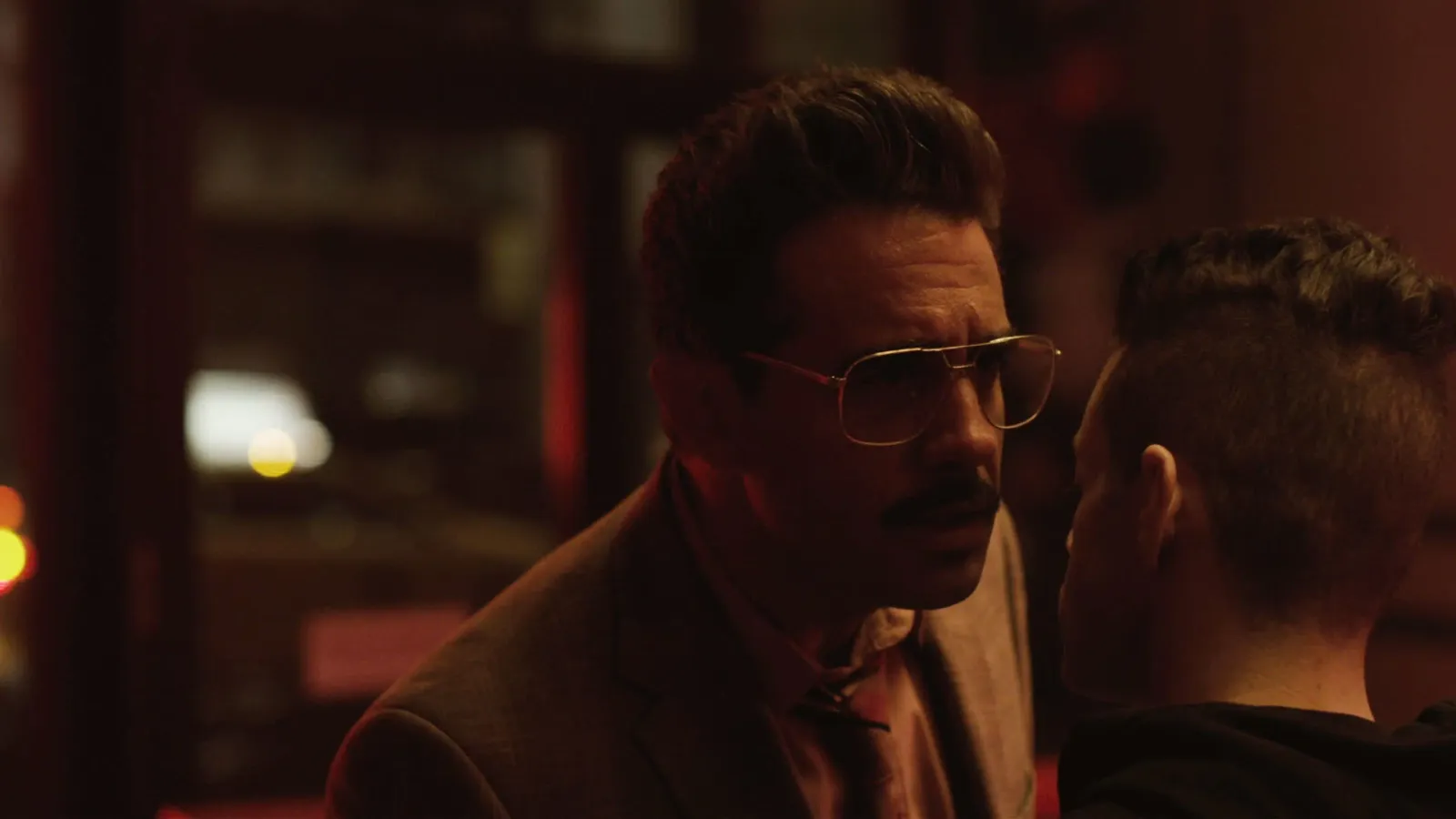
The third season begins with a line that is less an introduction than a declaration: “When we forget our principles, we invite chaos.” Irving, the new character portrayed by Bobby Cannavale speaks these words. And that he is the voice of this warning is no accident: Irving is a fixer, someone who inhabits the border between order and disorder—a bureaucrat of the Dark Army capable of articulating simple words where structural violence lies beneath. This idea of “forgetting our principles” resonates as a warning—not only for Elliot, but for the series itself: What happens when a revolution, a hack, or even a fractured mind loses sight of what sustains it?
The narrative begins exactly where it left off: Elliot wounded by Tyrell’s bullet. That wound—many suspected it was illusory—is revealed to be real. Irving confirms his condition, transports him, and deposits him in Angela’s house. There, Elliot awakens face-to-face with the inevitable: what he believed was in his head—his paranoia, his conspiracies, his Mr. Robot—is real. The mental and the material can no longer be distinguished. Here, the series enters a Kafkaesque space: as in The Castle, the difference between the imagined and the real ceases to matter, because the system operates as an all-encompassing, ungraspable whole, where the subjective can not be separated from the structural.

Elliot appears wounded—both physically and psychologically. That physical wound—the gunshot marking the end of last season—becomes a metaphor for the fragility of the self, the impossibility of complete repair. His gaze, sometimes lost, sometimes intense, recalls my own fears: the fear of vulnerability, of not recognizing myself, of identity dissolving under the weight of circumstance. And yet, within' this fragility lies beauty: beauty in the brutal honesty of one who cannot disguise their fear, in the sincerity of a face that reveals more than it hides.
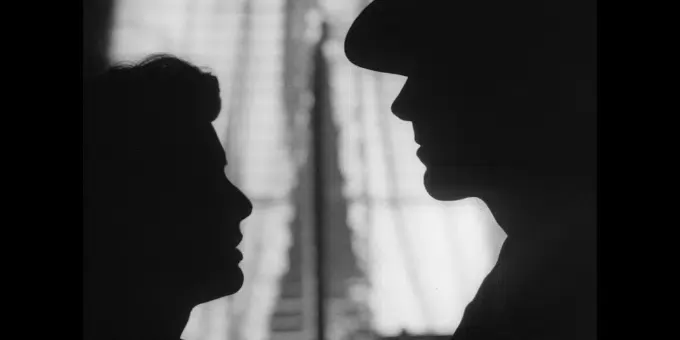
Photography is another protagonist. The cold, almost metallic palette—grays, deep blues, muted greens—combined with stark contrasts of light and shadow, and offkilter framings that seem to push characters toward the edges of the screen, creates a sensation of unease and estrangement that pierces through me. Every shot is designed to generate tension, to reflect alienation, to make the city, the offices, even domestic spaces feel like stages of vulnerability and isolation. And I, as a viewer, feel part of that tension; I feel how the camera pushes me to look from an uncomfortable angle, to confront Elliot’s fragmentation and my own internal shards.
Silence is another impactful element. It is not the absence of sound, but presence charged with meaning. The prolonged silences, pauses between dialogue, amplified ambient noises—create a rhythm that forces me to breathe differently, to inhabit discomfort, to dwell in the characters’ anxiety. It is as if the air itself is thick with tension—as if every held breath is a reminder that nothing is under control, not even the mind itself.
What moves me most is how this episode transcends the story of hackers and conspiracies. It speaks of time, of memory, of void, of identity, of solitude. It speaks of me, of us—of how we face the world and how we face ourselves. The beauty of Mr. Robot lies not only in the precision of its narrative, its meticulous aesthetics, its constant tension—but in its capacity to reflect humanity in its most extreme fragility, to turn television into a mirror of our own existence.
Between Code and Shadows: The Cinematic Gaze
From the very first frame, this episode reveals Sam Esmail’s absolute mastery over every aspect of mise-en-scène. Direction is not neutral; every frame, every camera movement, every pause in editing is designed to reflect the fragmentation of Elliot’s mind and the tension of a world crumbling around him. What deeply impresses me is how Esmail makes the form of the episode become a reflection of the protagonist’s subjective experience: the visual and sonic narrative functions as a map of his mind, where every shadow, reflection, and silence holds meaning.
Direction and Camera
The camera follows Elliot with an intimacy that is both tender and oppressive. High-angle shots shrink him against the city; close-ups pull him too close to his inner turmoils, forcing us to share his anxiety. The off-center framing, already characteristic of the series, here takes on deeper purpose: conveying imbalance, discomfort, alienation. In the opening scene, as Elliot walks down an E Corp corridor, the camera remains fixed while he moves—creating a sense of displacement and observation that makes me feel inside his head, trapped in his irregular rhythm and the tension surrounding him.
Minimal movement—a slight pan, a subtle shift in focus—creates a sense of containment that contrasts with the internal chaos of the character. It is as if the camera doesn’t just observe, but breathes with him, capturing anxiety in pause before each action. This cinematic technique recalls Deleuze’s theory of the “image-time”: cinema organized around duration, perception, and the character’s consciousness—not external action.
Photography and Color
The color palette is cold: dominated by grays, dark blues, and muted greens. This chromatic treatment turns every space into a reflection of urban alienation and technological disconnection. Artificial lights(neon or fluorescent) cut through darkness in sharp lines, creating contrasts that remind me the city, though alive, is hostile and fragmented. Warm tones are scarce and appear only in moments of intimate vulnerability or memory, generating an effect of rarity and emotional fragility.
Light functions almost as another character: in shots where Elliot is alone, light falls from impossible angles, casting long shadows that seem to stretch into his darkest thoughts. In the scene where he reviews his computer, the blue glow of the screen dominates the frame, isolating his face from the environment, underscoring his solitude and technological obsession. This aesthetic reinforces the sense that the environment is not neutral—it is a reflection of the protagonist’s fragmented mind.
The massive blackout sweeping the city is not mere set design. It is the aesthetic device that marks the entire episode.
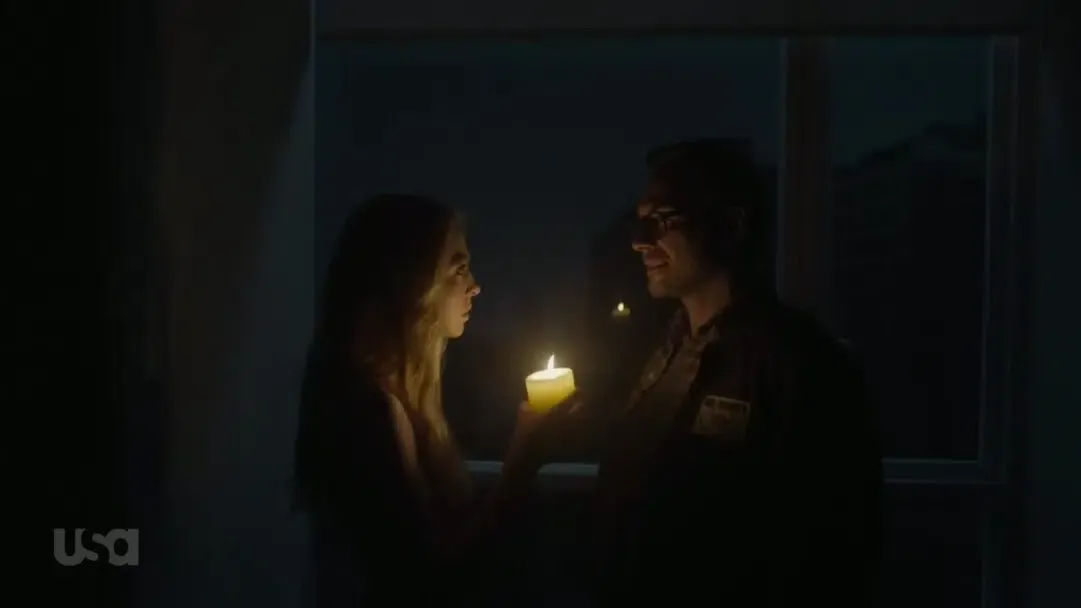
Darkness operates on two levels: on one hand, it is oppressive and paranoid, like Elliot’s mind. On the other, it enables dissent—like the garage full of hackers plotting. Night is simultaneously alienation and refuge. It is curious to think that the city is in power-saver mode, and everything unfolds at night.
Giorgio Agamben would describe the blackout as a state of exception: a suspension of normality allowing powers to institute new forms of control. But within this same suspension, margins find fissures to conspire. We might also say this is a visual demonstration of alienation.
Elliot is a displaced, fragmented subject, and the camera translates this fracture by relegating him to the corners of the frame. As Žižek notes, the contemporary subject never occupies the center; he lives always displaced, overwhelmed by a system that exceeds him.

Montage and Rhythm
Mac Quayle’s score deserved its own analysis. It does not merely accompany action—it creates atmosphere, tension, meaning. Synthesizers, electronic noise, low-frequency pulses function as echoes of Elliot’s inner world: a blend of anxiety, surveillance, and technological alienation. In the initial confrontation with Mr. Robot, the music supports but does not dominate; the silence between phrases, contained breaths, and ambient echoes transmit more than any chord ever could.
Ambient sound, carefully amplified, contributes to immersive experience. Every footstep, every keyboard click, every hum of machinery is designed to make us feel pressure from the environment onto the character. Esmail demonstrates absolute control over sound design, using audio as an extension of psychological narrative.

Inner Echoes: The Psychology of Elliot
What moves me most in this episode is how it compels us to inhabit Elliot’s mind. His experience is neither linear nor clean; it is a web of obsessions, fears, contradictory impulses, and a profound desire for control clashing with his fragility. His mind unfolds before us like a labyrinth where lucidity and delirium coexist, and as a viewer, I feel simultaneously inside and outside that mind—trapped in its irregular rhythm, sharing its anxiety and confusion.
Elliot: The Fragmented Self
Elliot is a character whose vulnerability is so evident it becomes a mirror of our own doubts and fears. The physical wound he carries from last season is an external reflection of his internal fracture. Every gesture, every glance, every held breath is a map of his emotional fragility. Yet beyond pain, Elliot embodies the tension between two seemingly opposite desires: the need to control and the impulse to surrender to chaos. This contradiction is what makes him human and recognizable.
The conflict with Mr. Robot is, essentially, a conflict with himself. Mr. Robot represents Elliot’s destructive side—the voice that questions, challenges, and threatens his perception of himself and the world. This relationship recalls Julia Kristeva’s notion of the abject: Mr. Robot is what Elliot rejects, yet constitutes his identity. It shows us that the self is not a harmonious whole, but an assembly of fragments fighting each other—and reconciliation with these fragments is a painful, sometimes impossible process.
Elliot and Mr. Robot intensify their struggle here. Elliot seeks to rebuild, to stop destruction—even to infiltrate E Corp to deactivate from within what he himself unleashed. Mr. Robot, in contrast, embodies the desire to carry things to their ultimate consequences. This inner battle evokes Dostoevsky’s “double”: living with a distorted replica that is unbearable yet indispensable.

Darlene: Empathy and Vulnerability
Darlene, Elliot’s sister, functions as an emotional counterpoint. Her sensitivity and affection are not always expressed in words; sometimes they manifest in small gestures or glances, revealing the tension between wanting to protect her brother and needing to preserve her own independence. Darlene represents shared vulnerability and human connection: her fragility reminds me that no one stands entirely alone, and even in moments of greatest strength, we need the other.
What moves me is how her relationship with Elliot reflects universal dilemmas: how to balance loyalty with emotional self-defense, how to love without losing oneself, how to sustain someone who, in many ways, seems unreachable. Darlene embodies empathy as both strength and risk—a reminder that vulnerability is not weakness, but the capacity to feel deeply

Angela: Calculated Coldness
Angela, by contrast, embodies extreme rationality and adaptation to a hostile world. Her coldness is not merely strategy—it is armor built to survive. She provoked ambivalence in me: on one hand, I admire her ability to navigate dangerous environments (she ceases to be simply the childhood friend and becomes part of the Dark Army); on the other, I feel a chill as I watch how she transforms vulnerability into emotional distance. Angela reminds me that suffering does not manifest in one way: some externalize it, others conceal it and become nearly impenetrable. Yet this ambiguity allows her to distinguish between Elliot and Mr. Robot.
Is she a strategist? A traitor? Or a survivor in a hostile world?
The psychological tension generated among the three main characters—Elliot, Darlene, and Angela—is the heart of the episode. Each interaction is laden with restrained emotion, significant silences, and small gestures that reveal far more than dialogue. This dynamic makes me reflect on my own relationships and how often what is unsaid weighs more than what is spoken.
Irving: The Banality of Evil
Irving, meanwhile, acts as a catalyst for everyday horror. His humor and banality recall Hannah Arendt’s description of the “banality of evil”: violence does not always wear monstrous faces, but emerges in subjects who perform their duties with bureaucratic calm. Irving repairs cars, repairs lives, manages corpses—he does what must be done. He does not judge. He does not feel. He merely executes. And that makes him more terrifying than any dramatic villain.

Labyrinths of Time and Identity: Visual Philosophy
The episode touches on universal fears: the fear of losing control, of being misunderstood, of being devoured by a system that seems larger than oneself. It also addresses the fear of solitude and death—present not only in Elliot but in every character—and which resonate with our own lived experience. Watching them, I feel an intimate recognition: we have all felt our minds betray us, our emotions overwhelm us, or the world drag us along with no remedy.
Byung-Chul Han, in The Burnout Society, describes the contemporary individual as caught between self-exigency and a constant sense of inadequacy. Elliot embodies this perfectly: there is no external tyrant oppressing him; his struggle is with himself, with his inability to reconcile his desires and his reality. His exhaustion is not only physical, but emotional and existential.
Desire and Void
Elliot’s desire is neither linear nor rational. He desires freedom, justice, love—but also fears the consequences of his own actions. This conflict generates a void perceptible in every silence, every sustained shot. That void, far from being absence, becomes a space filled with tension, possibility, reflection. Observing it, I realize the void is a human condition: we all experience it when facing difficult decisions, losses, betrayals, or our own fragility.
Contradictions and Complexity
What makes the characters of Mr. Robot especially human is their contradiction. They are neither heroes nor absolute villains; they are complex beings, with desires and fears that sometimes oppose each other. Elliot wants to destroy E Corp and yet preserve something of himself; Darlene wants to help and protect, but also seeks independence; Angela seeks justice, but moves within a territory where justice no longer has a name. None are pure. All are contaminated by the system. And that makes them truly real.
This complexity elevates the series above the technological thriller. It is not a story of good versus evil. It is a story of fragments seeking, in vain, to reconstruct themselves. And in that failure, we find an uncomfortable truth: perhaps we cannot heal. Perhaps we can only learn to live with the wound.
The Series as Mirror
Mr. Robot offers no answers. It offers questions. And in that space of uncertainty, I recognize myself. When Elliot looks in the mirror and does not know who he is, I look too—and do not know who I am. When he stands still in an empty room, I too stand still, listening to the echo of my own thoughts. When he says, “All of this is real,” then doubts it, I doubt too.
It is not a series to be watched. It is a series to be lived. To breathe. To carry within, like a virus that changes how you see the world.
And that is its most powerful quality: it does not merely tell a story. It transforms perception.
Every frame, every silence, every narrative twist, every intentional technical glitch, every pause in dialogue—is designed to make you feel you are inside a mind unraveling. And you, the viewer, are not an external observer. You are part of the system. You are the user who keeps logging in, even knowing the program is corrupted.
Because at heart—are we not all users of a system that demands we be productive, connected, strong, flawless? Have we not been taught to hide our fractures, to disguise our exhaustion as “temporary stress”? Have we not been sold the illusion that if we work harder, adjust better, become more efficient, we can escape?
Elliot does not escape. He sinks. And in his sinking, he shows us the way out: honesty.
There is no victory in Mr. Robot. Only survival. And in that survival, there is a quiet kind of heroism: the courage to keep breathing, even when the world has left you without air.
The Power of Silence
This chapter needs no explosions. No unexpected twists. No theatrical climaxes. It needs only one sustained shot: Elliot sitting on the floor, the glow of the screen illuminating his face, the sound of his slow, heavy, human breath.
That single shot is enough.
Because there—in that silence—is the entire series, not only in this chapter.
There is the world.
And there, also, am I.
Time as a Labyrinth
Time in Mr. Robot does not flow chronologically or uniformly; it fragments, halts, overlaps. Elliot’s experience reflects this altered perception: memories, decisions, and anticipations mingle in his mind like layers superimposed upon each other. Deleuze, in his Image-Time, describes cinema as a medium capable of showing duration and internal perception of time—and this episode is a palpable example of that theory. Sustained shots, silences, and off-centered frames are not merely aesthetic devices; they are attempts to visually translate the subjectiv experience of time.
In the scene where Elliot contemplates the city from a high building, time seems to stop. There is no music to accelerate perception, no editing to propel action—only him, the wind, the nocturnal lights, and a sense of infinity and void. That moment makes me think of Walter Benjamin and his concept of history as a constelation of moments: each instant contains echoes of the past and possibilities of the future, and memory, like the camera, selects what to illuminate and what to leave in shadow.
It is not about remembering what happened, but feeling how what happened continues living in the present. The series does not depict the past as narrative excess, but as physical presence: a shadow walking beside Elliot, an echo resonating in the click of a keyboard, the flicker of a screen. Here, cinema becomes a living archive—not a story, but a resonance
Death and Existential Void
The constant threat of death—physical, emotional, symbolic—pervades the entire episode. Elliot carries the awarenes that any misstep could be fatal, and this consciousness directs not only his actions but colors his perception of the world. Here I find resonance with Nietzsche and his reflection on finitude and the necessity of embracing life in its totality—with its risks and contradictions. Death is not merely an end; it is a force that gives meaning to every decision,every gesture,every silence.
The void Elliot feels—the sensation that the world and society press upon him without offering refuge—also recalls Byung-Chul Han, who describes contemporary society as a space where excess positivity and self-exigency generate an interior void. Elliot moves within this void: I perceive it not as absence of life, but as terrain where emotional intensity is magnified, and every choice carries more weight than it would in a linear, predictable world.
This void is not nihilism, It is clarity.It is the consequence of having seen too much: the codes that control money, the algorithms that decide who lives, who falls, who is invisible. He is not disconnected from the world. He is too connected, and that has left him naked.
Identity and Fragmentation
Elliot’s identity is fractured, and every interaction with Mr. Robot reveals layers of his personality he does not fully recognize. This fragmentation recalls Julia Kristeva’s notion of the self as perpetually unstable—a mosaic of desires, fears, and internal voices. Elliot is, in a sense, a postmodern subject: his identity is constructed and destroyed simultaneously, and the series invites us to reflect on how many of us live with identities we cannot fully control—identities that dissolve in contexts and relationships.
The scene where Elliot faces a complex moral decision reflects this tension: his mind is a battlefield where ethics, desire, and fear intertwine, and every action can be interpreted in multiple ways. Here I find an echo of Derrida’s concept of deconstruction: nothing is absolute; everything is interpreted, revised; truth becomes relative, fragile, mutable.
But here there is something more: it is not merely that identity is multiple. It is that each identity has a different owner. Mr. Robot is not an hallucination—he is a voice that speaks because someone—perhaps him, perhaps another—decided he had the right to exist. And that voice does not fall silent. Because if it does, who remains?

Memory and Trauma
Memory in this episode functions as both narrative thread and force distorting reality. Elliot remembers, imagines, and anticipates simultaneously, and the series plays with this instability to show how trauma affects perception. Roland Barthes, speaking of the punctum in Camera Lucida, describes how a detail can pierce us and alter our vision of the image; here every memory or flashback of Elliot functions as a punctum that forces us to experience his pain and vulnerability immediately and intensely.
The relationship with trauma becomes a reflection on the fragility of the mind: memories merge with paranoia and the violence surrounding him, creating a perception of reality that is both intimate and dangerous. I find myself reflecting on how we all carry fragments of past experiences that color our present lives, and how cinema can capture this complexity so profoundly that we feel the screen breathes with us.
It is not trauma that breaks him. It is the impossibility of naming it. That is why he screams in silence. That is why he stares at the camera without words. That is why, when he speaks, it is as if for the first time someone hears him.
Love, Desire, and Ethics
Though centered on conflict and tension, the episode subtly touches on desire and relation to others. The way Elliot connects—or distances himself—from Darlene and Angela reflects not only his survival strategies, but his yearning for human connection and recognition. Simone de Beauvoir spoke of existence as relation: being-for-the-other and being-with-the-other defines much of our identity. In this episode, every relationship becomes a mirror of what Elliot fears and desires: love, understanding, belonging—but also power and control.
Darlene does not save him. But she looks at him. And in that looking, there is radical ethics: not intervening, not healing, simply being. She offers no solutions. She offers the presence. And that, in a world that wants to fix everything, is a form of resistance.
Angela, by contrast, does not look. She evaluates. Her desire is not connection, but is equilibrium. She wants justice—but not at the cost of herself. Her love is an equation: how much can I give without disappearing? She is not cold. She is cautious. And in her caution lies a loyalty deeper than any declaration.
Elliot does not seek love. He seeks to be seen. And in these two female characters, he finds two possible ways of being seen: one with an open heart, the other with eyes wide open.
The Ephemeral and the Transcendent
Finally, there is a sense of ephemerality throughout the episode. Each scene, each gesture, each silence is fleeting and charged with meaning. Benjamin spoke of experience in modernity as fragmented, ephemeral, and how the perception of speed and fragmentation alters our relationship with memory and history. Mr. Robot takes this idea and materializes it visually: the city is immense, the characters are small, and life seems a collection of fragments dissolving before we can comprehend them.
Yet it is precisely in that ephemerality that beauty and emotional intensity reside: each moment contains everything we are capable of feeling and reflecting.
A held breath. A light going out. A keystroke that changes the course of a life. Nothing is eternal. But nothing is insignificant.
The Monologue’s Turn: From “F**k Society” to “F**k Me

One of the most powerful moments in the episode arrives when Elliot breaks the usual pattern and speaks directly to the camera—not in voiceover, but eye to eye. This shift alters the entire dynamic: for the first time, he acknowledges us as direct interlocutors. And above all, what he says is different. He no longer curses society in the abstract. Now, he blames himself. From “f**k society,” we move to “f**k me.”
This philosophical turn recalls Foucault’s concept of “care of the self”: to transform the world, one must first take responsibility for oneself. Elliot understands the system does not only oppress him from outside—he has been part of its reproduction. True revolution begins with accepting one’s own fracture.
The montage, which intercuts his monologue with archival footage, amplifies this revelation. Until now, those images illustrated paranoia against global capitalism. Here, they function as catharsis: a call to responsibility, to not delegate everything to a messianic hero. Elliot is no longer the impossible chosen one—he is a subject who must take ownership of his errors. Here, the series articulates a paradoxically optimistic message amid its nihilism: chaos can be confronted if we abandon the comfort of blaming the exterior.
The political and social dimension of the episode exposes the paradox of contemporary revolution. fsociety’s attack on the financial system, once seeming emancipatory, is revealed as incomplete, co-opted, insufficient. The gaps it leaves do not generate freedom, but new forms of control. Slavoj Žižek would argue that revolutionary gestures often fail to escape the system they seek to destroy, because their tools are already contaminated by that same power. The blackout, then, does not function as liberation, but as a symptom: the incapacity to escape the cycle of domination. Revolution becomes silence. Pause. A world on standby.
The Encrypted City: Social and Cultural Reflection
Alienation and Technology
The series centers on alienation, and this episode expresses it through Elliot, whose relationship with technology is both tool and prison. Elliot controls systems, manipulates code, confronts corporate giants—yet simultaneously, he is isolated, disconnected from real affective bonds, trapped in constant surveillance. This reflects Byung-Chul Han’s analysis in The Burnout Society where excessive digital connectivity generates isolation, self-exploitation, and existential void. Elliot is the embodiment of a hyperconnected subject who knows the digital world better than himself—and whose alienation is the product of both system and his own fragmented mind.
The urban spaces reinforce this idea: New York is imposing, luminous, technological—but also inhospitable and depersonalized. Tall buildings and impersonal offices show how progress and innovation can coexist with dehumanization. In this sense, Esmail makes a visual social commentary: the world we’ve built draws us closer to systems than to people, and control over information becomes an instrument of power that marginalizes the human.
Capitalism and Power
Elliot’s central conflict with E Corp functions as a metaphor for contemporary capitalism and structural inequality. E Corp is not merely a fictional corporation: it represents concentrated economic power, the opacity of financial systems, and the sense of powerlessness against gargantuan institutions. Watching Elliot’s movements, the series makes me reflect on how modern life is marked by structures that surpass us, and how rebellion—however ethical or justified—always confronts far greater forces.
Visual aesthetics contribute to this critique: minimalist offices, neon-lit boardrooms, computer labs, endless corridors. All these elements show a world where efficiency and productivity outweigh the human, where alienation is not accidental but designed. Esmail combines aesthetics and social message: cinema becomes critique.
Youth and Precarity
Darlene and Elliot, though young adults, embody the concerns of a generation trapped between unfulfilled promises and unsustainable expectations. Labor precarity, social pressure, and fear of failure are not merely narrative elements—they reflect real issues confronting contemporary youth. The series resonates with sociological theories on precarity and digital culture, showing how young people face a world demanding immediate results while offering few opportunities for personal fulfillment.
The characters’ lives are marked by urgency and risk: every move may be decisive, every mistake fatal. This tension reflects a modern zeitgeist: the feeling that we live under constant surveillance, that every act is recorded, judged, evaluated, and that real autonomy is limited.
Feminism and Relations of Power
Angela and Darlene represent distinct ways of confronting a world dominated by masculine and corporate power structures. Darlene, through vulnerability and empathy, demonstrates that feminism can be action and sensitivity; Angela, with her calculated coldness, shows the strength required to survive hostile environments. The series, without explicitly feminist messaging, raises reflections on how women negotiate power, autonomy, and ethics in an unequal world.
The contrast between male and female characters underscores social critique: men seem integrated into the system, while women must navigate it cautiously, constructing their own strategies to survive. This reading resonates with contemporary studies on gender inequality, representation, and power.
Connection with Contemporary Issues
Mr. Robot is not fiction—it is commentary on our reality. The use of invasive technology, data manipulation, corporate and state surveillance, economic precarity, and emotional alienation reflect debates shaping our society. Every scene—from a computer processing data to an impersonal office—reminds us how systems of power affect the everyday and how individual action confronts forces that seem insurmountable.
The series invites reflection on social responsibility, political awareness, and digital ethics. It reminds us we live in a world where technology can be both liberating and oppressive, and where individual action has consequences that transcend the personal. As a viewer, I feel this episode interrogates me: it questions my relationship with technology, work, institutions, and others.


Memories of the Spectator: An Intimate Diary of Looking
As I watch the first episode of Season 3, I cannot help but feel I am more inside my own head than in front of the screen. Elliot is not merely a fictional character—he is a mirror reflecting my fears, obsessions, silences, and deepest doubts. Every sustained shot, every elongated shadow, every silence speaks to human fragility, to the loneliness we carry even surrounded by people, and to the constant struggle to hold ourselves together against the void threatening to devour us.
I discover myself recognizing in Elliot moments I thought existed only in me: the anxiety that makes every decision impossible, the sensation of being trapped in a labyrinth with no exit, the need to control what cannot be controlled. When he walks through E Corp’s corridors, I feel his vertigo, his weight, his emotional exhaustion. I wonder how many times in my own life I’ve felt the same: that the world is vast, indifferent, and my efforts are small against the machinery surrounding me.
Darlene reminds me of the strength born from vulnerability. Her way of holding Elliot while maintaining her own independence makes me think of relationships I’ve had, moments when affection and empathy were acts of courage. Angela, with her calculated coldness, provokes fascination and a faint dread: her strategy of self-protection makes me reflect on the masks we wear to survive, how we hide emotions to avoid vulnerability, and the tension between authenticity and the need for control.
There are scenes that pierce me like personal memories. When Elliot observes the city from above, I feel his sense of infinity and void. I see myself in quiet places, watching lights that seem distant and yet impossible to ignore. Time suspends, and I feel the fragility of life, the intensity of each moment, the certainty that everything is ephemeral. The city, with its towering buildings and streets that resemble labyrinths, becomes a metaphor for the human mind: complex, fragmented, always in tension between control and chaos.
The silences of this episode are music for my thoughts. Every pause between dialogue, every held breath, every hum of machinery forces me to look inward. I feel I share Elliot’s anxiety, but also his capacity for observation and reflection. In those moments, I realize the series does not merely tell a story of hackers and conspiracies—it invites me to explore my own mind, confront my contradictions, and accept that fear and fragility are not weaknesses, but signs that I am alive and conscious.
The relationship between Elliot and Mr. Robot feels especially intimate and disturbing. It is a reminder that the struggle with oneself is inevitable—that we all have inner voices that challenge, destroy, and yet push us to grow. I am astonished at how the series makes every internal conflict tangible: it is not merely narrative—it is emotional experience. I wonder how many times in my life I’ve confronted my own shadows, hidden desires, contradictions—and how each encounter has defined me.
At the end of the episode, I am left with an ambivalent feeling: fatigue, because the tension has remained constant; because the series captures the complexity of the human so precisely; and a quiet sense of relief, because it reminds me I am not alone in my inner struggle—that we all carry fragments of fear and desire that make us human—and still, we go on.
Writing this while watching allows me to transform the experience into something tangible. Each sentence is an attempt to capture intensity, to turn fleeting emotion into lasting memory, to transform fiction into an intimate mirror of my existence. Writing, in this case, is breathing: it is letting art pierce me, letting the characters speak, and answering from my own fragility and sensitivity.
This episode is not just an episode.
It is a ritual.
A ritual of recognition.
A ritual of mourning.
A ritual of incapacitation.
A ritual of return.
We, the viewers, are not witnesses. We are accomplices.
Because when Elliot looks into the camera and says “f**k me,” he is not speaking to us.
He is speaking to me.
And I…
I answer in silence.
With a tear.
With a sigh.
With a “PLAY” button I never pressed again.
Because I no longer need to see more.
I already know what comes next.
And I know there is no escape.
Only this moment.
This breath.
This shared wound.
And perhaps, for the first time, it is enough.





Comments 11