Between emotional boundaries: the international cinema of Wong Kar-wai
Directing
Every time I walk at night, I can't help but think of Wong Kar-Wai films. I think of his characteristic way of lighting the scenes, I think of an emotion that cannot be fully named. A nostalgia that does not necessarily have an origin, but which weighs heavily nonetheless.
His films accompany me like certain memories: they are not entirely clear, but I know they have left their mark on me. What attracts me most about his work is not only the visuals—which are profoundly beautiful—but also his ability to narrate the states of the soul, to put into cinematic language what we often cannot even express in words.
I remember that his films were present at important moments in my life: my first degree at university, my first friendships, my first film club, and my first date with my partner. Even in the most inconsistent memories, his films are there in the background. His cinema has something of an old perfume, of an unsent letter, of contained desire. His aesthetic is not just a visual matter: it is a way of looking at the world and relationships. A way of inhabiting love and loneliness.
For me, Wong Kar-wai's cinema is a place where time dissolves and memory becomes raw material.

An emotional aesthetic
Wong Kar-wai's aesthetic is unmistakable; it is not a mere embellishment, but rather the central vehicle of his narrative. His cinema does not seek objective reality, but rather emotional reality. He uses images as if they were visual poems: not always clear, not always linear, but intensely evocative. Each shot is composed as if it were a memory or a desire. Sometimes blurred, sometimes too sharp, as when something hurts. His frames give the sensation of being suspended in time.
The saturated and contrasting colours that characterise his work — passionate red, neon green, melancholic blue — are not just visual choices but moods. The image in his films behaves like memory: sometimes it repeats itself, sometimes it slows down, sometimes it fragments.
The technique of step printing, which slows down movement without softening it, creates that sense of suspended time. It is as if his characters are walking a tightrope between what they desire and what they cannot achieve. I find this temporal dislocation deeply modern: we live wishing for what has already happened or what will never happen.
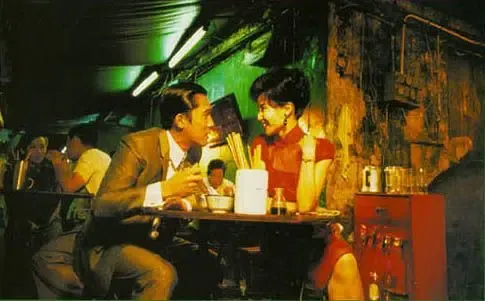
Photography and art direction: the intimate as territory
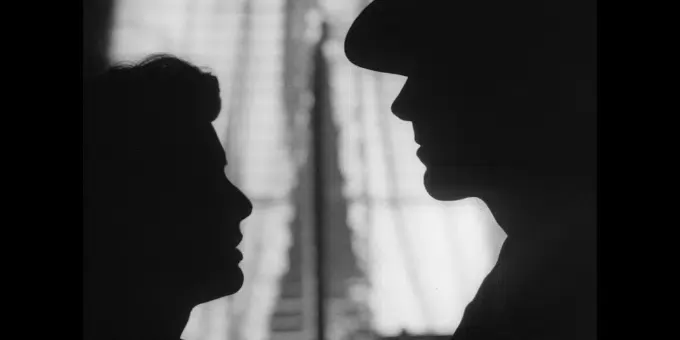
Christopher Doyle his regular and most emblematic director of photography, understands that light not only illuminates: it also constructs subjectivity. He understands that light is as sensitive as feelings. In Wong's films, light is always partial, filtered, fragmented. We rarely see a complete room or an entire city. We see details: someone's back, a reflection, the shadow cast by a curtain. The photography does not show: it suggests. And that is deeply cinematic.
The characters often appear boxed in narrow corridors, behind glass, separated by half-open doors, as if the world were full of invisible barriers between them and what they desire.
The art direction follows this logic: instead of showing large landscapes, it focuses on enclosed interior spaces, low ceilings, narrow staircases, spinning fans, hanging clothes, steam, damp alleys. The city is always there, but as an extension of the characters' emotional state. The domestic is political, the private is social. It is in these tiny places that the great conflicts of the soul unfold. There is no need for an imposing landscape when a corridor can say it all.
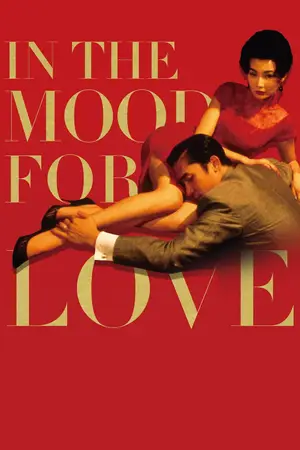
The art direction in his films works almost as an extension of the characters' souls in In the Mood for Love, the flowery wallpaper and Su Li-zhen's tight-fitting dresses become a beautiful prison. It is desire contained in its purest form. Everything is beautiful, but nothing can be consummated. And that is perhaps Wong's greatest aesthetic achievement: turning limitation into fertile ground.
The sociology of disconnection
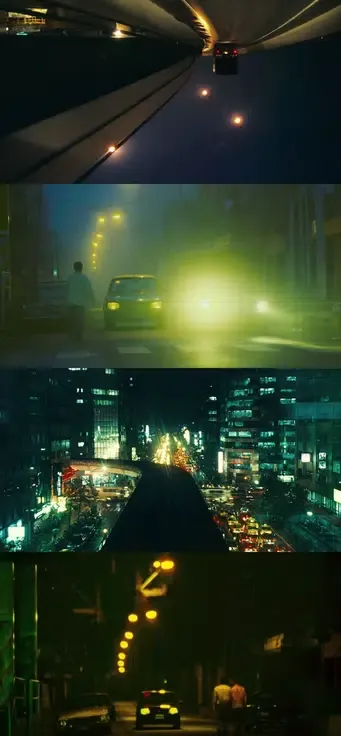
Although many consider him a romantic filmmaker—and in some ways he is—for me Wong Kar-wai is above all a filmmaker of rootlessness. His characters are displaced, out of sync, in transit, not only physically but also emotionally, because they seem to be waiting for something that never arrives or has already gone. They live in cities they do not fully understand or that reject them. And this is no coincidence: Wong is the son of migrants from Shanghai who settled in Hong Kong, and his identity is marked by that cultural fracture, by that 'being in between'.
His films are set in pre-1997 Hong Kong, before the transfer of sovereignty to China. And although he rarely talks about politics directly, everything in his films speaks of loss: loss of home, of language, of time. In Happy Together, what we see is not only a broken couple in Buenos Aires: it is also the impossibility of returning, of feeling at home again, even if one returns geographically.
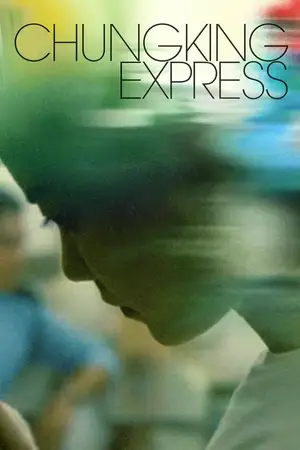
That feeling of displacement is also experienced in Chungking Express, where the police officers and the women around them are looking for something that even they cannot define. The city is alive and full of movement, but that does not mean that the characters are connected to it. On the contrary: there is an urban loneliness that pervades everything. The everyday, the pop, the banal coexist with the existential.

Love off-screen
In Wong Kar-wai's films, love is never what is said, but what cannot be said. It is what does not happen, or what happened and has already vanished. Love is not destiny: it is a kind of intermittence. Bonds are marked by the difference in timing. One loves while the other leaves. One is ready when the other has already closed the door. These are desires that are never fulfilled.
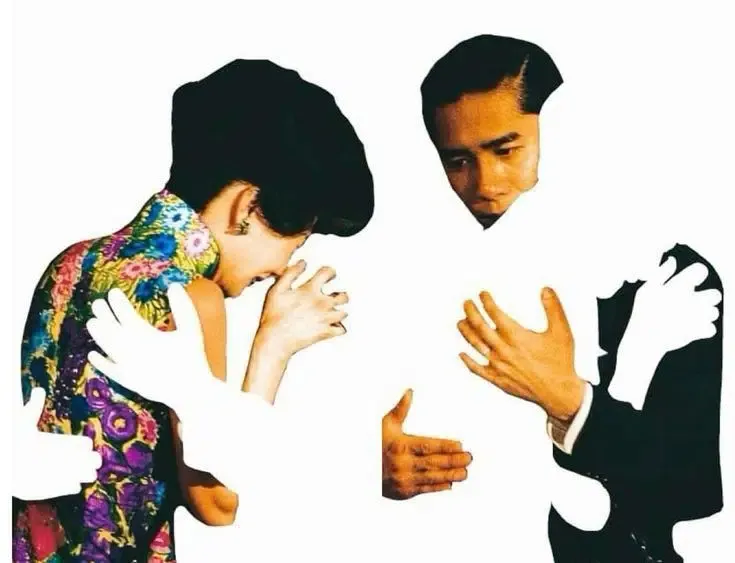
In In the Mood for Love, the impossible love between Chow and Su is never consummated, and yet it is one of the most intense romances in modern cinema. What unites them is not the body, but language, ritual, shared silence. Love is made up of details: walking down the same corridor, sharing a soup, pretending to confront the other.
In 2046, love is no longer even a memory: it is an aesthetic obsession, an internal archive. The characters live anchored to bonds that no longer exist, and metaphorically travel on a train to a place where nothing changes. But that place does not exist, of course. It is only the desire for time not to hurt.

The role of music
Wong Kar-wai understands that music is not an accompaniment: it is another character. His musical choices not only set the tone, but also become central to the emotional construction of the scene. Nat King Cole singing in Spanish, the soft bolero of "Quizás, quizás, quizás" or Shigeru Umebayashi's "Yumeji's Theme" are themes that are repeated with a hypnotic function.
Each repetition does not exhaust the song, but rather charges it with new emotionality. Instead of using music as a transition, he uses it as an emotional loop. The same song plays over and over again as the characters repeat gestures, glances, routines. Thus, the music becomes memory. A vestige of love that was not to be.
In Chungking Express, for example, the insistent use of "California Dreamin'" by The Mamas & The Papas functions as a kind of melancholic mantra, a desire for escape, for possibility, for escape. Music has this dual function: on the one hand, it sustains emotion; on the other, it contradicts it. The characters dream of a place they can never fully inhabit.
Women: strength, mystery and restraint
The women in Wong Kar-wai's films are not passive muses. They are deeply complex, active, contradictory characters. They are often the ones who sustain desire, but they are also the ones who set the limits. In In the Mood for Love, Su Li-zhen is the one who decides not to cross the line. She suffers, but she also has an ethic of desire. She allows herself to feel, but not to destroy.
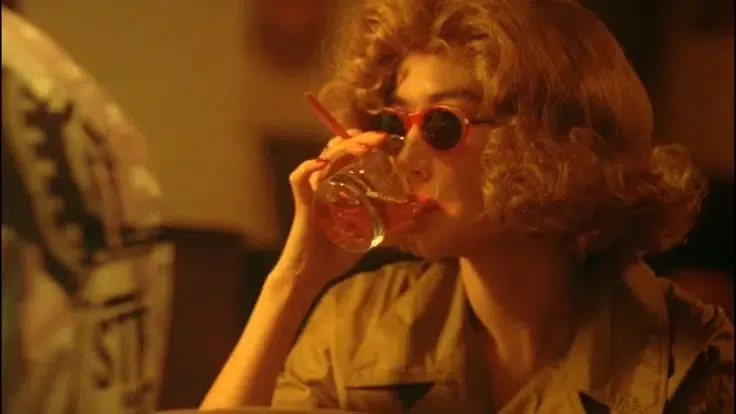
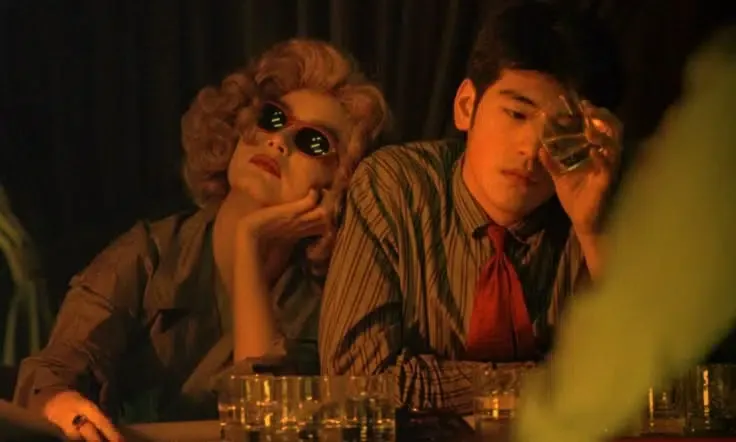
In Fallen Angels, the hired killer played by Michelle Reis hardly speaks, but her body and her gaze say it all. She has a physical presence and a contained pain that make her unforgettable. These are women who bear the weight of time, but do not give in to despair. They put on their make-up in front of the mirror, smoke in lonely rooms, look out of the window, but they do not wait to be saved. They choose.
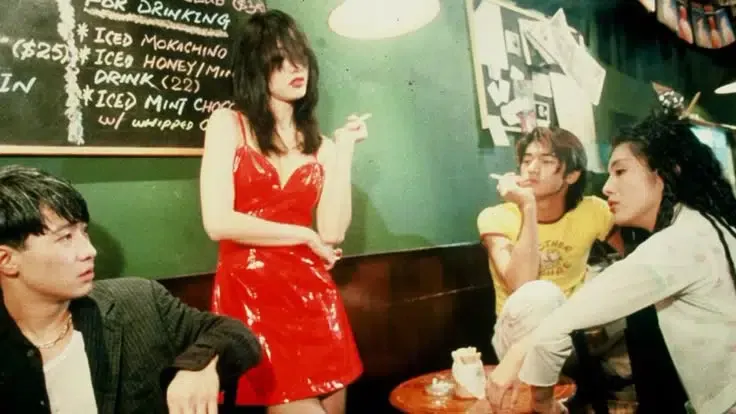
Even when they are secondary characters, the women in his films are deeply poetic figures. They embody possibility and loss. Mystery and mourning. But they are never decoration: they are the emotional centre.
In short, Wong Kar-wai's cinema affects me not because of what it shows, but because of what it leaves vibrating afterwards. It is a cinema that works with silence, with echoes, with repetition. It reminds me that not everything has to be said to be felt, that often the most powerful things happen off-screen. That love, sometimes, is a form of absence.
In a world that pushes us to run, to understand everything, to close off meaning, his cinema proposes the opposite: to stop, to look closely, to linger a little longer on what hurts or what was not. And that, for me, is deeply human.
In the Mood for Love (2000)
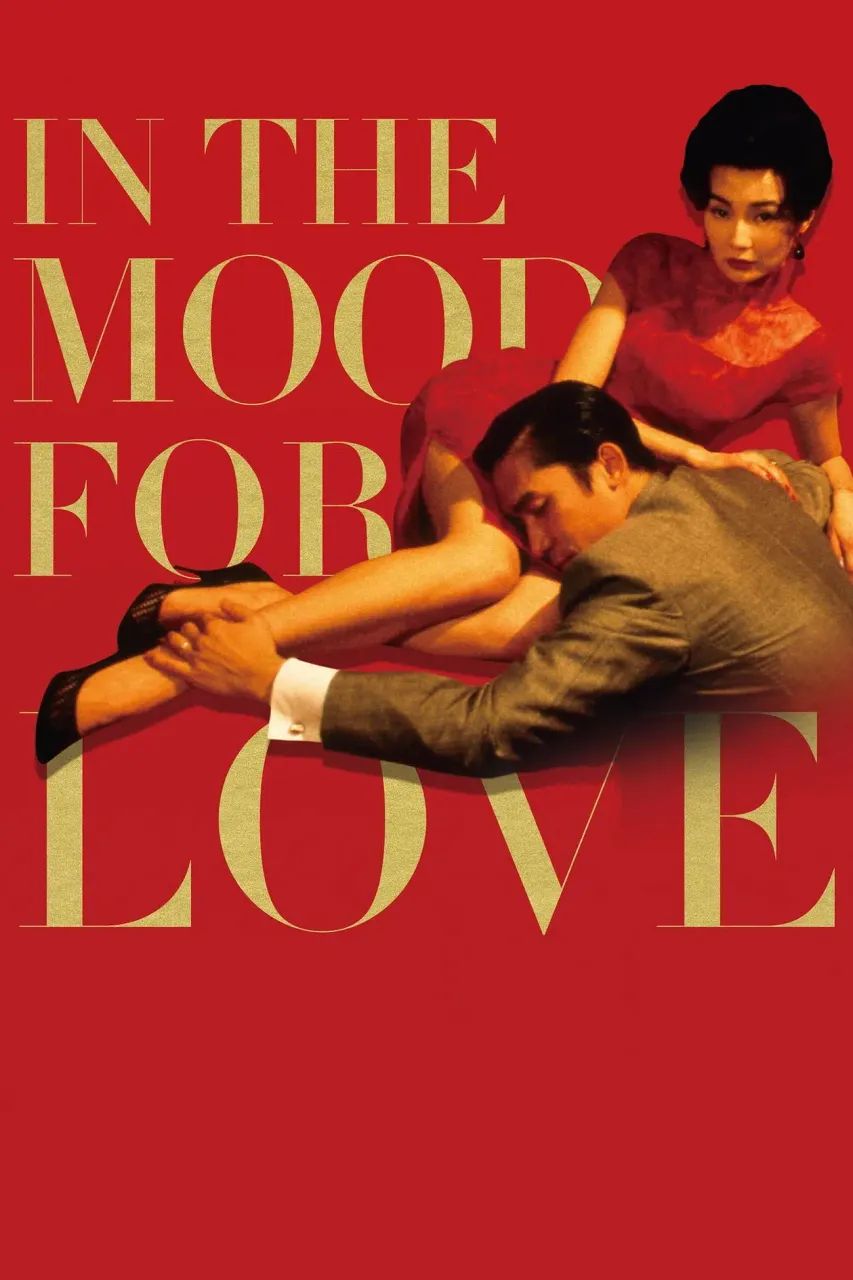
For me, this is one of the saddest and most sensual films ever made. Chow and Su, two neighbours who discover that their respective partners are unfaithful to them, begin a platonic relationship marked by restraint. They never fully touch each other, but everything in their gestures speaks of an intimacy that transcends the physical. The film breathes through colour, silence and the slow passage of time. Nat King Cole's music in Spanish, that soft bolero that repeats itself, gives it a tone of universal nostalgia.

Chungking Express (1994)

Here the pace changes. There are two intertwined stories about lonely policemen and eccentric women. The city is alive, noisy, chaotic. But even so, the characters are alone. Love appears in small objects: a can of pineapple with an expiry date, a note hidden in food. What I like about this film is that it shows how bonds are built on details, not grand gestures.
Happy Together (1997)

Set in Buenos Aires, this story of a gay couple who travel to Argentina to fix their relationship and end up falling apart shows another kind of love: more toxic, more desperate. But just as human. The black and white and colour photography marks the emotions as if they were seasons of the soul. It is also a film about migration, about not being able to return, about fragmented identity. For me it is one of the most beautiful and saddest films of all, it is an open letter about failed relationships, about a country unknown to many where the real barrier is not language but speech, the ability to speak and express feelings and thoughts without measure. I always remember the first time I saw it in a movie theater, it was so emotional that it touched every membrane of my skin, every neuron in my brain connected with something beyond what I could understand an unrequited love sitting next to me as we both recorded the inability to connect and express before our eyes.

2046 (2004)
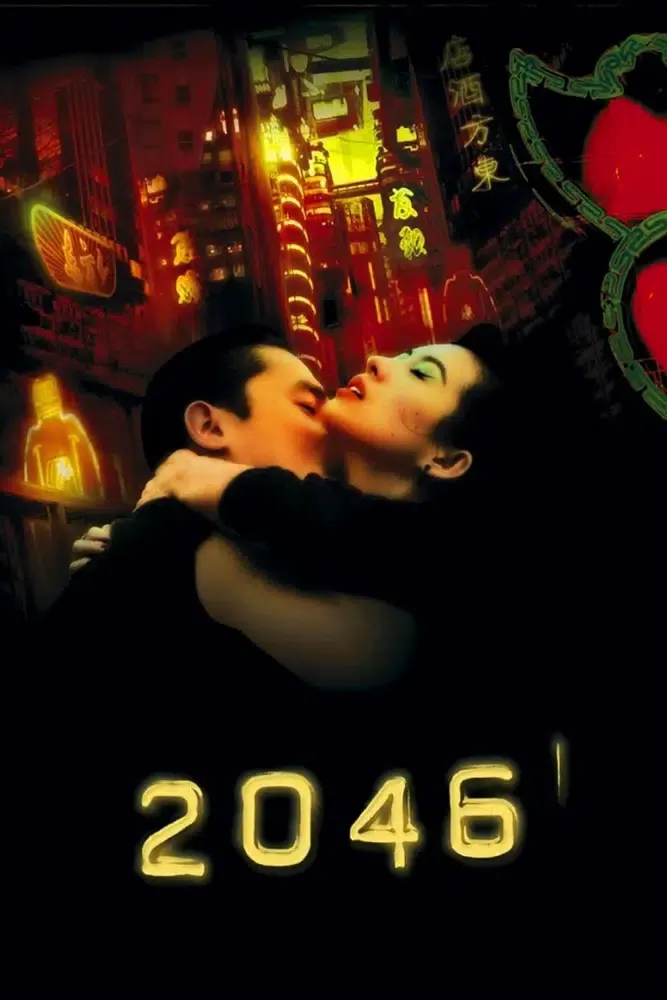
A kind of spiritual sequel to In the Mood for Love, but more ambitious, more open to artifice and science fiction. It is as if Wong were exploring memory from a more dreamlike place. The protagonist tries to write a story about a train that goes to a place where nothing changes: 2046. But deep down, what he wants is to return to a past that no longer exists. It is a film about the ghosts we leave behind, but which continue to travel with us.
Ultimately, Wong Kar-wai's cinema touches me because it is not afraid to dwell on what others overlook: a sustained gaze, a touch of hands that does not materialise, the silence that remains after a farewell. His cinema does not seek answers, but sensations. And in an increasingly hurried, narrative-driven, explanatory world, his poetics of the unfinished, of the suggested, seem to me an act of resistance. His films are not seen: they are felt. They are remembered as one remembers a dream.





Comments 10