Growing up as the worst person in the world
Narrative
There are no films I love as much as the coming of age, that subgenre that grows with you and provides as many answers as it does questions. And if there's one thing that's important to me, it's the exploitation of young adult stories with internal conflicts.

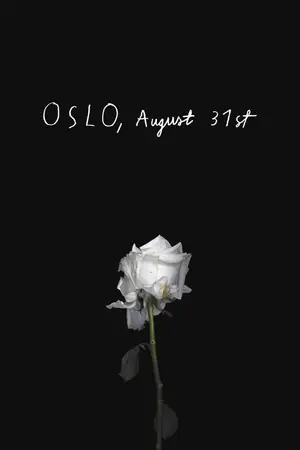
"The Worst Person in the World" (2021) is a Norwegian film directed by Joachim Trier that constitutes the closing of his so-called Oslo Trilogy, follows the life of Julie (Renate Reinsve), a 30-year-old woman who finds herself in a constant search for her identity and purpose in life.
Through Julie's point of view, and divided into 12 chapters, a prologue and an epilogue the film explores themes of growing up, adulthood, desire, anxiety, fear, motherhood and love.
The film's episodic structure breaks with classic linearity and allows for a more introspective exploration of its protagonist's emotional time. This narrative approach offers a kaleidoscopic look at Julie's life, with each chapter functioning as a window into a moment of transformation, rupture or doubt. Joachim Trier, with the constant collaboration of screenwriter Eskil Vogt, employs a cinematic language that combines emotional realism with elements of visual lyricism, as in the famous sequence in which Julie runs through Oslo while everyone seems frozen, suspended in time: a poetic reflection of the intensity of a momentary emotion in the face of social time.
The film not only explores the ups and downs of its characters, but contextualizes them with Norwegian modernity through its themes. And this is my opportunity to talk about it through its chapters.

Perhaps it is a way of exclaiming that ugly feeling when we make bad decisions or just another adjective to our personality. To change decade, to think about the end of our twenties is to realize that life is limited and our decisions have consequences.

Prologue
I remember the first time I saw this film was in a cinema, and I felt something that turned out to be inexplicable: I felt understood. A film in front of my eyes embraced me, held me, and represented me in countless ways. Those fears and desires were expressed through dialogues which, despite my basic understanding of Norwegian, I could grasp—not because of the language, but because of the emotion, and the experiences.
To this day, I don’t think there is a film that moves me as much as this one, caught between youth and adulthood—at that age that feels like life’s limbo. A film that speaks in the first person about anxiety, depression, and life’s obstacles, but emphasizes the constant search for identity.
When it ended, and people applauded as the lights came on, I couldn’t help but smile with tears on my face because in Julie, I also saw myself: a woman who didn’t know what to do with her life and still hasn’t found the answer.
A film that doesn’t speak my native language, but communicates in the language of growing up, the fear of death, loneliness, heartbreak, and life’s adventures.
Probably, we’ve all felt like the worst person in the world at some point. Maybe it sounds exaggerated—just like the emotions that live inside us. I don’t know.
Maybe it’s just a way to shout out that terrible feeling when we make bad choices—or simply, another adjective for our personality.
Turning 30, thinking about the end of our twenties, is realizing that life is finite and our decisions have consequences.
The Worst Person in the World is a film with a bold and realistic vision of youth—one that offers no exact formulas for how to live it.
In the prologue, aided by a partially omniscient female voiceover, we learn that at 29 years old, Julie is going through the existential malaise of those who live in affluent societies—people with too much free time who try to compensate for their lack of inner compass with a flood of nothingness from social media, to fill the void, the hole that has taken over everything.
I. The Psychology of the Characters
Julie is the film's protagonist, a woman who struggles with growing up and adulthood. It is not easy to become an adult.
A complex personality stands out among certain gaps in the story, her passions, her anger and everything that motivates her that blurs because the important thing is the present and that nonconformity that persists in her. We do not know her life in depth but she could be the visible face of insecurity thinking all the time with a feeling of immense emptiness. We do not know her life as she does not know her purposes and dreams.
Nothing she does fills her spirit, each change of career -from medicine to psychology, ending in photography- without emphasizing on any of them does nothing but introduce us to her existential conflicts.
Julie is searching for an answer, she goes through a long journey to find her identity and to find herself and her desires. Every detail that characterizes her personality is reflected in her personal relationships, mainly with Aksel (Anders Danielsen Lie), who is a comic book artist known for creating Gaupe (Bobcat), who later becomes her partner.
Aksel is Julie’s opposite—he has financial and emotional stability. He embodies maturity and certainty, yet as the film progresses, we discover that beneath all his confidence lies a deep fear of death. Aksel seems like the perfect partner for the imperfect Julie. But can such problems only exist in stable environments? Are we all capable of confronting existential dilemmas—or only those who live in peaceful societies?
Is Julie immoral, or simply nonconforming?
You can only answer these questions by watching the film—and feeling closer to her.
To me, Julie feels empty, but she has a full plate of options—none of which satisfy her.

II. Growing up is not easy
The film explores Julie's transition from youth to adulthood, it is suggested that this process is complex and challenging; each chapter exploits her growth through her insecurities and her conflict with responsibilities; at the beginning when Aksel invites Julie to a weekend with friends, we witness her discomfort with her surroundings: awkward questions about work, studies and even motherhood, she does not want to be a mother and imposes her ideology under the social pressure that a woman should be first and foremost a mother, then a woman and therefore happy.
For Julie, happiness doesn't depend on a family, it does not depend on having children at a young age. Happiness only depends on being able to decide and even then, it is not enough.
A character with these conflicts cannot have that role until she finds her place in the world because there is no right way to be a mother, much less to grow up.
It is contradictory to think that later Julie is faced with the possibility of becoming a mother, which leads her to reflect on this, did she change her ideals over time or did she become a desire of her adulthood? None of this, she is simply a contradictory character, she desires but does not want, she finds something she is not looking for and she gets tired of the stability she was looking for.
Julie's "problem" is not oppression or uncomfortable questions, but the excess of options. In a society where survival is assured, the void of meaning emerges as a central problem.
The film also addresses the issue of growing up and growing old. The characters consume mushrooms and go on a "journey" where we see their fears: Julie has a child and is transformed. For his part, the ailing Aksel reflects on life and how cultures are constantly replaced by others, and how he is unable to connect emotionally with art as he did as a young man.
III. Better than two is three
Julie and Aksel, two characters who complement each other with their oppositions.
He is 15 years older than Julie and has his eyes on the future; he wants to build a conventional future - they talk about children, move in together - while Julie is still discovering herself. Aksel is sympathetic, representing a generation with other values, and understands her at all times, although this is not ideal.
In the face of such stability Julie feels pressured and decides to run away, she gets into a party where she is not invited and suddenly meets Elvind, a young man who works in a coffee shop but who also has a partner.
Elvind seems to be a young man unconcerned with life who tries to flirt with her and there they question themselves: What does infidelity represent? What are the limits?
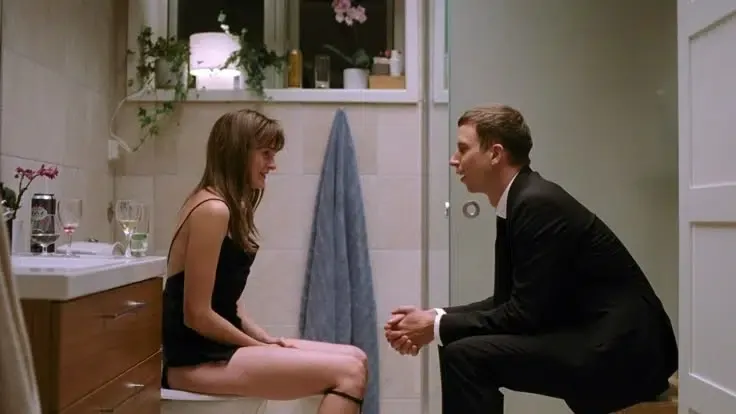
They share laughs, beer and even the bathroom to then say goodbye and feel that at that precise moment time stopped for them.
The relationship with him is easier to handle, both have similar ideals and enjoy being impulsive. They live in the present without thinking about the future.
Aksel and Elvind think about the present and the future by going through ultra sensory paths that lead only to Julie.
The film suggests that love and desire are no longer necessarily tied to life projects. In contemporary Norway - a country with high rates of well-being, gender equality and sexual freedom - relationships can be explored without external pressures, yet such freedom also generates paralyzing anxiety. However, such freedom also generates a paralyzing anxiety: how do we know what we want when we can want anything? What is the right way to love?
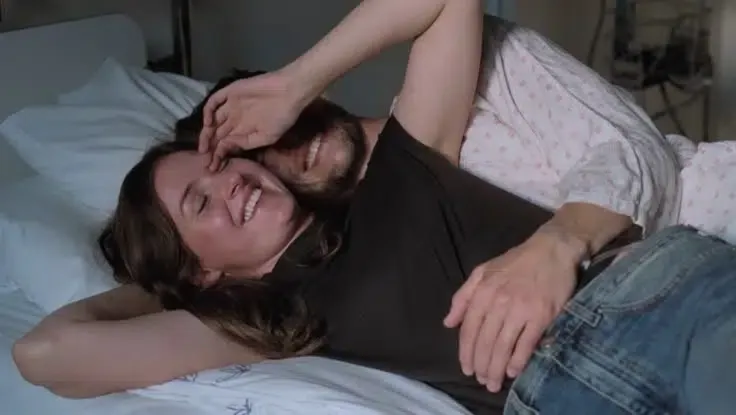
Julie breaks up with Aksel to start a life with her new romance, yet mentally she is still tied to him. But then again, things don't work out the way she imagines and she feels the unconformity of the relationship again.
IV. The sense of the ephemeral and the fear of being forgotten.
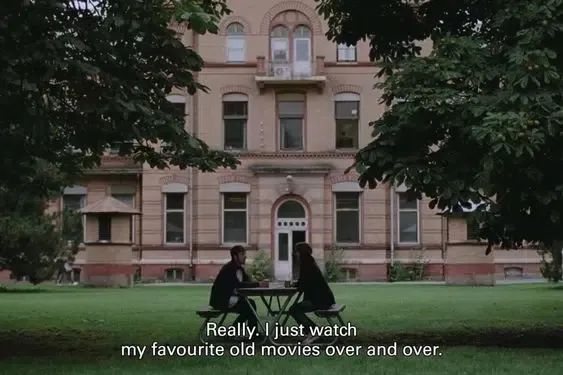
One of the most profound moments in the film begins with Aksel's illness and subsequent death. His dying introduces a reflection on mortality, art and legacy.
While Aksel is afraid of death, his greatest conflict is the fear of disappearing without leaving an authentic trace, becoming oblivion, a shadow that no one sees. He debates how his comics will be forgotten in a culture that is rapidly changing with technological change. There is nothing more frightening than the thought of a future where we will not be remembered as humans, nor will the fruits of our labor be remembered when life comes to an end.
Through Aksel, Trier introduces a subtle critique of contemporary culture - also applicable to Norway - where memory is increasingly replaced by digital immediacy. The present of becomes a photo on Instagram, and the past mere words that the wind murmurs. Aksel's death forces Julie to confront not only the finitude of others, but her own. From then on, Julie begins to make more rooted, less evasive decisions, as when she finally decides to stay alone and have her daughter without a partner.
V. Feminism and choice: freedom or solitude?
Julie is not a victim, nor a heroine. She does not seek to be a model of anything, and therein lies her power. The film avoids moralizing her choices. Trier and Vogt present a woman who chooses, who makes mistakes, who retracts, who desires and contradicts herself. In this sense, the film dialogues with contemporary feminism that advocates the right to female complexity. Julie does not represent an archetype, but a subjectivity in process.
However, at the end of the film, when Julie works as a professional photographer and raises her daughter alone, the question arises: has she found what she was looking for, or has she simply learned to live with doubt? Julie's loneliness is not tragic, but neither is it idyllic. It is, like her life, ambiguous, contradictory and imperfect.
VI. Identity: a journey of discovery
If there is one concept that applies throughout the film, it is Julie's search for identity, getting lost and finding herself a thousand times. Changing careers, changing partners in ideals, starting over.
Through Julie's narrative, it shows how identity is formed and transformed over time.
VII. Contradictions are fine
Julie's uncertainty and ambiguity are natural aspects of life itself, the important thing is to learn from difficult situations, learn to overcome fears, explore our inner self and think that any decision we make will always have two sides.
There is no worse ending than thinking that we are the worst person in the world, or failing that, not having tried.
At the end of the day, life is all about growing up like in a coming of age, learning from your mistakes, questioning everything and wanting to fulfill all your dreams. For me, this movie is an accurate reflection of what it feels like to be about to make a change in our life, to have to make drastic decisions with fear of making mistakes and leaving others because we don't feel comfortable. At the end of the day, that's what life is all about, being a little like Julie and starting a journey to discover yourself.
This movie is available on Amazon prime video.


Comments 11