The Gospel of Sinners: A Cinematic Testament of Faith and Fire
Sociocultural
Let’s decode Sinners’ DNA—uncovering the real folklore, music history, and spiritual truths behind Ryan Coogler’s haunting vision.
Sinners, the latest fever dream from director Ryan Coogler, is here to steal your soul.
Even before the film dropped, I was obsessed with the trailer. Something about it whispered, this one’s different. And turns out. it is. Reviews exploded all over the internet, and they weren’t lying.
With Sinners, Coogler brings us something bold: cinema as culture, cinema as reclamation, cinema as resurrection. Here, horror doesn’t just scare. It remembers.
So yes, this is my third attempt at writing this review (because when your film includes vampires, gangster twins, Irish folk music, and West African rituals, you need time to process). Let’s talk about the themes, the symbols, the music, and the mythologies that make this film pulse like a haunted heart.

Understanding Horror Noir: Memory as Haunting
Before we can fully enter the world of Sinners, we need to understand the genre it belongs to: Horror Noir. This isn’t simply horror with Black characters. It is horror rooted in historical memory, collective trauma and the spiritual and social complexity of Black Identity. It’s not about monsters chasing victims. It’s about systems, beliefs, and inherited pain that follow people across generations.
In Horror Noir, fear is layered. It’s not only the fear of death, it’s the fear of erasure, disconnection, being trapped in a world that was never made for you. It examines how the past is not past, how ghosts live in laws, churches, plantations, prisons, and sometimes even in the language of love and family. The genre reclaims horror from spectacle and returns it to its roots: as a mirror of our deepest cultural anxieties.
Jordan Peele´s Get Out helped reignite mainstream attention to this tradition. His stories expose the invisible mechanisms of oppression, racism, assimilation, the exploitation of Black bodies and minds. But where Peele tends to frame his protagonists as survivors navigating systems designed to consume them, Ryan Coogler, in Sinners, does something more mythic.
Coogler does not position his characters outside history, trying to escape it. Instead, they are symbols shaped by history: prophets, saints, devils, martyrs. They are inhabited by legacies older than America, older than slavery. In Sinners, horror becomes ceremony. It’s not only about confronting fear. It’s about confronting the shape of faith, the violence behind certain traditions, the silence behind certain songs.
The film does not simply evoke terror. It evokes memory. The kind of memory that’s collective. The kind of memory that cannot be erased by time because it lives in the body, in the rituals, in the music. In Sinners, the horror is not that the past returns. It’s that it never left.
Vampires & the Horror of Belief Systems

This film is full of vampires, but not the sexy kind…. These creatures do not seduce; they colonize. They don’t feed on blood for pleasure; they feed on memory and culture. They devour what is sacred. Sinners presents vampirism not as a gothic spectacle, but as a metaphor for something far more insidious: the parasitic systems that survive by draining life from Black identity.
In Sinners, the horror is not external; it is inherited. The most terrifying monsters are belief systems passed down like heirlooms. The vampires don’t possess. They whisper scripture. They ask for obedience, dressed as salvation. Their rituals look sacred, but they are hollow performances meant to postpone true reckoning. They offer redemption that costs your identity.
There is no wooden stake to drive through the heart of these creatures. Because here, the vampire isn’t just a being, it is a structure. It is an ideology that demands silence and punishes difference.
This is where Sinners finds its most profound horror: in the realization that faith can be weaponized. That salvation can be a leash. That music can be turned into mourning. In this world, the devil doesn’t arrive as a shadow in the doorway. He arrives as ritual and repetition. As the belief that suffering is holy, and silence is strength.
The Devil’s Soundtrack

You can’t talk about Sinners without talking about the music, and you certainly can’t talk about the music without thinking about Ludwig Göransson.
The Oscar-winning composer dives straight into the swampy heart of the blues. To do it right, Göransson and director Ryan Coogler didn’t just read a few Wikipedia pages and call it a day. No, they packed their bags, and hit the road through Mississippi, Clarksdale & Memphis. This wasn’t some studio-safe research trip; it was a communion with ghosts. They sat with musicians whose songs come from bone and blood, listened to stories and learned that the blues isn’t just music, it’s a wound that sings.
But Sinners doesn’t stop at American soil. The film pulls its heartbeat from West Africa too, reviving the Sawoli dance: a ritual of rhythm and ancestors. On screen, the dance isn’t just choreography; it’s a rebellion. In Sinners, dance becomes more than performance. It’s a plea to the sky, an exorcism in motion. Sorrow twirls in a smile. Every step dares God to look away.
By the end, the film isn’t just about music. it is music.
The Sacred Myths Behind the Madness

We can agree that Sinners is complex ,not just in style or mood, but in something deeper: a spiritual and symbolic language that spread trough centuries. This is a film built like a tapestry, woven with threads of ancient stories, collective memory, and mythic duality.
More than a horror film, Sinners feels like a cinematic anthology , a blend of many tales passed down through oral tradition and lived experience. It wouldn’t be far-fetched to say that during Ryan Coogler’s research for Black Panther, while submerged in the cultural rivers of African heritage, he found a seed. That seed, nourished by the ghosts of oral histories and folklore, may have grown into what we now witness in Sinners ; A haunting, deeply coded horror.
So I went looking. Through pages, archives, oral retellings, and fragments of stories, I followed the trail and I found echoes. Echoes of the same serpents, gods, and twins who walk through Sinners with blood on their hands and meaning in their steps.
Let’s explore these tales…. the stories that don’t just inspire the movie, but live inside it.
1. The Twins and the Python

Folklore: In Efik mythology (southeastern Nigeria), a pregnant woman meets a sacred python in the forest. The snake spares her life on one condition , she must offer one of her unborn children. After giving birth to twins, she must choose. It’s a tale of divine obligation, sacrifice, and the haunting cost of promises made in fear.
Connection to Sinners:
In Sinners, the snake is more than a creature , it’s a symbol of ancestral debt, of ancient pacts we inherit without consent. The twins in the film carry this weight, as if they were born under the same promise. They don’t just reflect duality , they embody a sacred split, a birthright steeped in mystery.
2. Mawu-Lisa: The Goddess of Cosmic Balance
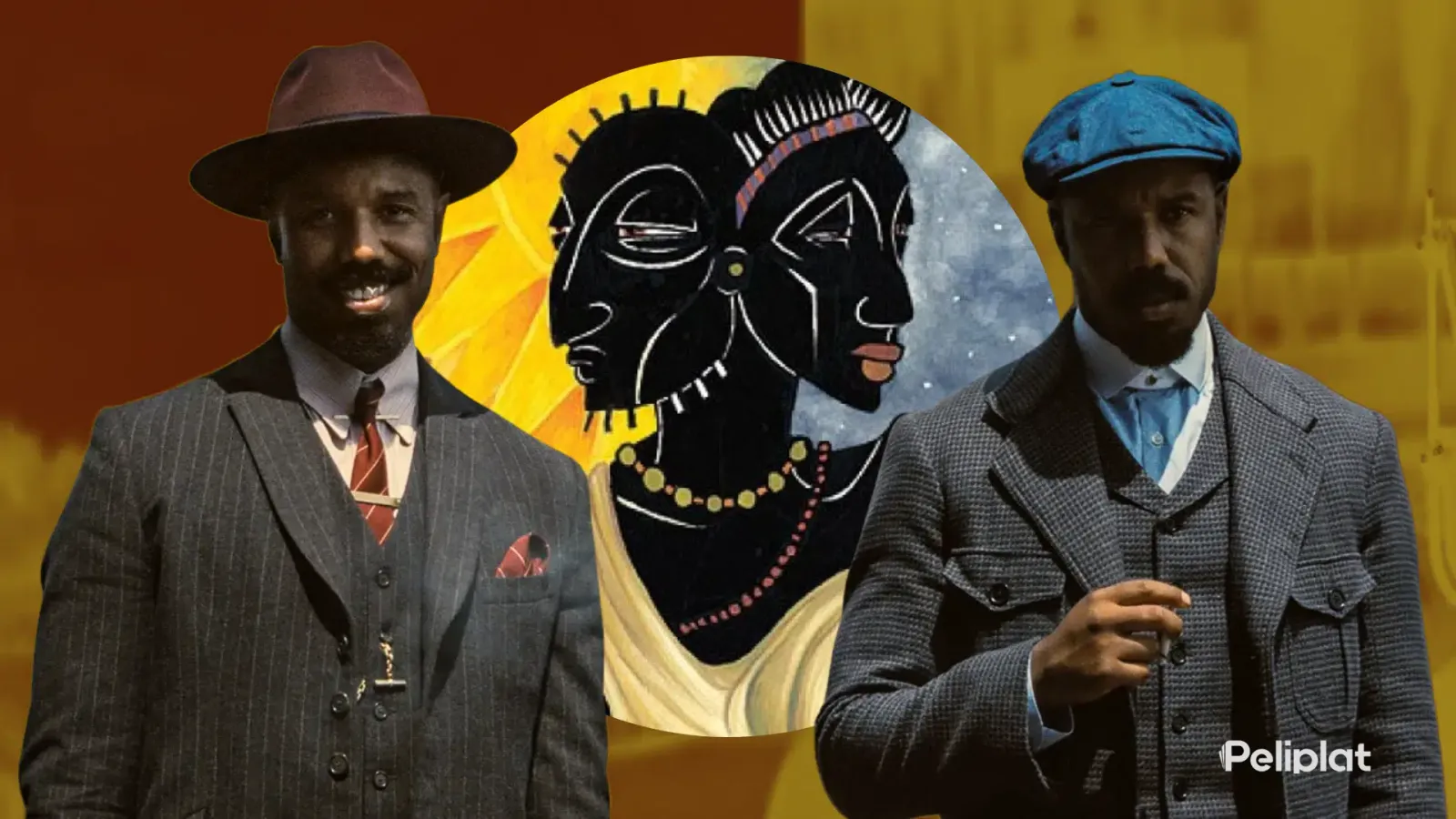
Folklore: In West African cosmology, Mawu and Lisa are divine twins — one female, one male — representing the moon and the sun, night and day, wisdom and strength. They are born of the same essence, forever locked in balance. Mawu-Lisa is a single deity made of opposites, always creating, always correcting.
Connection to Sinners:
Elijah and Elias , Played by Michael B. Jordan , these twins are not mere siblings. They are walking metaphors. One rooted in belief, the other in rebellion. One seeks sacrifice, the other revenge. Together, they become Mawu-Lisa’s shadow ,fractured by trauma, but still linked by divine symmetry. The film becomes an arena where cosmic forces wrestle under mortal skin.
3. The Ibeji: Divine Twins of the Yoruba World

Folklore: In Yoruba religion, twins — or Ibeji — are sacred beings. They are watched over by Shango, god of thunder, and are believed to possess powerful spiritual connections. If one twin dies, a wooden figure (an ere ibeji) is carved in its place, to preserve the spiritual bond. To lose a twin is to unbalance the universe.
Connection to Sinners:
In Sinners, when one twin suffers, the other echoes it. Their bond is spiritual, not just biological. They are cosmic mirrors. Coogler doesn’t just use the Ibeji as a reference, he channels it. Through image, silence, and pain, we watch these characters not as individuals, but as sacred pairs. haunted by the fear of separation, compelled by the duty to restore balance. This isn’t about good vs. evil. It’s about spiritual integrity.
Literary Shadows — August Wilson and the Echoes of the American Stage
While Sinners is rooted in African spiritual mythology, it is also a deeply American film. Not in its patriotism, but in its pain , in the bruised dreams of Black men and women navigating systems that were not made for their survival. To understand Sinners fully, one must look not only to the ancestors in ritual but also to the ancestors in literature. Few writers have chronicled the emotional, spiritual, and generational weight of Black American life with more power than August Wilson.
Wilson’s ten-play “Pittsburgh Cycle” carved a century’s worth of memory into the American stage. His characters ( dreamers, musicians, mothers, conjurers and laborers) often find themselves suspended between survival and salvation, faith and betrayal, remembrance and forgetting. Ryan Coogler, in building the world of Sinners, seems to draw from this well, particularly in his use of confined settings, philosophical monologues, and the metaphorical power of music and inheritance.
Let us look at five literary works that resonate through the bones of this film . Four by Wilson, and one unexpected but fitting horror novella by Victor LaValle.
1. Seven Guitars (1995)

Written by: August Wilson
Summary: A group of friends gathers after the death of Floyd “Schoolboy” Barton, a blues guitarist who had just secured a record deal. The play unfolds through flashbacks, revealing Floyd’s struggles with love, systemic racism, and his dream of making it out.
Connection to Sinners:
The character Sammie Moore , played by Miles Caton, echoes Floyd : A blues guitarist whose ambition is stifled by structural oppression. Coogler positions Sammie as a symbol of both promise and fatalism, underscoring how racism not only limits opportunities, but erodes identity. The guitar, again, is not just an instrument , it’s a vessel of memory and a target of exploitation.
2. The Piano Lesson (1990 Pulitzer Prize Winner)

Written by: August Wilson
Summary: Two siblings fight over a family piano carved with images of their ancestors. The piano is both a burden and a blessing , a symbol of generational trauma and Black artistry.
Connection to Sinners:
In Sinners, the central conflict between the twins Elijah and Elias mirrors this dynamic. Their inheritance isn’t a piano, but a spiritual and economic legacy — one rooted in pain, the other in ambition. Their attempt to open a bar is a gesture toward independence, yet they are forced to question whether the future demands transformation or preservation of the past.
3. Ma Rainey’s Black Bottom (1984)

Written by: August Wilson
Summary: Set in a 1920s recording studio, the play explores the exploitation of Black musicians by white producers. Ma Rainey, a powerful blues singer, fights for artistic control while her bandmates clash over identity and survival.
Connection to Sinners:
Coogler draws on these themes by highlighting how the characters in Sinners. The film critiques how Black culture is often repackaged and sold by systems that disregard its originators. Even in the horror genre, Sinners refuses to separate identity from industry.
4. Joe Turner’s Come and Gone (1984)

Written by: August Wilson
Summary: Set in a boarding house, the play follows Herald Loomis, a man searching for his wife after being illegally enslaved by Joe Turner. The story is a meditation on displacement, spiritual healing, and identity.
Connection to Sinners:
Joe Turner lingers beneath the surface of Sinners, especially in its exploration of memory and captivity. The characters carry trauma in their bodies, their silences, and their rituals. Coogler creates a similar metaphysical space . where past injustices haunt the present, and redemption is not promised, only pursued.
5. The Ballad of Black Tom (2016)

Written by: Victor LaValle
Summary: A reimagining of H.P. Lovecraft’s The Horror at Red Hook, told from the perspective of Charles Thomas Tester, a Black man drawn into occult horror while navigating 1920s Harlem. LaValle transforms Lovecraft’s racism into a framework for reclamation and terror.
Connection to Sinners:
LaValle’s novella and Sinners share a thematic kinship: the horror is not just supernatural . it’s social and historical, systemic. Coogler uses horror not to escape reality, but to expose it.
The Last Song : Robert Johnson and the Price of the Soul
The closing moments of Sinners are more than epilogue.
In the mid-credits sequence, we see an aging Sammie Moore , now portrayed by blues icon Buddy Guy.Time has passed and he has lived. Then, from the shadows, Stack and Mary return, unchanged by time, carrying the cold immortality of the undead. They offer Sammie eternal life but he declines. A gesture of devotion. A choice to remain human.

This moment carries with it the weight of a myth that predates cinema. The story of Robert Johnson, the legendary blues musician who, according to folklore, met the Devil at a crossroads and exchanged his soul for musical genius. Johnson’s story is not directly told in Sinners, but it echoes through the film like a distant chord.

Sammie’s refusal is not just personal. It is spiritual. In a world where survival is offered at the price of one’s essence, he chooses to preserve his soul. He resists the seduction of power, the erasure of suffering, and embraces the full arc of human experience: pain, memory, death. He chooses to remain mortal so that his song remains true.

The film ends with one final note: young sammie, after the bloodshed, playing This Little Light of Mine. A hymn of resistance. A declaration of spirit. A reminder that the blues, born of sorrow and survival, does not come from the devil, it comes from the truth
Mentioned in this piece
 Sinners2025
 The Ballad of Black Tom
 The Piano Lesson2024
 Joe Turner's Come and Gone
 Nope2022
 Get Out2017
 Us2019
 Horror Noire: A History of Black Horror2019
 Jordan Peele
 Ryan Coogler
 Michael B. Jordan
 Ludwig Göransson
 Miles Caton
 Buddy Guy
 Li Jun Li
 Wunmi Mosaku
 Omar Benson Miller
 Delroy Lindo
 Jack O'Connell
 Hailee Steinfeld


Comments 8