A Different Man, the Same Pain
General Reviews
When production began on the teaser for Dangerous, Michael Jackson's eighth studio album, the artist locked himself inside his trailer for nearly an hour, right before the start of what was supposed to be a single take. All they needed was a thirty-second close-up of his face.
The crew, concerned by his erratic behavior, went to check on him. What they got in return was a cold, devastatingly human response:
“When you look into the black of the lens, all you see in that endless darkness is your own face. And that’s terrifying.”
Self-acceptance is the hardest task of all
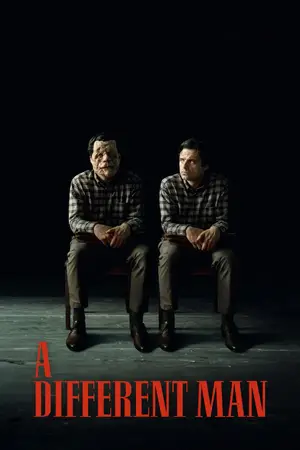
Edward, portrayed by an unrecognizable Sebastian Stan, doesn’t just hate his life - he hates the way he looks. His face, marked by tumors caused by neurofibromatosis, becomes a window into his soul: one etched with pain, loneliness, rejection, and hate - not only toward society, but toward himself.
But everything changes in a heartbeat. His life is radically transformed when he’s offered the chance to try an experimental drug that promises, in heavy quotation marks, to “cure” his condition. Against all expectations - including his own - it works.

His old face dissolves into blood and despair, and with it, Edward dies for good. In his place, a new man is born: Guy Moratz. With a new face comes the promise of a new life - but not necessarily a better one. Because inside, nothing has changed.
This tension - between physical transformation and internal stasis - sits at the very core of Schimberg’s vision. Heavily inspired by films like The Elephant Man (Lynch, 1980), Schimberg delivers a complex, dark, and compelling drama about self-perception, identity, and physical shame. The film poses uncomfortable questions about the idea of the self and its many layers. What do I truly project to the world: what's inside me, or what's on the surface?

Slowly, Guy/Edward begins to realize that many of the struggles from his “former life” stemmed from one brutal truth: the first person who never accepted him…was himself. And this is pushed even further when Oswald (portrayed by Adam Pearson) enters the picture - another man with facial deformities, who forces Guy to confront an even deeper, more disturbing question:
What happens when someone shows up who’s a better version of you…than you?
![Crítica] “A Different Man” (2024): cambios que duelen y nunca sanan - Cinencuentro](https://img.plotcoda.com/u/article/20250513/431af711772263ef69e3f91832d619d9.webp)
The pain of facing the mirror
Through a layered and complex drama, with subtle touches of dark comedy, A Different Man explores deeply human conflicts - ones that are excruciating not because Edward’s face is literally and figuratively falling apart, but because the transformation he undergoes is of a different nature altogether. It’s an emotional, psychological, almost spiritual catharsis - one that forces him to reckon with who he is beyond what he projects into this thing we call reality. He must realize he is more than just a handsome face.
Or, perhaps, just a face.

It’s fascinating to watch Edward’s entire belief system collapse under the weight of the new life he’s chosen to inhabit. His ego, superego, and id are warped to the point of being unrecognizable - not just to the world, but to himself. And in the wreckage, he begins to see that maybe - just maybe - he played a role in the life he once dismissed as a failure. And maybe, after all, that life wasn’t as disastrous as he once thought.
Yet the most painful realizations come not from what he gains, but what he loses. But just as powerful is the pain of watching how, as human beings, we tend to only value what we have once it’s gone. That’s why the film evolves from a story about self-acceptance into something much broader: a reflection on masculinity, identity, and above all, love.
![REVIEW] Un hombre diferente – Cuatro Bastardos](https://img.plotcoda.com/u/article/20250513/a4f883100c9e6cbb0d3aa1b29d7119a1.webp)
It’s not just about “loving your flaws” - the most superficial and overused interpretation. It’s about loving yourself as a complex mixture of physical, emotional, and social conditions that form a persona who is far from perfect, and who doesn’t need to be.
It’s a message that digs deeper than aesthetics or surface-level empowerment. The film’s final message isn’t “love your body, stretch marks and all,” but rather: love yourself in all your dimensions. The parts you show, the ones you hide, and the ones you haven’t dared to explore yet. It’s a call to know ourselves, to challenge and understand who we are, so we can live in harmony - not just with the world, but with ourselves.
Or at least don't hate yourself.

It’s about learning to love the pain. The fear. The numbness. The shame. You don’t have to be some kind of Übermensch, or the next TV icon. You’re already being the best possible version of yourself, building dreams brick by brick - and that’s more than enough, as long as it brings you peace. Just as Edward was doing.
And Schimberg captures this bittersweet truth with haunting precision. All of this comes full circle in that magnificent final shot of Guy, his face soft with a pale smile, listening as his old friend - who hasn’t seen him in years - says: “You haven’t changed a bit.”

Even after all that time, and a few crimes along the way, the film makes one thing crystal clear: Edward and Guy claim to be different, but have always been the same man, from the first frame to the last. Because no matter how much we change on the outside, there’s no experimental drug in the world that can rewrite what’s inside us.
A labor of love for cinema
Schimberg’s film marks not only a significant step forward in his still-budding career as a director, but also serves as the perfect showcase for his cast - each of whom masterfully navigates the film’s tonal shifts between drama and comedy, revealing a striking range of emotional depth and versatility.

As a curious fact, the chemistry between Pearson and Stan isn’t just good casting - it’s genuine. The two actors have been close friends for years, though this marks their first time sharing the screen as co-leads.
Sebastian Stan proves here that he’s far more than just the latest superhero on the assembly line. But it’s Pearson who truly steals the show. His raw, deeply human performance has earned him the lead role in the upcoming remake of The Elephant Man, currently in pre-production - a move that will no doubt propel his acting career in a powerful new direction.

One review site jokingly noted that 2024 was “the year of pharmaceutical body horror,” and while inevitable comparisons to The Substance (Fargeat, 2024) have surfaced, Schimberg’s film - despite premiering months earlier - feels like a more emotionally resonant and artistically daring leap forward for contemporary cinema.
A Different Man is a compelling work that forces us to reflect on identity, human connection, and the labyrinth of our own psyches - all through the lens of purpose and meaning. Because, as the film quietly suggests…

“All unhappiness in life comes from not accepting reality.”







Comments 2