'I'm Still Here': Face Hardship With A Smile
Directing
Brazilian director Walter Salles is the first filmmaker in Oscar history to have been nominated for both Best Foreign Language Film and Best International Feature Film. The former was for his 1998 film "Central Station," which narrowly lost to the Italian film "Life is Beautiful"; the latter was awarded to "I'm Still Here" this year.

Of course, the Academy only renamed the Best Foreign Language Film category to Best International Feature Film in 2020, so it's only a matter of time before Salles' rather unremarkable record is surpassed. Before the category's renaming, several European film masters of the last century had won Best Foreign Language Film multiple times—not just nominations. Italy's Vittorio De Sica won twice, his fellow countryman Federico Fellini four times, and Sweden's Ingmar Bergman three times.
Similar to "Central Station," "I'm Still Here" is a drama centered on an ordinary woman from the director's hometown of Rio de Janeiro, celebrating her noble character. However, compared to the tear-jerking and touching "Central Station," it adopts a more restrained approach in expressing emotions during family upheavals. The character development emphasizes a realistic, non-dramatic authenticity, and the narrative techniques are more refined—making it truly deserving of the Best International Feature Film honor.
The protagonist of "I'm Still Here," Eunice Paive, comes from boisterous yet harmonious middle-class family. She and her husband, a former congressman, have four daughters and a son, and they live in Rio's wealthiest neighborhood, Leblon. Just a street away from their home lies a golden stretch of sand where one can play beach soccer against the backdrop of Sugarloaf Mountain and the blue sea. This area also boasts the most expensive real estate in all of Latin America. Meanwhile, they're busy renovating a large country house, a testament to their affluent lifestyle.

However, a tumultuous era doesn't necessarily guarantee the permanence of their prosperous life, and even their personal safety becomes a concern. In 1964, Brazilian military forces, backed by the United States, overthrew President João Goulart, initiating a 21-year military dictatorship. The patriarch of the Paiva family, Rubens—both a character in the film and a real historical figure—fled abroad in 1964 and didn't return to Rio until 1970. Although he seemed to have fully returned to his former profession as a civil engineer, his apparent withdrawal from politics didn't mean the military dictatorship would forget his status as an important figure of the previous regime.
At the beginning of the film, the contrast between the family's cheerful, carefree life and the unsettling news from the outside world is effectively established. In news on TV, the Swiss ambassador to Brazil has been kidnapped by armed guerrillas demanding the release of their imprisoned comrades in exchange for their hostage. Meanwhile, the eldest daughter, Veroca, is pulled over and searched by military police officers while joyriding with friends with a home video camera. Back home, Veroca complains about the terrifying situation, relieved that she had managed to evade her aggressors because one of her friends had his father's lawyer ID in the car. Eunice playfully quips, "It's good to have a lawyer in the family." On the other hand, Rubens casually wonders why an old friend, a bookstore owner, insists on moving his entire family to London. When asked by Eunice about his intention to relocate, he says, "[He's] paranoid, thinks he's being watched." Unexpectedly, surveillance, arrests, and even disappearances soon come crashing down on his own family.
During my long grand tour through South America in 2016, I traveled through Brazil for over a month. I remember reading in Lonely Planet's introduction of the small town of São João del-Rei in the state of Minas Gerais. Tancredo Neves was born there, and he became the first democratically elected president after the end of the military dictatorship in 1985. Unfortunately, he died of a sudden illness before he could officially take office. The travel guide went on to comment, "At least this president helped end what was perhaps the 'most gentle and least organized' military dictatorship in history." The surrounding context of this remark spoke to the famously optimistic, live-in-the-moment nature of Brazilians.
Perhaps because Brazilians are indeed so joyous by nature, their military dictatorship never seems as sinister or terrifying in literature or film as those of their neighbors Argentina and Chile. However, "I'm Still Here" powerfully conveys the chilling and oppressive atmosphere when Eunice and one of her daughters are taken to a military camp for "assistance in investigation." Blindfolded, they have no idea where they're being taken. The dim, never-extinguished lights of the prison cells, where natural light cannot enter, make time itself feel uncertain. Different investigators, skilled in interrogation tactics, steadily erode the psychological defenses of those forced into captivity on the other end of the table.
After all, this was a 21-year-long military dictatorship that led to the deaths and disappearances of 434 people and subjected 20,000 more to torture. It's unimaginable that Brazilians affected by this dark period could have endured it entirely with the carefree spirit of samba.

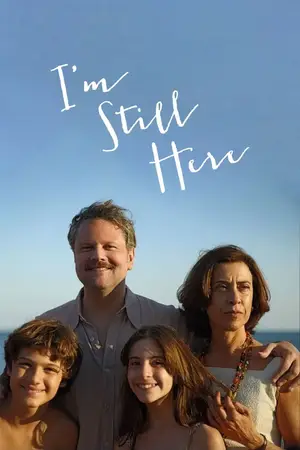
However, Salles still chose to let his characters face hardship with a smile. Four group photos taken at different points in time define the tone of "I'm Still Here."
The first photo is from January 1971, the family's last picture together before Ruben's disappearance. Gathered on Leblon Beach, they smile brightly for the camera. In front of them , armored vehicles rumble along Delfim Moreira Avenue.
The second photo comes after Eunice and her daughter return from the military camp. They're interviewed by a magazine courageous enough to report on the issue of the disappeared. The editor hopes for a more somber, even sorrowful expression from them, but Eunice refuses, insisting that she and her family smile for the camera.
The third photo is from 1996. By this time, Eunice has moved to São Paulo and works as an advocate for Indigenous rights. She finally receives an official death certificate for her husband, and with a sense of closure, she smiles for a picture with her son and daughter who've come to visit.
The fourth and final photo is from a family reunion in 2014. That year, five military officers were finally indicted for torturing and killing Rubens. At 84, Eunice is in the advanced stages of Alzheimer's disease, and she wears a vacant expression. Yet when she faces the camera with her children, she breaks into a radiant smile. This is also the final shot of the film.






Comments 2