Fight Club: The Social Critique That Became a Warning
General Reviews
By: Fernando Ramírez Vanegas
Within the vast and extensive mental library of my cinematic memories, I hold onto incredible gems that are hard to forget. If I were to discuss all of them in this article, there wouldn’t be enough space, and I’d still fall short of saying everything I need to. Today, however, I want to talk about movies that transcend mere entertainment and become pieces of cultural and psychological analysis. In some cases, they even serve as warnings, as is the case with Fight Club (1999), directed by David Fincher and based on the novel by Chuck Palahniuk.
This film challenges viewers to question identity, purpose, and the social structures around them. What’s truly fascinating, however, is how this work can be interpreted in such varied and polarizing ways. For many, Fight Club represents rebellion against consumerism an invitation to break free from the constraints and moral constructs of modern society. For others, especially those who carefully examine its hidden messages, this film can be a genuine “red flag.” And don’t get me wrong not because it’s bad or shallow, but because it reveals problematic aspects when it becomes the favorite of someone who idolizes Tyler Durden, the character embodying the most subversive philosophy in the film.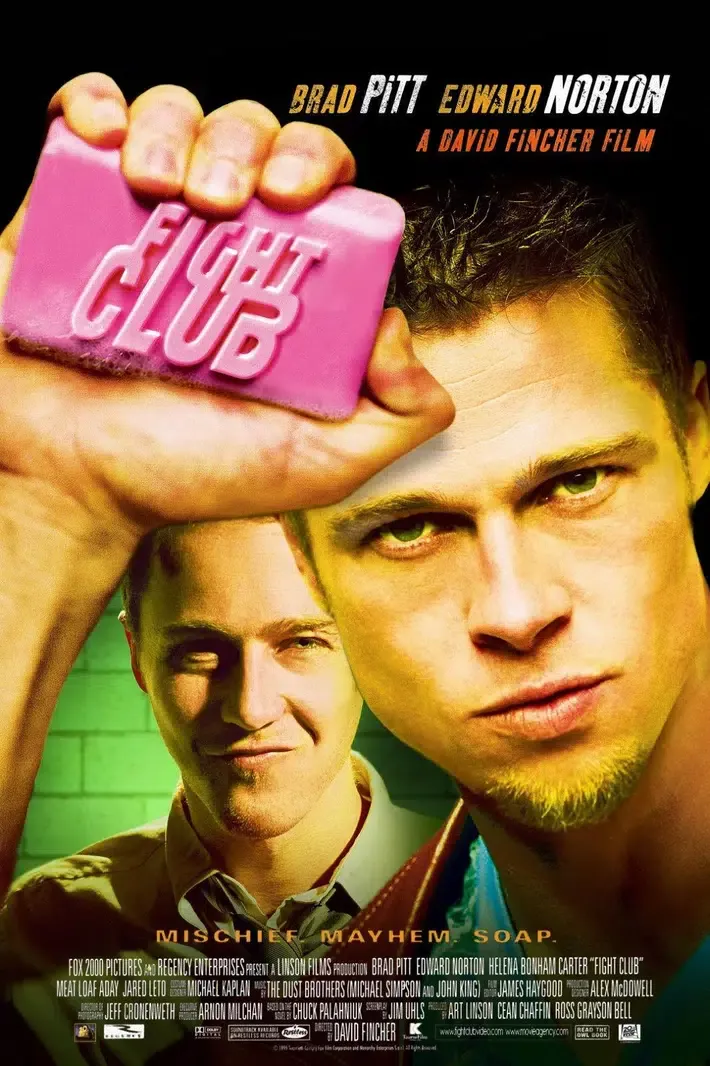
So, Who Exactly Is Tyler Durden? Tyler Durden is the personification of chaos. From the moment he appears on screen, Tyler captures the viewer’s attention with his libertarian style and sharp nihilistic rhetoric. Tyler is the epitome of anarchy in its purest form: he has no fear, no attachments, and no limits. He isn’t bound by ethical or moral values; his attitude is a mix of mockery and satire toward societal laws. He challenges the status quo, becoming the voice and spark for all the outcasts and misfits who scream against office jobs, endless bills, and the idea that your worth as a person is defined by the possessions you own.
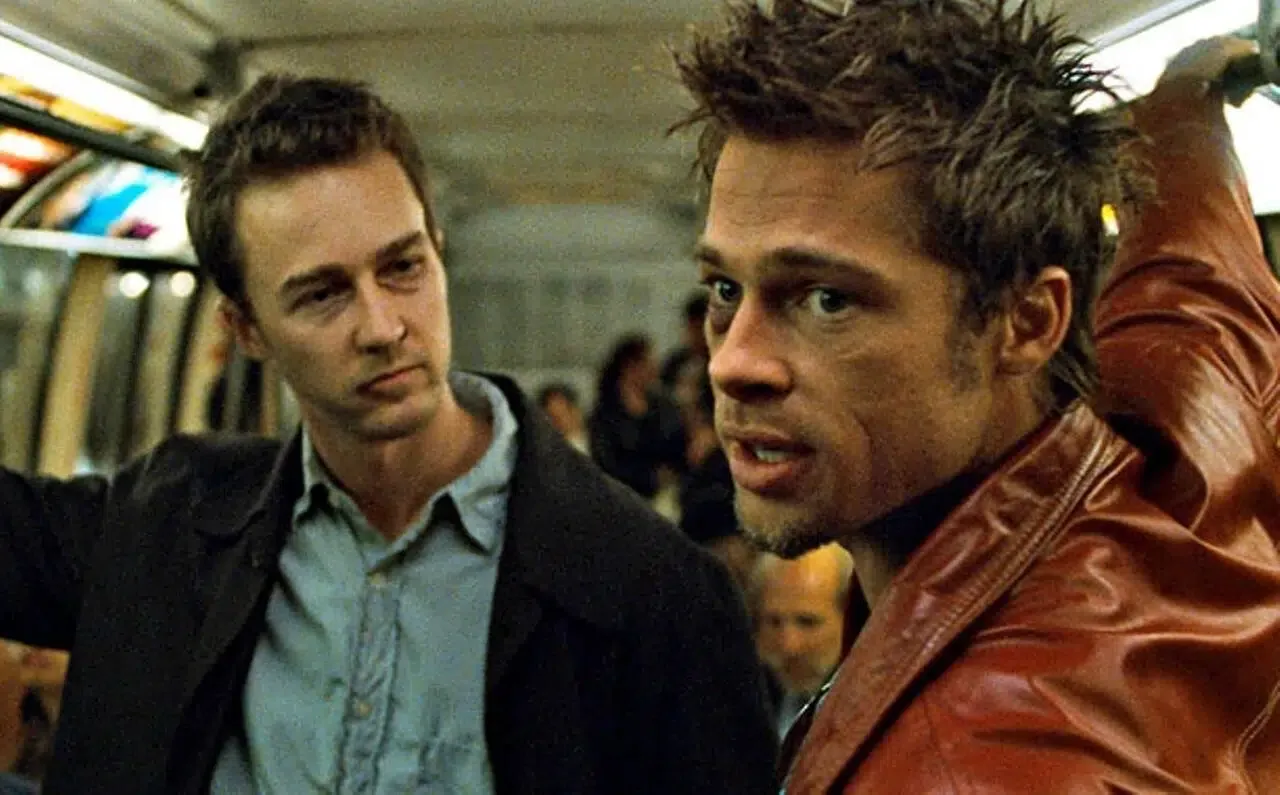
However, Tyler doesn’t seek positive transformation he seeks total destruction. His nihilistic philosophy, though initially enticing, falls apart under closer scrutiny. Tyler isn’t concerned with building something better; he only wants to burn down what exists.
In contrast, we have the Narrator, whose name we never learn. He’s the true protagonist a man trapped in an empty, suffocating existence, stifled by a monotonous job and disconnected from his emotions. Plagued by insomnia, he attends support groups to fill his existential void, which he further tries to compensate for by buying catalog furniture and things he doesn’t really need. Tyler isn’t a friend or a mentor; he’s the Narrator’s alter ego, a manifestation of his repressed anger and his desire to escape monotony.

This conflict between the Narrator and Tyler’s duality is what sets off alarms. The Narrator represents the desire to find meaning and authenticity in a world full of consumerism and stereotypes. Yet, in his search, he falls into extremes and excesses.
The film’s narrative raises a troubling premise: What happens when our inner struggles take control? How much of ourselves are we willing to sacrifice to feel free?
The work itself is just that a work of art. The creator isn’t to blame if the message of the film is misinterpreted. However, we can’t ignore that some viewers glorify Tyler Durden without understanding his complexity. Idolizing Tyler is dangerous because he represents toxic masculinity disguised as freedom. His disdain for norms and his rhetoric of “It’s only after we’ve lost everything that we’re free to do anything” can lead some to justify destructive behaviors toward themselves or others.
If we approach the film with coherent judgment and analysis, we can see that Fight Club is a warning. However, when someone treats it as a life manual, that’s when the red flag arises. The movie demonstrates the danger of letting our most basic and irrational instincts take control. Its message isn’t about destroying the world but about accepting our dualities and finding ways to coexist with them.

When someone tells me that Fight Club is their favorite movie, I don’t make a snap judgment about whether that’s good or bad, but I do pause. I want to know why they like it. If they love it for its message of liberation and self-acceptance, that’s great. But if they glorify the film because they see Tyler as a hero, that’s cause for concern. Tyler is a warning, not a role model.
To conclude this analysis, I’d say that Fight Club teaches us that true freedom doesn’t come from destroying everything but from confronting ourselves. We don’t need to eliminate anything within us but rather understand our place in the world to make it a better place. This is exactly what the Narrator learned when he faced himself. It’s not about running away or destroying; it’s about finding purpose beyond chaos.
And if that’s not a message worth reflecting on, I don’t know what is. What I do know is that life isn’t about how many turns the world takes, the brand-name jeans or shirts you wear, or misinterpreting the message of a brilliant movie like Fight Club. Life is about learning about yourself, avoiding the wrong red flags, and at the end of the day, knowing you can enjoy a good movie that inspires growth and new concepts. Appreciate the imagination and psyche of the creator of such a marvelous work as Fight Club.




Comments 69
Para mí, El Club de la Pelea es una película extraordinaria, tanto en términos de cinematografía como de significado. Ofrece una reflexión profunda sobre la prisión de lo establecido y la violencia como una posible consecuencia de la represión emocional. Pero esa es solo mi interpretación, al igual que tú tienes la tuya y un psicópata podría tener una completamente distinta.
A lo que voy es que una persona con tendencias violentas, rasgos psicopáticos, falta de empatía o traumas profundos puede verse influenciada por casi cualquier cosa. Por ejemplo, la película favorita de Ted Bundy era El Mago de Oz, y Jeffrey Dahmer era fanático de Star Wars, dos títulos que difícilmente consideraríamos red flags.
En definitiva, todo es contextual y depende del punto de vista desde el que se analice. Te dejo mi like, saludos!
Me gustó mucho tu análisis.