Embarking on a journey after watching 'The Journey'
Sociocultural
Life isn't a journey. When you eventually reach your travel destination and starts staying there, the imaginations and images of that far-off place, once shaped by travel guides and movie stories, are never the same again. For example, in my teens, I imagined Buenos Aires, the capital of Argentina, where I now work and live, as a place where flying confetti and loud cheers fill La Boca and the River Plate Stadium, a place with hidden taverns that offer restrainedly lustful tango dance performances, a place with the world's widest avenue called Avenida 9 de Julio that spans 18 lanes, and a place where scenes with boats navigating flooded streets and people walking backwards in dilapidated theaters shrouded in mist from movies like "The Journey" (1992) and "Clouds" (1998) were filmed.
But once the daily grind of life begins, the perception of magical realism that defines the Latin American continent fades. Work, leisure, entertainment, sports, and the troubles and gossip that come with them are pretty much the same everywhere. The magic stays confined to news stories that are far removed from everyday life: large-scale protests at the Congress Square, plainclothes female officers drawing guns to fight off robbers, or the dismissal of the deputy sports minister by the president's office for demanding an apology from the Argentina Football Association over Enzo Fernández's racist incident. However, such "daily exceptions" in the news are presented in different magical ways in different places around the world. For me, the culture shock lies only in the fact that, contrary to the East Asian region where I had lived for many years, the cost-effectiveness of material and spiritual sustenance in Argentina is completely reversed. Food and clothing are expensive and continuously soaring in price, while performances, theater, and movies are extremely cheap but of high quality.
And as it happens, I am a literary youth whose spiritual needs far exceed material needs. The country's financial system for living and entertainment fits me just right.

Once upon a time, I was a professional traveler whose desire to be constantly on the road far outweighed that of being a lazy homebody. During the 10 years when I was unemployed, I traveled to over 100 countries, partly because I was inspired by an Argentine film mentioned earlier, "The Journey." It was directed by Fernando Solanas, an advocate of the "Third Cinema" concept who once served as a senator and even ran for president.
The first time I watched "The Journey" was during my college days, in an audio-visual store next to the campus. The store owner and I silently and intently watched young Martín on the TV screen as he ran away from his home in Ushuaia (at the world's southern end) and rode his bicycle across the South American continent to find his biological father who illustrated this magical piece of land in comics.
I quickly bought the DVD home and watched it many times. The scenes of young Martín traveling through the Latin American regions are unforgettable to this day, including the Patagonian plateau (sold by the government to pay off foreign debts), the almost flooded Buenos Aires, the Bolivian highland desert that turned into a toxic waste dump, and the Brazilian gold mines that spiraled into a bottomless pit. I also remember the deliberately exaggerated images of passerby characters, including the "flawed" Latin Americans who are always driving big trucks, the ship captain who comes from the Chilean side of Tierra del Fuego, Tito who lives in a slum and continuously hits the drums to incite a “noisy war”, the Argentine president "Dr. Frog" who calls on people to swim hard for the country, the Peruvian Indians who bear 4.95 kg of foreign debt, and the rampant Colombian crime syndicates. Solanas even designed a heads of state conference where all attendees have to be on their knees and made the presidents of different nations play a "kneeling tennis match," as loud announcements are made on TV and radio, declaring that kneeling is the only way to ensure one's safety under current circumstances in the continent because standing straight risks getting hit by a bullet while lying down proves that one is already dead. However, after the tennis match, the only one able to stand and walk is the American president, "Mr. Jackal."
These metaphors couldn't be more direct and clear. Later, I learned that the film was made in the early 1990s, during the early years of former Argentine president Carlos Menem's term in office. He drastically changed the Justicialist Party's, as well as Peronism-driven economic's intervention policies, vigorously promoted right-wing neoliberal market economics, and improved and strengthened the country's relations with the United States. This led to the large-scale privatization of Argentine public assets. Obviously, as a firm believer in social justice and staunch Peronist, Solanas was very critical of Menem's shift, which is reflected in the film's depiction of the act of fawning over the United States.

Beyond the straightforward political metaphors, this film is also emotionally rich. Much like Che Guevara's "The Motorcycle Diaries," Martín's cycling journey sees his eager anticipation of finding his father gradually give way to a deep sympathy for the people of Latin America. The silent girl in red, whom Martín encounters three times, remains a mysterious presence. Each time Martín sees her, he asks her where she is from, what her name is, and why she doesn't speak. If we consider this ethereal girl as a projection of Martín himself, then he is engaging in a form of existential questioning and seeking answers to the most fundamental questions of humanity: "Where do I come from?", "Who am I?", and "What am I doing?".
"The first thing God created was the journey, then came doubt, and nostalgia," said Greek film master Theo Angelopoulos in his renowned film "Ulysses' Gaze" (1995), which he used as a philosophical motif.
During Martín's journey, he certainly experiences doubt. As for homesickness, I didn't perceive it in "The Journey."
Many years later, I, too, got on a journey after watching "The Journey." As a restless martlet, or perhaps because I'm absolutely certain that I always have a decent hometown to return to, I rarely feel homesick.

In 2016, I embarked on my grandest journey to date. After a month of driving through the stunning landscapes of the American Southwest, I flew to Cartagena, a famous Colombian city on the Caribbean coast. As the most important port during the Spanish colonial period and the setting of García Márquez's masterpiece "Love in the Time of Cholera," it was the perfect starting point for my journey. Fueled by a desire for exploration which is further ignited by magical realism, I traveled clockwise through Colombia, Brazil, Argentina, Chile, Bolivia, Peru, Ecuador, and Panama for nearly half a year. This journey fulfilled some of my imaginations and changed some prejudices I had.
Summing up the "Follow in the Footsteps of Pablo Escobar" tour in Medellín, my guide said, "You may think we Latin Americans are full of dark humor, or, more sophisticatedly, magical realism. Or you might have been misled by the media into believing that Escobar was some kind of Robin Hood who robbed the rich to help the poor. To tell you the truth, growing up in a city riddled with gunfights and surviving till now is a f*cking nightmare!" Just then, a thunderclap rumbled across the sky.
That year, on the last day of June, I arrived at Martín's hometown. While exploring the Maritime Museum, which was once a prison facility, in the afternoon, I realized it was Martín's school. In the movie, portraits of historical greats hung along the dark corridors of this large old building constantly fall off the walls, and the statue of a general in the public square outside is blown away by the wind.
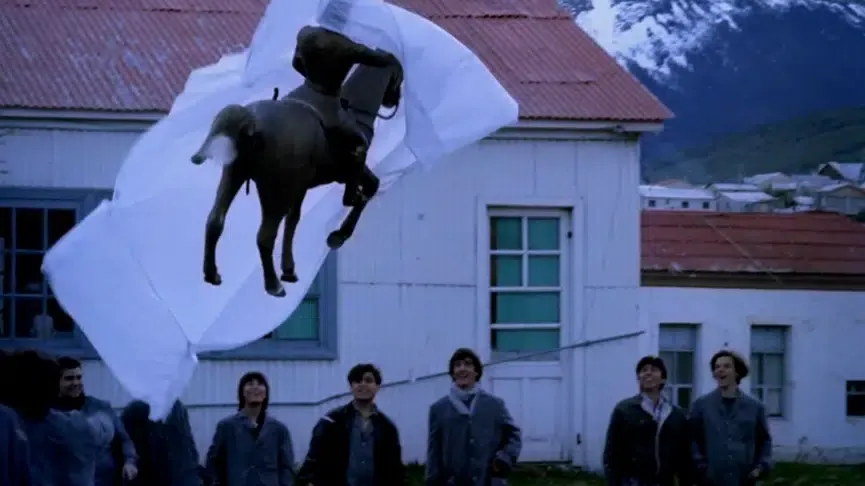
People on this magical continent are probably like paper-mache statues that disappear with the wind. I remember hearing about an entire village vanishing overnight during the civil war in El Salvador when I was there, much like the town of Macondo in "One Hundred Years of Solitude."
Of course, life isn't a journey, nor is it a movie. Life is more like a solid statue. The obelisk on Avenida 9 de Julio stands firmly, and no matter how terrible inflation got, Argentinians proudly celebrated their nation's three-time championship around this landmark. I hope all these robust elements that exude confidence will never be swept away by the wind like the general's statue.





Comments 0
No comments yet.