'Am I OK?': The Power of Lesbian Roles in Cinema
General Reviews
After "Madame Web" flopped, Dakota Johnson quickly moved on to promote her next film. She did the right thing. If "Madame Web" was a box office disaster, "Am I OK?" is the rescue team that pulls her out of the ruins.

In my eyes, Johnson is a very gentle woman. She exudes an unconventional kind of sexiness with her innocent, fragile, and frank demeanor. Upon greater scrutiny, she looks mesmerizing, but not in an ostentatious or overbearing manner. She is the woman that female audiences fantasize about becoming. Whether in "Fifty Shades Freed" or "Suspiria," this characteristic of hers has been patently highlighted. I don't know if men find her charming, but during my teenage years, I, a heteronormative woman, dreamt about becoming like her—a great beauty who doesn't fully know how attractive she is.

The limitation of such a role is that she always exists as a target of desire projection. Many of Johnson's romantic movies focus on bountiful displays of lust or cheesy flirting. She is often forced into one-note roles, which capture only a single aspect of her roles' personalities. This deprives her of the chance to explore the different sides of her characters. Therefore, her acting is restricted to the stereotypical behavior of a stunning woman who always tilts her head up to look innocently at others while subconsciously biting her lips in the hope of being loved.
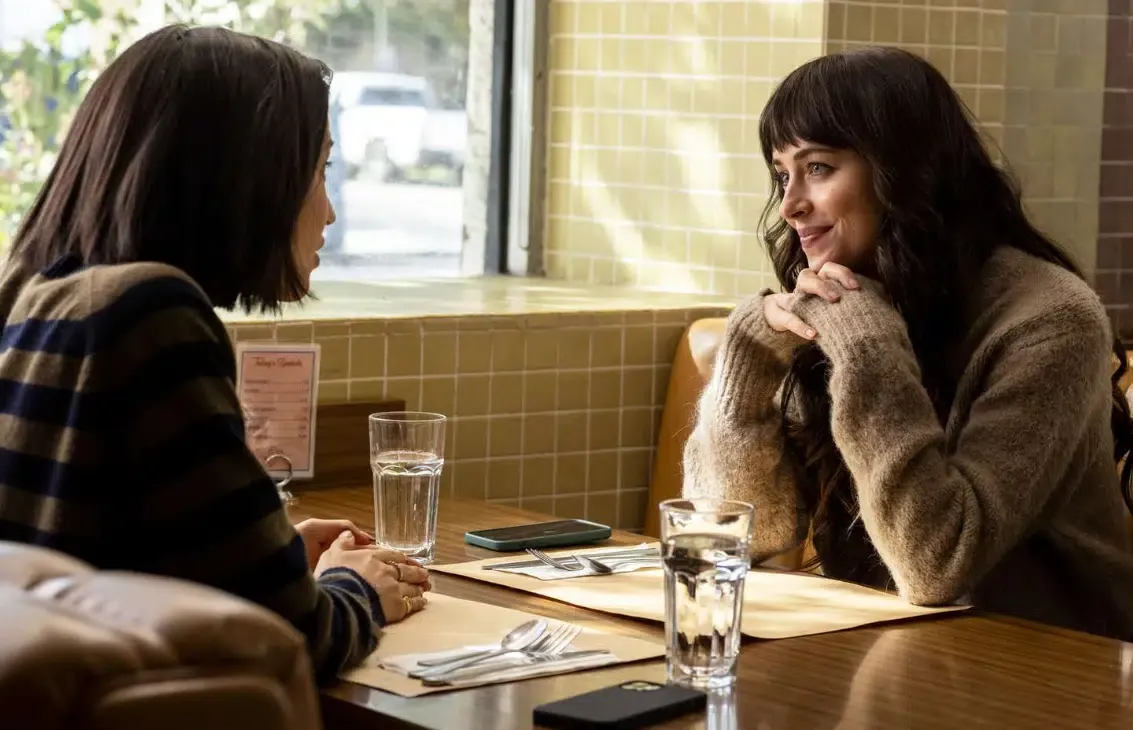
But in "Am I OK?", Johnson feels somewhat different. In this movie, she plays a 32-year-old woman, Lucy, who realizes that she might be a lesbian. But the focus of the story is not on how she finds a like-minded girlfriend, but on her coming-out process, where she is accompanied by her best friend.

Although I can't empathize with her coming-out experience, her attitude toward friendship and self-exploration resonates with me. This is especially so when she lies in bed with her best friend and talks about her inner fears. For the first time, Johnson isn't a sexy goddess but an ordinary girl like me. Most times, I feel comfortable in my own skin. But at certain moments, I can't help but panic over the differences between myself and the "normal" people around me. Her vulnerability, confusion, and hesitation stem from uncertainties about her identity and future, not from love or a crush. In other words, the theme of this movie is, in fact, female self-growth and friendship, rather than romance. Johnson appears very natural in the movie and truly portrays an ordinary girl. She doesn't need to go nude, show fear, or seduce anyone.
I believe such a movie that captures an abundance of the different facets of life and psychological details cannot be pulled by the screenwriter out of thin air. Relevant reports confirmed my guess. Directed by stand-up comedian-cum-actress Tig Notaro and her wife, Stephanie Allynne, who is also an actress, "Am I OK?" is based on the real-life coming out story of the film's screenwriter, Lauren Pomerantz. In an interview with Entertainment Weekly, Pomerantz noted that the story depicts her real-life friendship with her best friend Jessica Elbaum, who serves as a producer in the movie.
It can be said that "Am I OK?" is a film by a lesbian screenwriter, director, and producer. This movie explores and showcases Johnson's acting skills in an unprecedented way. It makes me wonder if playing a lesbian is a new way for actresses to prove their prowess.
Apart from Johnson, other actresses such as Cate Blanchett, Rachel McAdams, Rachel Weisz, Kate Winslet, and Saoirse Ronan have also been featured in lesbian movies over the years, though they themselves haven't come out as lesbians. Frankly, their acting skills are already outstanding, and their excellent performances in these movies contributed to their overall good reviews. I think this is a trend in the development of queer cinema, but my lesbian friends sometimes complain that lesbian stories should feature out-and-proud lesbian actresses instead. Is playing a lesbian really the way to validate a heteronormative actress' acting skills?
I think what Johnson says makes sense. "Playing someone unlike yourself" is indeed a challenge in acting. However, I believe that regardless of their own sexual orientation, actresses participating in queer movies and playing lesbians can be a good opportunity to showcase themselves. This is not only because queer cinema is a developing trend, but also because such roles can liberate female characters from heterosexual relationships, giving them more plots that reflect their subjectivity, thus offering female roles more room for character development than before.
Take Johnson as an example. When she is placed in a heterosexual relationship in a movie, she is always that party who is gazed upon. She is always assumed to be an object of love, and her love story always has a perfect ending. All her actions stem from a certain desire for recognition. But in "Am I OK?", she doesn't have a special love interest, and the film doesn't deliberately depict her dating women after coming out. After all, the focus is not on whether Lucy finds a lover, is loved by her partner, or gains recognition and gets praised in her love relationship.

The story ends with her having a renewed understanding of herself and starting a new way of life, which brings her closer to her "true" self. She is the absolute protagonist of the story, as she exists for no one but herself. This is also why I believe lesbian films can give actresses more space to perform. They go beyond just being lovely objects to becoming the subject of love. They can choose to either love a particular woman or some women, or not to project their love onto anyone and simply be themselves.
I enjoy watching such female characters, as much as I like those movies that highlight female subjectivity. Playing a lesbian might be a shortcut to possessing subjectivity, but it's not the only way to do so. Are there other roles that can give actresses greater space to perform? That is another topic worth discussing.




Comments 1