Why Does "Saltburn" Keep Showing Naked Male Bodies ?
Sociocultural
"I feel sick."
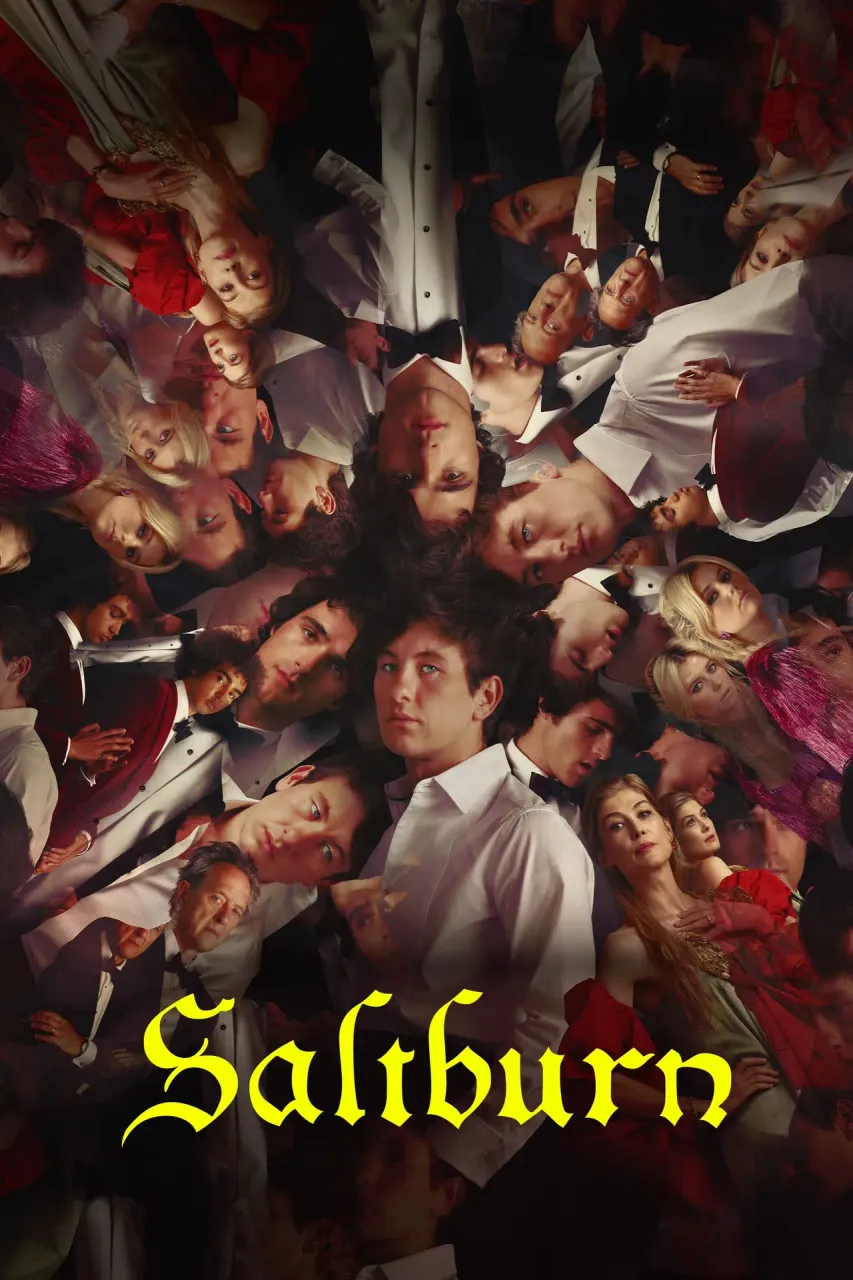
That's what I and a few of my girl friends all agreed on after watching Saltburn. After delving deeply into the source of my discomfort, I realized that it isn't because of the scene where the main character Oliver (Barry Keoghan) secretly drinks Felix's (Jacob Elordi) bathwater or his weird behavior at the graveyard that got the viewers talking. It is actually due to the way the whole movie is told and the associations it draws. I even think its director, Emerald Fennell, deliberately wants me and all other viewers to feel this way. So, what's so special about the way Saltburn tells its story? What has it shown me ultimately? And, most importantly, why did the director choose to tell the story this way? But before I get into all that, let's briefly check out Fennell's first movie, Promising Young Woman.

Just like Saltburn, Promising Young Woman was also directed and written by Fennell, with Carey Mulligan playing the main character Cassandra. She pretends to be an easy target and hunts down guys who prey on her. In the end, through methods of self-sacrifice, she gets payback on the culprits who sexually assaulted her friend (who committed suicide). This kind of story about a woman seeking revenge is undoubtedly even more important in the #MeToo era. The most thrilling part of the movie is when Cassandra goes from being a disguised target to being the executor and avenger. But after all the excitement, Cassandra’s death constantly reminds us that similar to this female character in the movie, we're up against a really powerful and seemingly indomitable masculine society in reality.
Promising Young Woman, with its extremely vivid portrayal of the female perspective, is a film that we cannot ignore; at the same time, its director has left an imprint on us as well. That's why I was surprised at first when I saw the story of Saltburn being told from Oliver's point of view and when the important relationships of movie characters are between men. But as I tried to understand the whole movie and the motives of its creators, I realized that these are necessary.
Saltburn is not a modern equivalent of The Talented Mr. Ripley
When I was checking out Saltburn, I was naturally reminded of The Talented Mr. Ripley. Oliver in Saltburn is just like Tom in that movie, you know, scheming and ambitious. Both films show how they exhaust all means to transform from nobodies to members of the upper class. And get this: Oliver and Tom both have rich heirs born with silver spoons in their mouths by their side. These fancy dudes are not only loaded but also extremely charismatic, which effortlessly makes them the life of the party. But guess what? In the end, they get preyed on and violently murdered by Oliver and Tom. Both stories wrap up with these two ambitious folks coming out on top. So basically, Saltburn seems like a modern version of The Talented Mr. Ripley.
But wait, the whole storyline of ambitious people doing whatever it takes to reach the top is nothing new, and it's not even the most unique thing about Saltburn. At the very most, this movie cranks up the harsh reality of survival in this world. In my opinion, compared to The Talented Mr. Ripley, the most standout thing about Saltburn is how Oliver, an unknown guy, is totally into Felix, the rich heir, not simply for Felix's wealth. Instead, Felix becomes a target for Oliver to fulfill his sexual desires. In The Talented Mr. Ripley, the allusion to the sexual relationship between Tom and Dickie is kinda subtle. But after you understand the relationships between the male characters in Saltburn, it's crystal clear that Fennell is carrying on with the theme she started in Promising Young Woman, which is all about men being preyed on. And to take it even further, Fennell turns them into objects of desire in this film, when usually it's the ladies who get this role.

There are no same-sex romantic relationships in Saltburn
Although Saltburn has some explicit hints and scenes of same-sex love, and its creators mentioned that the story of the film draws inspiration from Evelyn Waugh's Brideshead Revisited, I still find it hard to see it as a film about romantic relationships between men. The reason is that Saltburn portrays same-sex love not to show the pain or beauty of love, but to promote the sexual objectification of men. Plus, all scenes involving same-sex love or the display of male bodies in Saltburn serves to make men subjects of the male gaze that are being checked out and objectified.
Whether it's the character designs in the film or the actual traits of the actors themselves, the contrast between Oliver's normalcy and the suaveness of Felix, played by Elordi, who is referred to as "the most beautiful man in the world," is definitely significant. Most films that aim to portray same-sex love often choose two equally attractive actors to depict a romantic relationship. Even if the stark difference in appearance between Oliver and Felix may not be enough to prove the sexual objectification of Felix, what's even more important is that Felix appears multiple times in the film in Oliver's sexual fantasies and as his target of voyeurism. Oliver's eyes and the camera focus on Felix's body, and it is shown on-screen with a good reason. Felix's body is exhibited in a fragmented fashion, while he remains still and silent. One of the most classic scenes is Oliver peeking at Felix as he masturbates in the bathtub. In these scenes, Felix is totally the one being observed, while the audience and Oliver are the observers.

In the documentary film Brainwashed: Sex-Camera-Power, its director Nina Menkes explicitly pointed out that the showcasing of fragmented body parts, direct display of the female body, and silencing of women are the most common visual language targeted at women observed in the perspectives of viewers dominated by the male gaze. The way Felix is filmed in Saltburn is the same as the way many films depict female characters. This largely explains why Felix often reminds me of Monica Bellucci in Malèna, as they both possess astonishing beauty and are incomprehensibly silent. Saltburn introduces Oliver as a person from beginning to end to the audience, regardless of whether he is inherently bad, but Felix is mostly just a silent eye candy. He seems mysterious, but in reality, lacks vitality, and his appearance and body are more apparent than his inner self.
If Oliver's voyeurism of Felix isn't enough to show that the film puts men in the position of being observed, then the portrayal of women in the sexual scenes does the opposite by explaining what are non-objectified characters. In the scene where Oliver performs oral sex on Felix's sister Venetia (Alison Oliver), the camera focuses on Venetia's face, not other parts of her body. Even when she is being scrutinized by other characters, she is shown from a distance alongside Oliver. This scene also highlights the fact that Venetia is on her period, and throughout the entire scene, the audience focuses more on Venetia's feelings rather than her body, while for Felix, the audience's focus is completely the opposite.
After confirming the director's intent of making guys the subjects of scrutiny, it's pretty clear why the movie focuses on Oliver's perspective. To turn guys into preys devoid of subjectivity, they have to be the desired objects of other dudes. And to avoid any romance getting in the way, the director even portrays Oliver as a regular-looking and ambitious person of a sinister nature. Whether it's him hooking up with Felix’s graveyard or dancing naked at the Saltburn mansion, Oliver’s main goal isn't about revealing his desires, but about insulting Felix and the upper class he represents.

Saltburn presents the perspective of the male gaze, but not in the traditional way
So, does Saltburn, by making a man the desired object of other guys, break down the male gaze and the relationship between guys, or does it just reinforce the dominant status of men under the male gaze in a different way? To answer this question, I think we need to go back to reality. Fennell knows surely that in a world where 91% of rape and sexual assault victims are women, and most of the rapists are guys; portraying Oliver as a woman would completely disconnect the story from the real world. This is like the deadliest problem with Gone Girl (its lead actress Rosamund Pike also makes an appearance in Saltburn).
According to feminist film scholar Laura Mulvey's, the male gaze has three perspectives: the male perspective behind the camera (the filmmakers' viewpoint), the perspective of male characters in the film, and the audience's perspective. In Saltburn, the filmmakers behind the camera clearly recognize the existence of the male gaze. So, when Fennell uses the male gaze paradigm and the perspective of male characters to objectify guys, she's actually, in a satirical way, confirming the existence of the male gaze. This is also an important step she takes towards creating contents centred on the female gaze.
What gets me thinking is that regardless of whether we realize that the director purposely objectifies guys, many viewers, myself included, feel uncomfortable after watching the film. Our discomfort comes from the fact that guys in the film no longer behave like humans but sexual objects that lack their own thoughts. At the same time, audiences today have gotten used to seeing women that are sexually objectified through the male gaze, and just ignore such occurrences. You can imagine how difficult it is to break free from the male gaze. But what inspires me is that there are female filmmakers like Fennell who bravely choose this challenging path.









Comments 0
No comments yet.