Panama Canal in Hollywood Films: 110th Anniversary of The First Voyage (Part II: Crime Stories)
Sociocultural
On October 10, 1913, U.S. President Woodrow Wilson sent a telegram from the White House that authorized the setting off of explosives that destroyed the Gamboa Dike. Water overflowed the Culebra Cut, thereby forming the Panama Canal that joins the Atlantic and Pacific Oceans. This historic event created a lasting impact on international relations and geopolitical dynamics for over a century.


Hollywood also used Panama —a small Central American nation—where abundant real-life events happened as a storytelling backdrop to craft narrative films according to genre templates in film. Unfortunately, these films predominantly revolve around crime and espionage, allowing audiences in the North to witness the miseries of the South in the comfort of their homes or movie theatres. Yet, Panama, which is situated in the South, rarely produces indigenous films, and is left to present its geographical marvel, the Canal, as the stage upon which these thrilling Hollywood stories unfold.
In conjunction with the 110th anniversary of the first voyage along the Panama Canal, let's take a retrospective look at the stories of it portrayed in Hollywood films. After all, America, the engineer who successfully carved this marvel, had colonialized this vital passage for nearly a century.

In the first part, we talked about two films centered on the historical presence of the U.S. military. Now, let's explore other films set against the backdrop of the Panama Canal, whose themes revolve around crime, smuggling, and corruption.
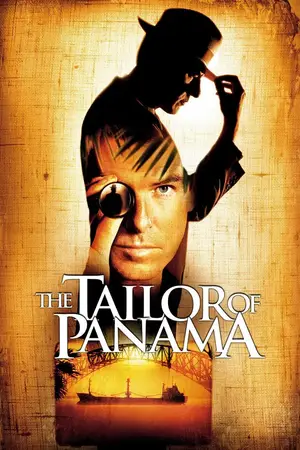
The Tailor of Panama: No matter who controls the canal, it remains a conduit for criminal activities
'Panama?' The opening line of the film “The Tailor of Panama” is uttered with bewilderment by Pierce Brosnan who sits in the MI6 office. This former James Bond actor (in fact, he still played James Bond in 2001 when ‘The Tailor of Panama’ was released) plays a charming yet scheming and corrupt version of 007 in this movie.
‘But for God's sake, be careful out there, man. There's a nasty web of money laundering, drug trafficking, and corruption,’ warns the head of MI6 intelligence. And this, of course, represents the prejudices against Panama in British and American cinema.

In the film, the tailor is made an idealist who organizes a non-existent anti-government guerrilla group called the "Silent Guerrilla" during the post-Noriega era. This is because the Americans only took down Ali Baba but not his Forty Thieves when they ousted Manuel Noriega in 1989, suggesting that there are still militias waiting for an opportunity to act. In reality, as the CIA official in the film rightly states, ‘As long as they stop urinating in the canal, whether it's Panama, the U.S., or China taking over, and smuggling drugs—everyone turns a blind eye.’

The story also highlights the wife of the British tailor, who works for the Panama Canal Authority. As a result, the camera captures the panoramic view of this famous historical Canal Administration Building and provides a close-up of the giant 93-square-meter mural inside. The mural, which painted by William B. Van Ingen in 1914, depicts four key moments in the construction of the Canal: the construction of the Gatun spillway, the construction of the culverts on the sidewalls of the Miraflores Locks, the installation of lock gates, and the excavation of the Culebra Cut.

‘The grand construction sites and enormous machinery in the mural make the construction workers appear tiny. The mural visualizes a shared sentiment held by many Panamanian writers: the significance of the Canal to American culture and technology is equivalent to that of the Great Pyramids to the ancient Egyptians’, wrote Marixa Lasso in her book "Erased: The Untold Stories of the Panama Canal". She further notes that this famous mural shines a spotlight on the engineering marvel but diminishes the presence of the workers.
It is imaginable that in espionage films set against the backdrop of the Canal, the protagonists are often charismatic spies and corrupt politicians. Meanwhile, much like those overshadowed workers in the mural on the walls of the building of the Panama Canal Authority, the "Silent Guerrilla" imagined and exploited by politicians, also like the voice of all the Panama people, are cruelly underrepresented or even erased by history.
Contraband and Hands of Stone: The Perils and Opportunities of El Chorrillo
The operation of the Miraflores Locks depicted in the mural is showcased in Mark Wahlberg's 2012 film "Contraband." This may also represent another function of Hollywood films, which is to give the audience a brief understanding of various industries while enjoying the films. In "Contraband", the focus is on customs, shipment, and cargo containers.

The story revolves around Chris (Mark Wahlberg), a man who decides to retire from a life of crime. However, he is forced to come out of retirement when his wife’s brother messes up a drug deal. Chris has to make a comeback and smuggle a large shipment of counterfeit money from Panama to the U.S.. After orchestrating a minor accident as their cargo ship approaches the Miraflores Locks, he and his accomplices head to the chaotic El Chorrillo district in Panama City to retrieve those counterfeit money. A series of unexpected events unfolds during their hasty escape.

This narrow administrative district was initially established to accommodate immigrant workers from the West Indies who participated in the construction of the Canal. During the U.S.’s control of the Canal, the model towns representing this area were Balboa and La Boca. The former was for white employees, and the latter was primarily for black employees from the West Indies. The Isthmian Canal Commission (ICC), established by the U.S. government in the early 20th century, replaced the 41 towns listed in the 1912 census with a series of carefully planned and refurbished towns, presenting a new landscape with no agriculture, no private properties, and few towns.

El Chorrillo, evidently, was not the model district that the Americans had hoped for. However, that was where the military dictator Noriega, mentioned in many of the aforementioned films, grew up in. El Chorrillo also nurtured Robert Durán, the lightweight champion who dominated the boxing world throughout the 1970s. In 2016, the biographical film "Hands of Stone," named after Durán's nickname, extensively portrayed the anti-American sentiments of children growing up in this impoverished area. Despite their challenging childhoods, both Durán and Noriega achieved immense fame in adulthood (be it positive or negative), and what remained unchanged was their deep-rooted anti-American sentiments.

It is not surprising. When you grow up in the muddy, crime-ridden "indigenous towns," and on the other side of the divide, there are green fields, fresh flowers, and beautiful swimming pools which firmly threaten the survival of your nation, hatred is inevitable. Durán grew up in the neighborhood later named the "House of Stone". After achieving success, he built a mansion. In 1977, he saw General Omar Torrijos sign the Panama Canal Treaty with U.S. President Jimmy Carter in a television news segment. Excitedly, he rushed to the bedroom to celebrate this news with a suggestive joke about a ship entering the Canal, but it led to a clash of perspectives. Durán complained that his wife was a wealthy woman who never experienced the hardships of colonization. She retorted, "We still have 22 years before the Canal returns to us. Before that happens, do something practical. Defeat the darned American on the cover of the 'People' magazine, who is also a lightweight champion."

Herbie Goes Bananas: A Journey Through The Canal
This is an episode from "Herbie", an American comedy series during the 1970s and 1980s. Following "Herbie Goes to Monte Carlo(1977)”, two good friends travel to Puerto Vallarta, a city on Mexico’s Pacific coast, to retrieve a beat-up old car. Surprisingly, clever Herbie hides a street kid and boards a cruise ship to reach Panama. He sails through the Miraflores Locks and Gatun Lake from the Pacific Ocean side, and arrives at the ruins near the second-largest city, Colon, on the Atlantic Ocean side.

I am sure the expensive toll was not paid for this vintage car to cross the Canal. The cheapest toll recorded in history was paid by an American named Richard in 1928— he only spent 36 cents. The company in charge of the Canal was particularly lenient and allowed him to swim the entire 80 kilometers without any assistance.
In fact, besides crossing the Canal by ship, people have always been able to travel across the Pacific and the Atlantic Oceans by train. The renowned travel writer Paul Theroux also traveled to Colón in an old-fashioned train in 1979. In that year, the U.S. handed over the sovereignty of the Canal Zone to Panama but retained de facto control over it. Even in late 1989, the U.S. invaded Panama under the pretext of opposing dictatorship, much like what is depicted in the aforementioned films and what it subsequently did to the Middle East. It was not until noon on December 31, 1999, that Panama officially regained full management and defense rights over the Canal, and the U.S. military completely withdrew. In 1979, Theroux briefly surveyed danger laden Colón and noted in "The Old Patagonian Express": "The poor houses on one side of the tracks are considered local; on the other side are military barracks, yacht clubs, offices, gardens and mansions. This side is for the rulers, and that side is for the ruled."





Comments 0
No comments yet.