Rating A+ |The Remains of the Day: It Didn't Fail Even losing Oscar


1. Why didn’t such a good movie win oscar
When the film ended, I felt like I was glued to the sofa and couldn't move for a long time.
Fantastic, this is an Oscar-worthy film!
On peliplat's website page, I found that it has been nominated for 8 Oscars including Best Film, Best Director, Best Actor, and Best Actress.
8 nominations, but gain nothing in the end. Such a result is undoubtedly bad. Why didn't it receive the award in the end?
After looking through the Oscar list for that year, I figured it out. Its opponents are "Schindler's List" and "The Piano", which are indeed masterpieces that can rank among the top in film history.


It is worthy of the Oscar though, it is untimely!
However, it gave me a better experience than most of the films today. I didn't expect a film from 30 years ago still shock me so much.
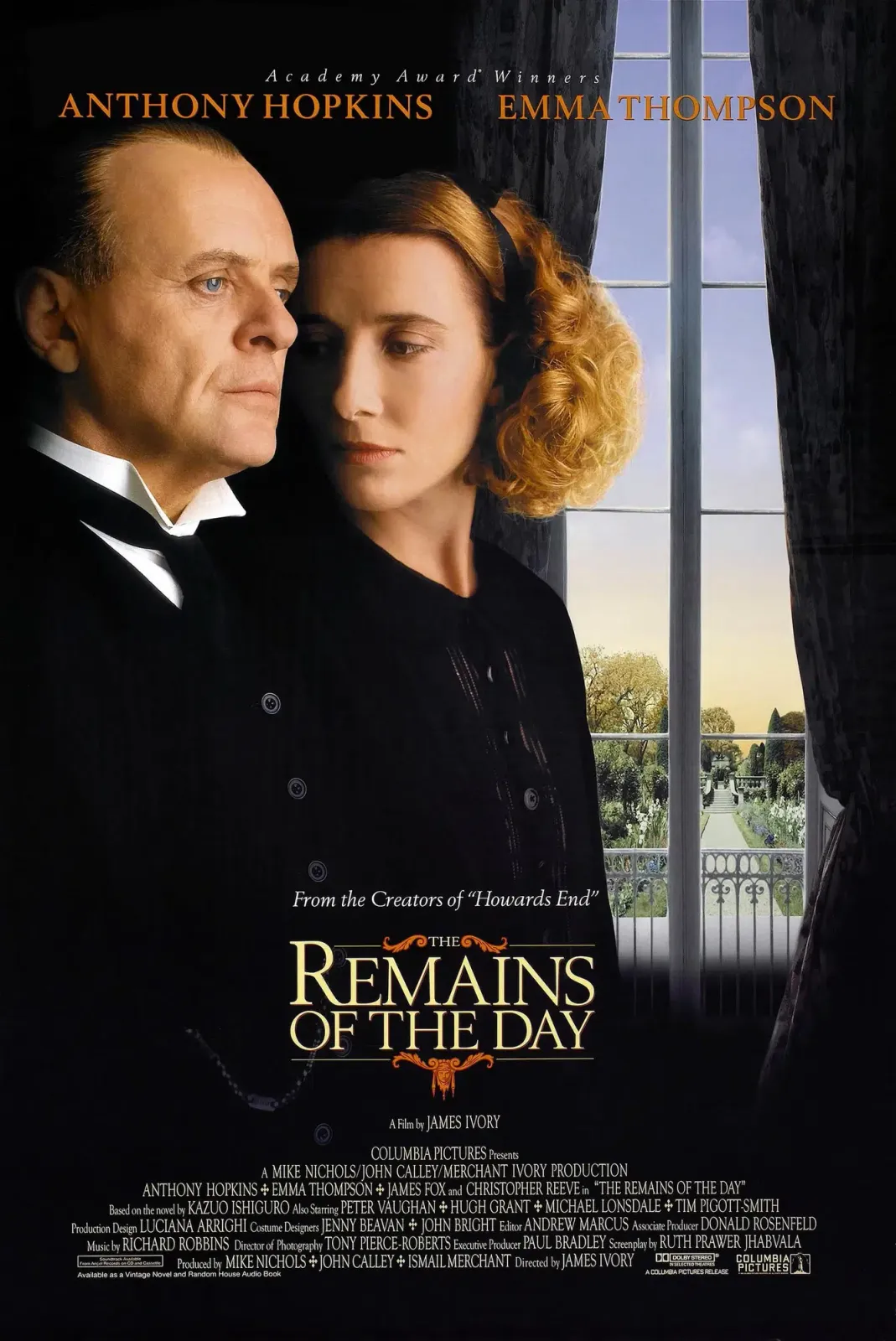
2. Kazuo Ishiguro's novel: Doing my best for something that is destined failed.
The Remains of the Day is adapted from the novel of the same name by Kazuo Ishiguro. To understand this film, you must first understand Kazuo Ishiguro.
Kazuo Ishiguro is a Japanese-British novelist and also a winner of the 2017 Nobel Prize in Literature. Almost every novel of him has won major literary award. The Remains of the Day was awarded in the Booker Prize, the highest honor in the fiction world.

Some people take it for granted that if there is an excellent novel as the base, the story of the film will not bad. The actual situation is the opposite, many films based on excellent novels have been criticized and reduced to mediocrity. This happens when the director and the author have a different understandings of the story.
I like Kazuo Ishiguro's novels. From science fiction, realism, and history to utopia, the backgrounds of the stories he designs are varied, but the characters in the stories all have a similar personality: they are doing their best for a thing that is doomed to fail.
It's still the same in The Remains of the Day.
The protagonist of the movie, Stevens, as a butler, is still dedicated to his duties when his master is down , maintaining the last trace of the dignity of the nobles.
Lord Darlington, the master Stevens serves, is more extreme. He is very gracious to help his downhearted friends, but does bad things with good intentions. He has ended up sparking a war and ruined his reputation.
The director interpreted this sadness from the novel. There are many techniques used in the film to reinforce this desolation. They make this movie a masterpiece.
3. Film technique analysis
(1) Dialogue
The emotions of "The Remains of the Day" are very restrained, even in the climax part, and the emotions are rarely revealed in the dialogue but conveyed through their eyes.
For example:
Miss Kenton: I accepted Mr. Benn's proposal of marriage.
Stevens: My congratulations.
Miss Kenton: I am prepared to serve out my notice. But if you'd release me earlier, I'd be grateful. Mr. Benn is planning to leave for the Western country in two weeks.
Stevens: I'll do my best. Now, please excuse me.
Can you imagine? This is the climactic moment in the movie, the final farewell of the hero and heroine who love each other! From this line, can you feel the helplessness and sadness of both sides?
The eyes of the two protagonists seem to be talking. Complicated emotions such as remembrance, reluctance, disappointment, and regret are shown in the eyes. The missing information in the dialogue is supplemented in the frame.

Obscure but strong, this kind of emotional expression is clever, and the advantages of the novel are further strengthened in the film.
(2)Two banquets
The two banquets given by Lord Darlington are the two climaxes, which occur at the beginning and ending. These two banquets have an important narrative function.
First banquet:
Explanations of Darlington's position: the banquet takes place before World War II starts, and he is on German side , implying that he will surely decline in the future.
Explanations of Stevens' character: his father, as a servant, is unexpectedly ill during a banquet. Stevens endures his grief and insists on serving Darlington at the banquet. When the banquet is over, Stevens' father has been found dead. It shows that he puts work above all else.

Second banquet:
The decline of Darlington has been irreversited: the banquet took place after the war began, and German officials visited again. They were arrogant, and they were no longer the same as they were before the war. Last time, they asked for Darlington's permission, while this time they asked Darlington to cooperate.
Stevens lost his lover again: Miss Kenton, who he loves, unexpectedly resigns to him at the banquet, and she also tells Stevens that she is engaged to someone else. Like last time, Stevens is painful, but still choose to throw a banquet for the doomed Darlington.
Both Stevens and Darlington are doing their best for something that is doomed to fail, which is typical in Kazuo Ishiguro's story.

It is worth mentioning that the film uses two banquets to show World War II instead of grand scenes such as showing airplanes and tanks. Such a narrative technique is wonderful.
(3) Timeline
The timeline of The Remains of the Day is scrambled, which is also an advantage.
One of the timelines is from the present and the other is from memory.
This kind of storytelling reminds me of Nolan's movies, "The Prestige", where reality and memory are intertwined.
For example, the beginning of the film is about the auction of the family property after Darlington falls. Then Stevens throws back his memory. These two timelines are constantly intersecting. The advantage is to let the audience predict the "future" in advance, it makes the "present" more like a tragedy.

Excellent techniques are for better expression. Whether a movie is excellent or not does not lie on how many techniques are being used, but how to make the audience touching.
4. Touching
Although the story takes place in the past, it gave me many wonderful connections to the real world. That's exactly where touches me.
For Lord Darlington, his changes made me feel that life is impermanent. Your situation in the future may turn to the opposite,, and you can't predict what will happen in the future.

Stevens has dedicated his life to his work. This job is stable and hassle-free. Is it a good job? Which is more important, stability or self-actualization? When there is a conflict between the two, what is your choice?

For Miss Kenton, the moments that changed her life are unexpected. One is an unexpected marriage proposal from another housekeeper Lewis, and the other is when she is preparing to resume her job as a housekeeper after many years when she unexpectedly meets her ex-husband. This makes her career efforts seem unimportant.

This reminds me of a sentence in the book "Maybe You Should Talk to Someone": In fact, there are not as many things that I can control in life as I imagined.
Rating A+









Comments 2