
The Piano Lesson Mini-Review #TIFF2024
In 2015, Denzel Washington announced that he’d be producing film adaptations of 10 plays by the legendary playwright August Wilson. The first was 2016’s Fences, directed by and starring Washington. The film was a critical and commercial success, and was quickly followed by Ma Rainey’s Black Bottom. Ma Rainey was released in 2020, the first of the adaptations to premiere on Netflix. The latest is The Piano Lesson, a family production for the Washingtons. Not only is the film produced by Denzel, it was directed by his youngest son Malcolm and stars his eldest son John David.
Malcolm is a first time director, and as you may expect, the movie is like a filmed play. Luckily, it’s a really good play.
Being an uncultured fool, I was unfamiliar with the original work, and I got to experience The Piano Lesson for the first time. I don’t think I will be alone in that, and that’s something that will only benefit the movie.
The story of the film is as follows: after a brief flashback, the film opens on Boy Willie (John David Washington) and his friend Lymon (Ray Fisher), arriving at the home of Boy Willie’s uncle Doaker (Samuel L. Jackson) in 1936 Pittsburgh. Living with Doaker is Boy Willie’s sister Bernice (Danielle Deadwyler), and Bernice’s young daughter Maretha (Skylar Aleece Smith). Willie and Lymon have arrived with a truck full of watermelons that they intend to hawk on the streets of Pittsburgh, but Willie has other motives. He’s after a piano, a family heirloom that Bernice strictly forbids him from selling. This conflict is the heart of the play.
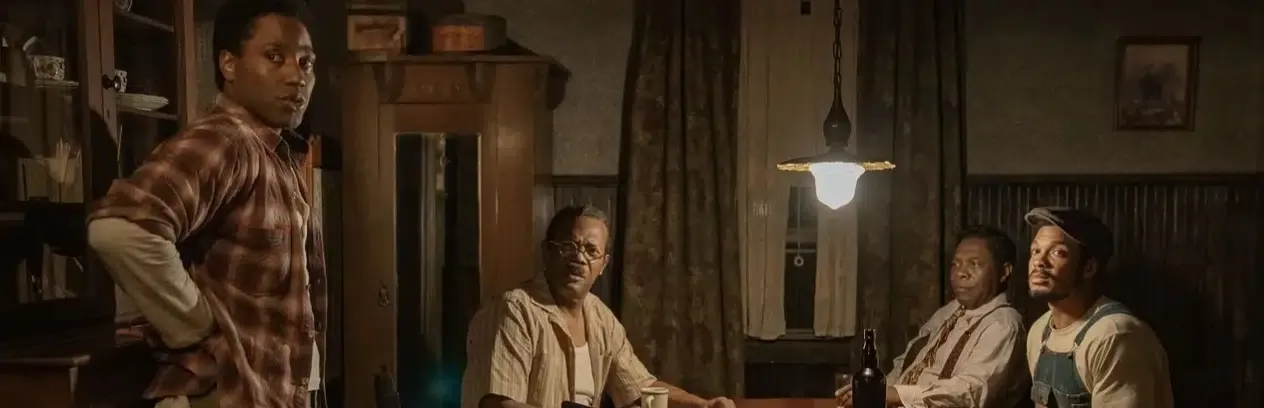
A sequence, midway through the movie, explaining exactly what the piano is and why it’s important - is the highlight of the film. I don’t want to spoil it here, but suffice it to say, the piano is the work’s central symbol. It’s representative of the family’s history, one tied inextricably to slavery, racism, and violence.
Each character has a different relationship with the piano, but the ties are deepest for Bernice and Boy Willie. The central question of the play is this: should the family ditch the memory of their trauma for a better future? Or are some things too important to forget?
This is a strong conflict because the answer is complicated, we understand why the family would both want to keep and sell the piano. So while the ending has the characters make a definitive choice, it makes clear what that choice denies them.
I’m sure I’m not the first to say this. I’m also sure that a lot of subtext went over my head. Bear with me, I am a white idiot doing my best with a foundational piece of black literature. I can only speak for myself, but for me this version of the text was compelling and resonant.

In terms of adaptation, most of the performances are very strong. I say “most” because there is one I am unsure about.
Ray Fisher played Lymon on stage in 2022, and his performance here remains calibrated to the stage. It’s a big, broad comedic take that clashes with the somber tone of the film. I’m not saying this story shouldn’t have comic relief, but in Fisher’s hands Lymon is a caricature.
Two other performances highlight the problem with this take - Samuel L. Jackson’s Doaker and Wining Boy, played by Michael Potts. Both are frequently funny, and both played the characters on the stage. Yet their performances are restrained - they have recognizable humanity. I eventually got used to what Fisher was doing, but he sticks out in such a strong ensemble.
Ultimately though, this is a solid adaptation. Washington introduces horror film techniques to externalize the supernatural elements of the play, and these are effective. He only loses some control in the climax - the intensity of Deadwyler’s performance is underserved by Washington’s straightforward approach to the material. This is a pretty minor complaint however. The Washingtons have set out to bring Wilson’s plays to a wider audience, and The Piano Lesson gets the job done.








Comments 0
No comments yet.