Incomplete by Shorna Abedin
Directing
INCOMPLETE: The Philosophy of What Remains Unfinished
What if the missing piece was never meant to be found?
Some stories end with an answer.
Others end with a silence that becomes the answer.
INCOMPLETE is a 49-second experimental short film by Shorna Abedin that explores one of the most quietly painful conditions of being human: the things we never finish, never say, and sometimes never get the chance to say.
The film does not attempt to explain its world through conventional dialogue. Instead, it creates a sequence of visual fragments—rain, a telephone booth, a letter, a grave, fireflies, and the shifting language of colour and monochrome. These images function less like ordinary plot points and more like fragments of memory.
And memory is rarely complete.
The Story Beneath the Story
At first, INCOMPLETE may appear to be about a particular person, a particular relationship, or a particular loss.
But the deeper story is more universal.
It is about timing.
There are moments in life when a single sentence could change everything.
“I love you.”
“I am sorry.”
“Stay.”
“Come back.”
But human beings often assume that time will wait for them.
It does not.
A letter can remain unopened.
A telephone can remain silent.
A person can disappear.
A confession can arrive after its listener is gone.
And suddenly, something that once seemed temporary becomes permanent.
That is where the title INCOMPLETE begins to acquire its philosophical meaning.
The incomplete thing is not necessarily a relationship.
It may be a sentence.
A possibility.
A version of ourselves that never had the opportunity to exist.
Why the Rain?
Rain often carries two contradictory meanings.
It can represent renewal.
It can also represent mourning.
In INCOMPLETE, rain becomes an emotional space between the two.
It washes the world, but it cannot erase memory.
It falls continuously, while human lives move only forward.
That contrast is important.
Nature repeats itself.
Human time does not.
We may experience another sunrise, another rainfall, another morning—but we never return to the exact moment we lost.
The Telephone Booth and the Letter
The telephone booth represents connection.
The letter represents communication delayed by time.
Both are technologies created to overcome distance.
Yet neither can defeat mortality.
That is the paradox.
Humanity has invented countless ways to communicate across space, but no technology can send a message into a moment that has already passed.
A phone can connect two people.
It cannot reconnect yesterday with today.
A letter can preserve words.
It cannot guarantee that someone will still be there to read them.
The Grave
The grave changes the meaning of everything that came before it.
Before death, silence can feel temporary.
After death, silence becomes irreversible.
The grave therefore becomes more than a symbol of physical death. It represents the death of possibility—the point beyond which certain conversations can never happen.
This is perhaps the film's most painful philosophical question:
What do we owe to the words we keep postponing?
Why Is It Called INCOMPLETE?
Because human beings rarely receive perfect endings.
We imagine that closure is something life owes us.
Perhaps it is not.
Some questions remain unanswered.
Some relationships end without explanation.
Some people leave before we understand what they meant to us.
Some dreams disappear before they become real.
And yet we continue.
Maybe being human means learning to live with unfinished things.
The goal is not always to complete everything.
Sometimes the goal is to understand what cannot be completed—and still move forward.
Cinema as a Fragment of Memory
I did not want INCOMPLETE to explain everything.
I wanted the audience to participate.
The film leaves spaces between the images because those spaces belong to the viewer.
Perhaps someone will see a lost love.
Someone else may see regret.
Someone may see death.
Someone may simply remember a message they never sent.
That is the nature of symbolic cinema.
The filmmaker creates the image.
The audience completes the meaning.
And perhaps that is the final paradox of INCOMPLETE:
A film about incompleteness becomes complete only when the audience brings its own unfinished story to it.
Recognition
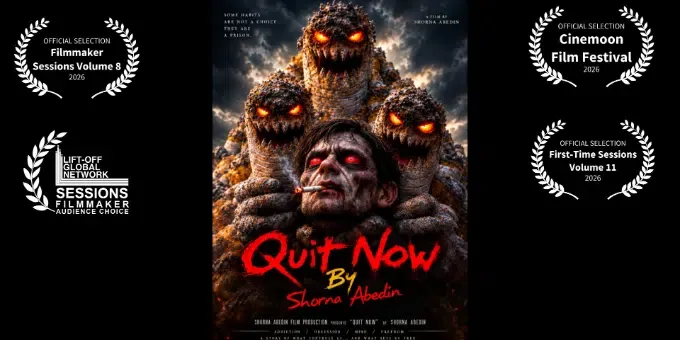
INCOMPLETE received an Honorable Mention at the Cinemoon Film Festival, United Kingdom, adding another chapter to its international festival journey.
For me, the recognition is meaningful—but the deeper purpose of the film remains the question it leaves behind:
How many things in our lives remain incomplete simply because we believed we had more time?
— Shorna Abedin
Filmmaker • Fine Artist • Author
🎬 Watch / Follow the Film:
FilmFreeway: https://filmfreeway.com/Incompleteshornaabedin


Comments 0
No comments yet.