"The General's Attendant Guard ": The Humiliation and Suffering of Anti-Japanese War Heroes Beyond the Battlefield
General Reviews
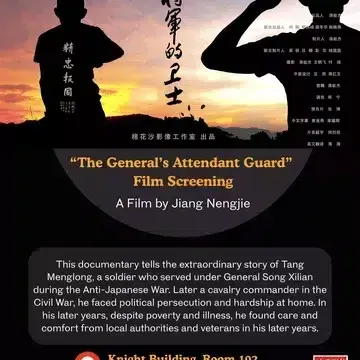
Recently, I watched the documentary “The General's Attendant Guard”, which reflects the postwar experiences and later-life circumstances of Tang Menglong (唐梦龙), an anti-Japanese war hero of the Nationalist Army. Regarding this documentary and the history and reality it portrays, I have a few things I very much wish to say.

The protagonist of the documentary, Tang Menglong (唐梦龙), was once a guard to the renowned Nationalist general Song Xilian (宋希濂). In 1937, following the Marco Polo Bridge Incident, Tang Menglong joined the Nationalist Army to resist the Japanese invaders and defend his country and homeland. Together with General Song and other comrades, from 1937 to 1945, Tang Menglong endured the brutal War of Resistance against Japan, was wounded in combat, and defended the nation and people with flesh and blood. After the war, he followed Song Xilian to Xinjiang. Tang Menglong and millions of Nationalist officers and soldiers like him, as heroes of a victorious nation who had rendered great and arduous service, were admired by their compatriots (and even by the people of the entire global anti-fascist camp) and rightly seemed to have a bright future ahead.
But afterward, the Chinese Civil War broke out. In just four years, the Chinese Communist forces defeated the Nationalist Army, and Song Xilian was captured by the Chinese Communist Party in the Southwest. Tang Menglong, who had been demobilized and returned to his hometown, along with his wife and children, then went through many political campaigns during the roughly thirty years after the establishment of the CCP state, in the Mao Zedong (毛泽东) era, especially the devastation of the “Cultural Revolution.” This was something many Nationalist officers and soldiers who had “laid down their arms and returned to the fields,” or even risen up to join the CCP, could never have imagined.
The “New China” that had “turned the world upside down” did not recognize these anti-Japanese war heroes. On the contrary, these Nationalist Army (“National Revolutionary Army,” also known as the “Kuomintang Army,” which term is used depends on one’s stance and perspective) officers and soldiers, no matter how meritorious their service in the War of Resistance, were still labeled “Kuomintang reactionaries.” In the Mao era, the main theme was class struggle and opposition to Kuomintang rule; the War of Resistance itself was not regarded as an achievement (the Mao era did not commemorate the war, did not mention the Nanjing Massacre, and even supported Japan against the United States). Yet one’s identity as a Kuomintang or Nationalist government figure was considered a grave crime (even though Mao Zedong himself had once served as a high-ranking Kuomintang official during the First United Front).
During the 1950 “Campaign to Suppress Counterrevolutionaries,” many heroes of the 1911 Revolution and the War of Resistance were executed by the CCP. Others were sent to barren and backward regions for “reform through labor.” During the Anti-Rightist Movement, many intellectuals who had participated in the War of Resistance were criticized and exiled. During the Great Famine, many Nationalist officers and soldiers undergoing labor reform (who had often endured the brutality of the Japanese invasion), as well as intellectuals who had served the Nationalist government and likewise taken part in the War of Resistance, starved to death in their places of exile. Later came the “Four Cleanups Movement,” which screened and persecuted CCP members who had once joined the Kuomintang. These campaigns and disasters destroyed the life prospects, personal lives, and even the lives of most contributors to the War of Resistance.
Tang Menglong narrowly survived these upheavals. But an even more brutal “Cultural Revolution” awaited him and other surviving Nationalist soldiers. During the ten years of the Cultural Revolution, which the CCP itself later acknowledged as a “catastrophe,” Tang Menglong and his wife and family were denounced and beaten by Red Guards. His neighbors, who were Red Guards, not only oppressed him constantly but even attempted to kill him. Fortunately, he fled to the wilderness to hide, surviving on food secretly delivered by his family, and thus escaped disaster. In their later years, Tang Menglong and his wife still lived in fear, and the Tang family continued to be afraid of their former Red Guard neighbors.
Tang Menglong’s wife was a Communist Party member. In her youth, she had been a model “progressive youth” and had disregarded her family’s interests to provide grain and money to the struggling CCP forces. Yet the frenzied Red Guards of the Cultural Revolution did not spare her either. She was persecuted into lifelong disability and spent the latter half of her life dependent on a cane. Such a fate was a tragedy shared by everyone from high-ranking CCP leaders like Liu Shaoqi (刘少奇) and Deng Xiaoping (邓小平) to many grassroots party members. The experiences of the Tang couple were a microcosm of what both former Nationalist and Communist individuals in Mao-era China endured; they were witnesses and survivors.
For roughly thirty years of the Mao Zedong era, Nationalist soldiers of the War of Resistance lived as if in hell. Many died; the survivors suffered endless humiliation, “only to be shamed in the hands of servants and to die crowded in the stables,” stripped of all dignity, and trampled upon “ten thousand times” in both body and spirit. Many took their own lives. The Tang couple also contemplated suicide. It was only because they still had children and did not wish to leave their young ones unattended that they endured and struggled on.
These men, these soldiers of the War of Resistance, should have been revered by their compatriots. In peacetime, they should have continued as the backbone of defending the nation and building the country, receiving generous compensation and care, often being honored at government offices and schools to recount the War of Resistance, enjoying countless flowers and applause. Had this been so, they would have enjoyed, in old age, the same generous benefits and personal care as the Nationalist soldiers who retreated to Taiwan and the allied American and British troops.
But the coincidences of history, the interplay of necessity and chance, and the convergence of domestic and international circumstances changed the fate of the Chinese people and also changed the fate of these soldiers of the War of Resistance. They were pushed into hell; their dignity and honor were destroyed, and even their basic rights and reputations as human beings were stripped away. Their astonishing achievements were completely erased, and they were saddled with various stigmas such as “Kuomintang reactionaries,” “landlords/exploiting classes,” and “disaster army” (a derogatory Mao-era term for the Central Army during the Civil War and afterward).
Many stories of these soldiers and their wartime experiences, many thoughts and emotions—real, profoundly moving narratives that could provide endless material even for ten thousand films like Band of Brothers, Old Gun, or Saving Private Ryan—were permanently submerged and lost as these people were silenced by persecution, driven into madness, debilitated by illness and old age, and ultimately died. Important war relics were destroyed or lost. The various certificates of honor and medals Tang Menglong received for his wartime service were either confiscated during house searches or buried underground and decayed. Many priceless relics of the War of Resistance, comparable to the Sichuan Army’s “Death Flag” or the Guangxi Student Army’s wooden inscription, “One day the Blue Sky and White Sun flag will fly over Mount Fuji,” were permanently and irreversibly destroyed.
When Mao Zedong died and Hua Guofeng (华国锋) and then Deng Xiaoping successively came to power, the surviving soldiers of the War of Resistance were no longer brutally persecuted for their Kuomintang or Nationalist Army identities, but their honor was not restored either. Even when “rehabilitated,” it merely meant a denial of the persecution, not a full acknowledgment of their status as anti-Japanese war heroes. Afterward, family planning and other harsh policies continued to afflict the Chinese people, including these war veterans (though the overall level of persecution was far lower than in the Mao era). Poverty also continued to trouble these heroes and their families.
Another important background also suppressed the memory and commemoration of the War of Resistance among these soldiers and the entire Chinese nation. The 1980s and 1990s were an era of promoting “Sino-Japanese friendship.” At that time, Japan’s economy was extremely prosperous, its technology advanced, and its national strength formidable. Its per capita GDP was more than thirty times that of China, and its total GDP more than five times larger. China, then impoverished and in dire need of foreign investment and technology, as well as the CCP’s need to oppose the Soviet Union (Mao-era friendliness toward Japan had also been driven by opposition to both the United States and the Soviet Union), led China toward rapprochement with Japan. This “Sino-Japanese friendship” was achieved by appeasing the Japanese right wing’s denial or even beautification of the war and its acts such as visits to the Yasukuni Shrine. When Emperor Hirohito (裕仁) of Japan, the chief war criminal of World War II, died, China sent a high-level delegation to pay condolences. Emperor Akihito (明仁) visited China in 1992 and received a warm welcome.
Against such a background, the War of Resistance and its soldiers were treated in a low-key manner by both the CCP authorities and Chinese society. Faced with the tide of Japanese goods, Japanese culture, and Japanese people (including Japanese tourists and relatively high-status Japanese workers in China who enjoyed “extraterritorial-like privileges”), Chinese veterans of the War of Resistance and survivors of Japanese massacres felt a mixture of emotions. In the anti-Japanese film Encirclement, the villager Erxi, whose family was killed and who fought the Japanese to the death alongside his brothers, in his old age stands in his nearly as destitute village as decades before, staring blankly and in confusion as a Nissan SUV drives past his door. According to the recollections of Chinese Canadian writer Tao Duan Fang (陶短房), a Nationalist veteran he knew who had participated in the Battle of Shanghai in the 1980s fainted on the spot upon seeing the Japanese flag at an exposition, whether from rage or from fright.
Although there were some works of commemoration at the time, such as the film Bloodshed at Taierzhuang, the degree to which the War of Resistance was mentioned fell far short of its immense historical significance and influence, and did not match the tremendous suffering endured by the Chinese people during the war. The War of Resistance and its heroes fell silent before reality. Many of these veterans had already entered old age and passed away, one by one, quietly.
If one compares this with the postwar treatment of the Japanese soldiers who invaded China, the fate and treatment of Chinese soldiers of the War of Resistance is even more heartrending. Although Japan suffered economic collapse and poverty among soldiers and civilians after its defeat in 1945, and many perpetrators once faced the prospect of accountability and trial, after the outbreak of the Korean War in 1950, all sides—China (both the Communist and Nationalist sides), the United States, and the Soviet Union—sought to win over Japan and abandoned the pursuit of accountability. The United States comprehensively supported Japan. Without eradicating the roots of militarism, Japan’s economy rapidly recovered. By the 1960s, many former Japanese soldiers who had participated in the invasion of China and committed atrocities there had begun to receive “consolation payments” from the Japanese government.
Those former Japanese soldiers who lived into the 1970s and beyond generally enjoyed considerable income and very favorable living conditions. Many Japanese people also regarded them as heroes who had defended the country and helped Japan regain respect after the war. This could be seen when Hiroo Onoda (小野田宽郎), who waged guerrilla warfare in the Philippines and did not surrender until 1974, returned to Japan and was welcomed by crowds lining the streets holding Japanese flags. Other “holdout Japanese soldiers,” such as Shoichi Yokoi (横井庄一), received similar receptions and preferential treatment upon returning home. Most of the Japanese troops who had invaded China lived materially abundant and comfortable lives in old age, often receiving care when ill or frail, and many lived to advanced ages, enjoying their later years.
By contrast, the injustice and misery endured by the righteous Chinese soldiers provoke even greater sorrow and indignation. It also leads one to ask, with deep doubt, who truly counts as the victor and who as the defeated in this war.
The Second World War is widely regarded as a decisive event that changed the destiny of humanity. It determined whether humanity would move toward independence, freedom, peace, and prosperity, or toward fascist tyranny, racial oppression, and the destruction of human dignity. Fortunately, through the courageous struggle of the international anti-fascist camp, including Chinese soldiers, justice triumphed over evil. Yet the Chinese soldiers of the War of Resistance, as contributors who helped open a new era for humanity and usher humankind into the most civilized, peaceful, and prosperous age in history, did not themselves enjoy civilization, peace, and prosperity. Instead, they found themselves in conditions more barbaric and brutal than war, and more impoverished and backward than before the war, enduring endless suffering and humiliation.
Not until the final years of the last century and the early 21st century, during the administrations of Jiang Zemin (江泽民) and Hu Jintao (胡锦涛), did China gradually begin to mention the War of Resistance against Japan, and did surviving veterans receive some attention and care, for a variety of reasons. By then, however, most of the veterans had already passed away, and only a few remained alive. By the time 2010–2015 arrived, when the War of Resistance was more widely highlighted and elevated to a lofty status, fewer than one in a hundred veterans were still living, and the overwhelming majority were already long gone. The circumstances of those deceased veterans were largely similar to Tang Menglong’s: in life they were generally poor and humiliated, and most never lived to see the day when they were once again broadly recognized by their compatriots as national heroes and contributors to the state. Many even took their own lives under a sense of grievance. No matter how grand the commemorations are today, they cannot make up for the tragedies that already occurred or undo the consequences that have already been created. What remains is permanent regret.
And this is precisely the bitter fruit of what the Chinese Communist Party did during the Mao Zedong era. By erasing the achievements of the Nationalist forces in the War of Resistance (during the Cultural Revolution, even the CCP’s own anti-Japanese achievements were denied and its own heroes were persecuted, such as Peng Dehuai (彭德怀), who commanded the Hundred Regiments Offensive, and even the surviving members of the “Five Heroes of Langya Mountain”), and by brutally persecuting the Nationalist veterans, the Party destroyed people and memory at the very time when the War of Resistance should most have been publicized and its heroes praised. Such damage can never be repaired.
It was not only veterans like Tang Menglong who suffered such misery. Survivors of the various massacres during the War of Resistance, survivors of the so-called “comfort women,” and survivors of forced labor conscription all suffered repeated harm after the CCP came to power, and those who survived generally kept a very low profile. Their efforts to defend their rights and to seek justice from Japan were also suppressed by the CCP authorities. By the time official support was given to such rights-defense efforts, the vast majority of these people had already died, and the remaining survivors still did not receive sufficient exposure or care. Meanwhile, the victims of the atomic bombings in Hiroshima and Nagasaki received global attention, gave speeches around the world, and their related organizations even received the 2024 Nobel Peace Prize. When the two are compared, reality once again makes China appear like the defeated country and Japan like the victorious one. The greatest and most painful regret of the War of Resistance survivors is that the memories of the overwhelming majority of them were obliterated by history and were not preserved or passed down.
What was destroyed was not only a grand national and collective memory, but also the lives and happiness of each individual. The experiences Tang Menglong recalled in the documentary, of repeated persecution during the Cultural Revolution, truly damaged a person’s basic dignity, body, and spirit. These persecutions also left indelible marks on his entire family and on every family member, leaving both visible and invisible trauma and shadows on Tang Menglong’s children, who were still young at the time. The long-term poverty of the family and its disadvantaged position in relations with neighbors, shaped by the broader environment and political persecution, continue to trouble the Tang family to this day.
During the War of Resistance, Tang Menglong feared no sacrifice, fought bravely, and defended the nation. Yet in the decades that followed, he could not even stand up to malicious neighbors, nor could he protect his own family. When bullied, he could only endure; when danger came, he could only hide. After enduring countless humiliations, Tang Menglong changed from a spirited general’s guard into a low-profile, cautious elderly civilian. Yet when he speaks of the War of Resistance and sings the Nationalist Army’s wartime songs, one can still see the essence of a hero. Regarding what happened after 1949, though he remains reserved, he still courageously recounted many of his experiences, without becoming numb or losing his courage.
Only in his later years, when the nation commemorated the War of Resistance and Tang Menglong received social recognition, did he and his now middle-aged son finally summon the courage to seek an explanation from the former Red Guard neighbor who had bullied them. The old Red Guard’s defense, like that of many other former Red Guards, informants, and wrongdoers, was that the environment of the Cultural Revolution left them with no choice. Yet every evil act is participated in and carried out by specific individuals. Many people took part actively and willingly, and even those who merely “followed orders” embodied what is known as the “banality of evil.” They may also have had their constraints, but if they are forgiven, where does that leave the victims? If right and wrong disappear, social morality further decays, and under the confusion of good and evil, more evil will be bred.
The changes in the Tang family’s fate were also shaped and determined by national policy and the broader environment. During those thirty years when satanic figures held power, the Tang family could only struggle in despair, with life and death left to fate and no ability to resist, like fish on a chopping board, at the mercy of others. In the Deng era, although there was a glimmer of hope and the end of “pariah” treatment, they could only live quietly, hardly daring to hope for justice. It was only in a later period that they finally received some affirmation in spirit and reputation. Every individual, under the pressure and manipulation of a Leviathan, shaped by the broader environment, has little autonomy. The various injuries, torments, and shadows of terror make people afraid to resist or claim their rights even when they are safe. That Tang Menglong did not actively and promptly seek treatment and compensation during the 1980s campaign to “redress unjust, false, and wrong cases” was not because he did not want them, but because he feared the return of what he had endured in the Mao era. The terror of tyranny makes people “voluntarily” relinquish their rights, and that itself is the crime of tyranny.
Although after 2013 the Tang family finally came to be socially recognized and widely respected, the ordinary realities of food, clothing, daily necessities, aging, illness, and death, along with countless trivial, mundane, and family matters, still trouble Tang Menglong and his relatives. Being interviewed and watching military parades bring only momentary joy; everyday life remains a long stretch of loneliness. Family conflicts and the saying that “there is no dutiful child at the sickbed after a long illness” also play out in the Tang family. Even a great person and immortal achievements cannot offset these hardships of life.
As for society’s concern for veterans like Tang Menglong, how much of it is genuine and how much is performative, how much is real and how much is empty, remains uncertain. When Tang Menglong’s daughter spoke of being turned away when she sought help from charitable organizations, it reflected how the halo of a War of Resistance veteran does not bring much practical assistance. China remains broadly poor, socially fragmented, and marked by charitable organizations that go through the motions. From the CCP leadership down to grassroots organizations, amid all the publicity, how much is truly admiration for his anti-Japanese achievements, and how much is simply using him?
Tang Menglong’s achievements belong to the period of the War of Resistance; the humiliation and suffering he endured, however, mainly came in the decades after the war, outside the battlefield. Or rather, it was another war beyond the War of Resistance: a continuous tragedy of compatriots harming one another, a one-sided slaughter by those who controlled the state’s machinery of violence against unarmed fellow nationals. This is even harder to understand and accept than being tormented by an enemy or dying on the battlefield. In his later years, Tang Menglong refused to wear the medal awarded to him by the CCP/China’s Central Military Commission, which may be seen as his final form of resistance, using refusal and “non-cooperation” to accuse those decades of persecution and trauma that should not be written off with a single stroke.
In 2017, Tang Menglong completed his winding life journey and bid farewell to a world that had bestowed upon him both lofty honor and immense suffering. His family continues to live in the ordinary world, tasting the full range of joys and sorrows of separation and reunion.

Tang Menglong was unfortunate: in his youth he faced the Japanese invasion and the shattering of his homeland; after 1949, he encountered too many calamities and was harmed by his own compatriots; even in his later years, his life was not truly happy. Yet Tang Menglong was also fortunate, because even more Chinese people and more War of Resistance soldiers were more unfortunate still, suffering greater persecution and injustice, dying earlier, and fading into obscurity in old age. Tang Menglong at least lived to see the day when he was once again recognized by the government and society. He was interviewed and filmed, and he spoke the heartfelt words he once dared not speak, or could not make widely known even if he did. In this way, he left behind some images and memories for the world.
Not only Tang Menglong, but in just the past few years, most veterans of the War of Resistance, survivors of the Nanjing Massacre, and survivors of the so-called “comfort women” have also passed away, with only a very few remaining. The lingering echo of an era that should not yet have ended (because there are still many untold stories, unresolved issues, and unrealized justice) has nonetheless irreversibly moved toward permanent silence.
Thanks to those who have cared for the veterans of the War of Resistance, who have seized, in the fleeting passage of time, the last living witnesses of that tragic and heroic era, preserving their images and voices, so that history is remembered after it has passed, and so that the lives that have gone on can achieve another form of immortality.




Comments 0
No comments yet.