Netflix's War Machine Is a Perfect Adaptation of Deleuze's War Machine
General Reviews
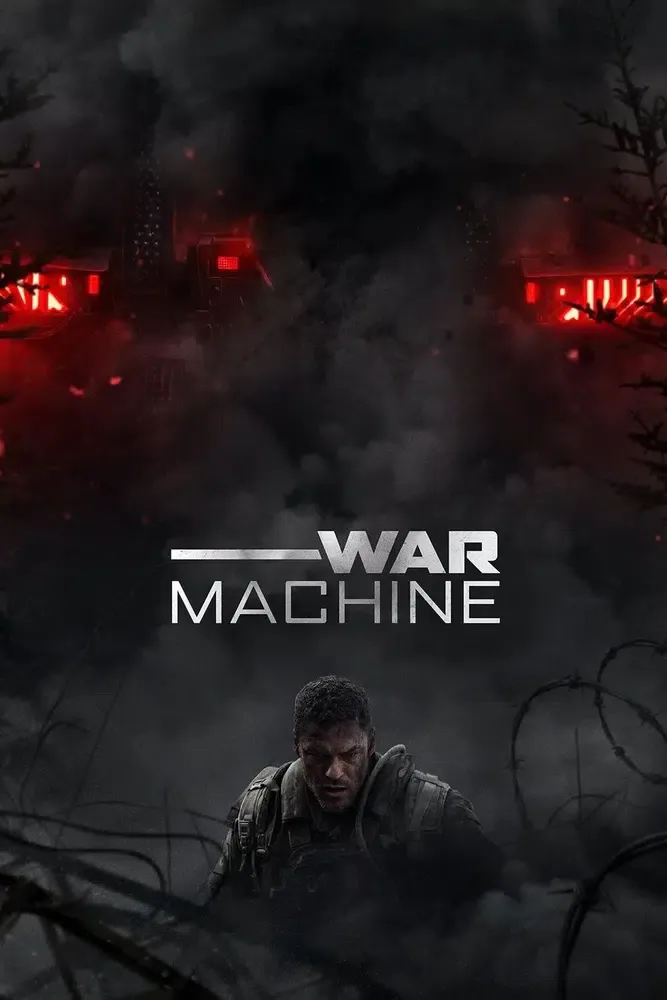
"Who is the War Machine?" I asked myself while watching Netflix's new film. The possibilities are endless, or three. And, more importantly, only one of them can be seen as a metaphor for fascism.
But other critics have not given this film the attention it deserves. "Big robot go boom. Big man with big biceps go big boom." That's the reaction I heard from some of my pseudo-colleagues regarding War Machine. I pity them as the fools they are. In truth, this film might be one of the best adaptations (most likely, the only one so far) of Gilles Deleuze and Félix Guattari’s concept of the war machine put to film.

And that is no accident. As I'll explain, the parallels, echoes, and improvements between book and film must be intentional.
Oh, well, par sit fortuna laboris. I did the work of the critic, so I deserve the praise of being the only one who has seen this film the way it was intended.
On the surface, War Machine is a dull sci-fi action "movie" about a group of Army Ranger candidates stranded in the forests of Colorado and hunted by a mysterious and deadly robot. This is a valid reading of the film; however, validity doesn't erase stupidity.
This political and philosophical drama explores the ways in which the State absorbs the nomadic war machine, yes, but it also hints at something scarier and uglier than a robot from outer space, but just as inhumane (although, quasi-paraxodically, never inhuman): fascism.
So, who is the war machine?
The first, most obvious reading (and therefore the worst reading) is that the robot itself is the machina bellica. This is the first level, where most passive viewers make camp, unaware of the summit of analysis that awaits beyond the fog of complacency. Yes, indeed, this cold, inorganic being terrorizing a group of soldiers in the woods of Colorado is a war machine, but only in the most literal sense, which is boring and dull.
Moving down the list in terms of obviousness (but not in terms of rightness), is that the character 81 is also the titular War Machine. This makes sense, as the man is built as a proverbial (but also quite literal) motherfucking brickhouse. And he is, of course, that guy (in this case, that machine). But ending my analysis here would be a case of intellectual testiculi caerulei.
Another reading of the text is politically necessary and more epistemologically satisfying. As I've said, in an exquisite Deleuzian twist, War Machine exists as a faithful yet apochryphal adaptation of the ideas presented in the book.
As the philosopher makes clear, the State has no war machine of its own; it can only appropriate one. The war machine, as a concept, is a way of existing, rather than a weapon; not merely an object of war, but a creative, transformative, nomadic energy.
The war machine is a form of power that exists outside the State. A lesser film would have trouble showing this idea visually and dramatically. However, War Machine is no popcorn movie.
Nomadology

#Vanlife is the war machine.
Iterandum est, the State does not create war machines, it captures them. The first half of the film encapsulates this perfectly.
The first glimpse we get of 81 is his rock-solid body in the desert of Afghanistan next to a convoy. This is all shorthand to show us the character as a nomad. Think, of course, of Mad Max's Road Warrior.
Before attempting to join the Rangers, 81 exists on the margins of military life: a mechanic, a fixer, a drifter moving from place to place. His past is marked by the death of his brother and the tattoo they share, “NFD: Never Fucking Desist”. This characterization places him outside institutional identity. In Deleuzian terms, he embodies a line of flight: a force of movement, possibility, change.
However, this begins to change the moment 81 attempts to join the Rangers. This begins his process of being co-opted by the State. In other words, Ranger training is how the war machine is domesticated. A similar idea can be found in the upcoming, posthumous Henri Laster book, Administrative Violence and the Death of the Nomad.
81 is raw nomadic possibility. We see this aspect of him in two realizations: his creativity and his outsideness.
Take a look at the way he fights. The rugged muscleman is actively foraging the land, affecting it to his volatile will to fight an asymmetrical, creative, guerilla-style warfare of survival and adaptation. Without weapons, without radio, without proper training, he must fall back on his nomadic identity to eliminate the robot.
This , in my humble opinion, is a perfect dramatization of the chess versus Go idea in the text. For Deleuze, chess represents the logic of the State where every piece has a fixed identity and a predetermined role. On the other hand, Go represents the nomadic war machine, where the stones are all identical. Their only meaning comes from movement and position.
In the film, the State can't fight back against the robot in a chess match. Its only option is to exploit 81's Go prowess.
What is the robot?
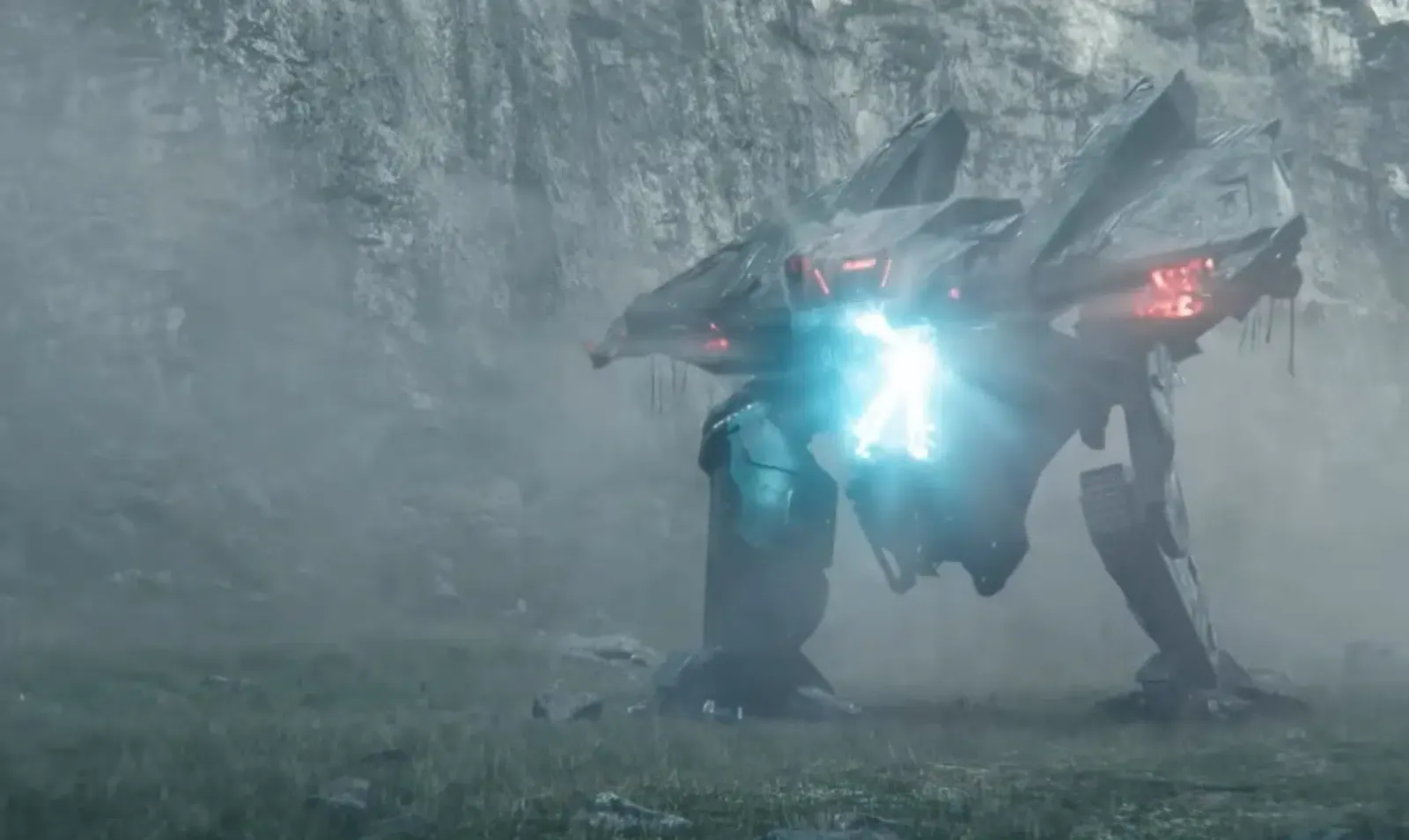

Not quite the same.
The robot in the film is the State's self-referential wet dream. A cold machine of logic, grids, hierarchy, topography, sensors, order, obedience, verticality, rigidity, stability, overcoding, of monopoly of power and violence.
In order to achieve this fantasy, the lesser State must wage war, and the only way to win this war is by absorbing the nomadic creativity and ways of existing, even if only temporarily. However, the film doesn't end with the destruction of the robot. The final sequences show the real political tragedy that is War Machine.
In the end, it is revealed that this robotic invader is one of thousands in the first wave of an alien attack on Earth. Every military in the world is preparing for a new wave of "tens of thousands" of these metallic beings.
But then, almost as if this was the planned outcome, Earth mounts a counteroffensive. Instead of the chaos we would expect, we witness the birth of a global military preparing for endless war. Around the world, war machines everywhere like 81 are being absorbed into the apparatus of the State, a global State.
The irony here is how heroic this is supposed to be. After the first battle, 81 delivers a speech to his fellow soldiers; he encourages them to fight on as brothers while the American flag watches over them in the background.
War Machine wants us to ask ourselves a question. What happens after the last robot is felled? Do you think the global State disbands? All these people absorbed into the State now have order, hierarchy, a target for their violence, and without the external threat, that bricked up political energy most explode somewhere.
Could it be that it will explode in our faces?
It beehoves us to look back on one of Felix Guattari's musings: everyone wants to be a fascist.



Comments 4