With Thelma & Louise, I’m on board #8M2026
General Reviews
I had always heard cinematic references to Thelma & Louise, and for one reason or another, I had never given myself the chance to watch it. But there is no time that does not arrive, nor destiny that cannot be reached. And just like them, in that seductive 1966 blue convertible Thunderbird, crossing the Californian desert highways… I escaped (a little) from this world that contains us.

About the story
In the late eighties, Callie Khouri, the screenwriter behind it, wrote the story as a direct response to the lack of active female representation in cinema, while working at a music video company in Los Angeles. For six months, the story lived in her head; she wrote it by hand and transcribed it over and over again in her office. Secretly. The script was rejected several times for its defiant tone and unconventional ending, until the now legendary Ridley Scott read it. He decided to produce and direct it himself, convinced that such narrative strength should not be diluted. Needless to say, Thelma & Louise won the Oscar for Best Original Screenplay.
Ridley Scott
Scott had already shown sensitivity toward female protagonists. In Alien (1979), he agreed to turn the character of Ripley into a woman—a proposal that culminated in one of the greatest female figures in science fiction cinema, played by Sigourney Weaver.
Casting
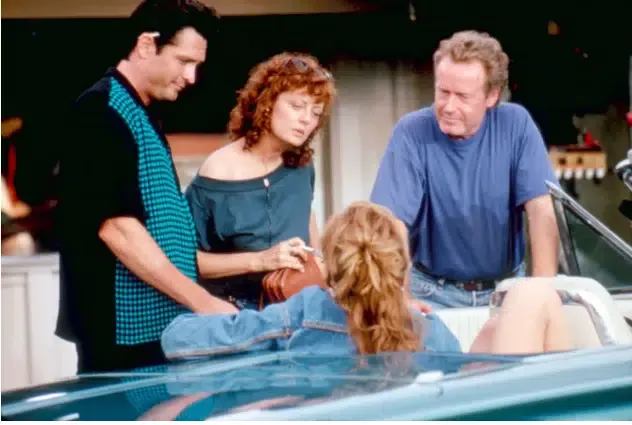
So, in Thelma & Louise, the choice of cast was key to the film’s emotional and cultural impact. Susan Sarandon, who had already been nominated for an Oscar for her role in Atlantic City (1980), was selected to play Louise: a strong, reserved woman with a painful past that drives her to make radical decisions. On the other hand, Geena Davis, Oscar winner for The Accidental Tourist (1988), brought Thelma to life: a naïve housewife who evolves into a bold and empowered figure. It is worth noting that both actresses were nominated again for these roles.
The casting also included Harvey Keitel, as a detective who tries to help our protagonists (so different from his role in Taxi Driver). It also featured Brad Pitt in a memorable performance that marked the beginning of his career, and the late Michael Madsen.
What makes the film special?
The first thing that comes to mind is Adrian Biddle’s cinematography, which captivates us with a desert aesthetic that evokes the road trips of classic American westerns. It perfectly accompanies Louise’s rough, mysterious, and beautiful spirit, as well as Thelma’s curious and exploratory nature.
The ending and its resonance
Finally, and no less relevant, the volatile and decisive ending rises as the story they embody. A story that emerges in a society marked by violence against women, misinformation that distorts their struggles, the manichaeism that simplifies their voices and reduces them to extremes, and the urgency of a collective awakening.
In the context of March 8th, the memory of Thelma & Louise is not just a cinematic tale—for me, it is an example of rebellion and stolen dignity, a cry that crosses generations and reminds us that freedom, though fleeting, can be an act of poetic justice against a world that insists on denying it.
From Mexico, a country burdened with femicides, structural inequalities, and a pain repeated in every mother searching for her daughter, this reflection is my way of shedding light on a struggle that should be daily, and shared by all.


Comments 1