Between dogs and stages: The cinema of Luc Besson
General Reviews
Luc Besson is a director whose filmography can be read as a journey from urban stylization to pop science fiction. His early works, such as Le Dernier Combat (1983) and Subway (1985), introduced him as a specialist in enclosed atmospheres and marginal worlds, where the city itself becomes an oppressive character. With The Big Blue (1988), he broadened his scope, exploring immersion in extreme universes and the obsession with human limits. And in the early 1990s, he consolidated his style with Nikita (1990) and Léon: The Professional (1994), films that portray violent yet profoundly human characters, always in tension with society.

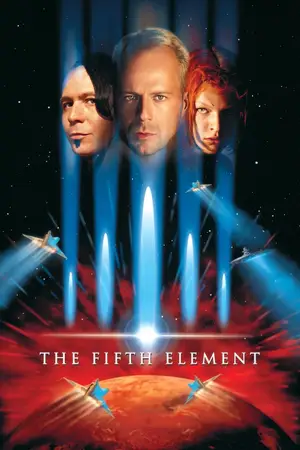
But his leap into cult cinema came with The Fifth Element (1997), a dazzling display of baroque and colorful science fiction, where visual aesthetics prevail as the driving force of the narrative and position him as a creator of pop universes.

Then came more ambitious and uneven explorations: The Messenger: Joan of Arc (1999) attempted the historical register with controversial results, while Angel-A (2005) returned to the intimate and poetic. The Arthur saga (2006–2010) took him into animation, and later Lucy (2014) and Valerian (2017) bet on visual spectacle, though they were criticized for excess and lack of narrative cohesion. I admit, they don’t seem to me his strongest works either.
In recent years, Besson returned to his roots with stylized thrillers such as Anna (2019), which evoke Nikita. Finally, Dogman (2023) emerges as a synthesis of his trajectory: a dark and visceral tale that revisits the marginality of Léon, the symbolic animality of The Fifth Element, and the psychological tension of his early works. Here, dogs function as a metaphor for loyalty and survival, while the protagonist embodies the fracture between humanity and bestiality.

Douglas’s life in Dogman is, quite literally, a dog’s life. He grew up scarred by abuse, abandonment, and violence, and found in “those animals” what society denied him: loyalty, companionship, and a sense of belonging. Like stray dogs, he survives on the margins, feeding on scraps, seeking warmth in the pack, defending his territory tooth and nail. Yet with so much love to give.
Douglas is as loyal and protective as a dog, but don’t be mistaken—he has no masters—only peers, the other outcasts of society, those whom institutions fail to protect and official society refuses to acknowledge.

The protagonist of Dogman is played by Caleb Landry Jones. His career began with a small role in No Country for Old Men (2007), but he soon established himself with appearances in films such as Get Out (2017), The Florida Project (2017), and Three Billboards Outside Ebbing, Missouri (2017), where he won a Screen Actors Guild Award. Later, he starred in Nitram (2021), a role so intense that it earned him the Best Actor award at the Cannes Film Festival and recognition from international critics.
The Scene
Drag in Dogman is not a mere aesthetic device; it is a metaphor for survival, ultimately reclaiming a stage that never belonged to him. The song becomes a silent cry: “I am more than what you made me.”
Critics have pointed out that this blend of dogs and drag is one of the film’s most eccentric and brilliant traits, because it breaks away from somber realism and opens a space of theatricality that reveals the complexity of the character. It is a moment where the dog’s life intersects with the life of the stage, and where Douglas, for an instant, ceases to be discarded and becomes the protagonist of his own narrative.
Luc Besson
In Dogman, Luc Besson not only returns to his roots—he takes them to the extreme. Douglas is the testimony of a dog’s life, marked by abuse and exclusion, but also by loyalty and the capacity to love unconditionally. Today, at 66, he embodies the maturity of a filmmaker who has traversed multiple registers and styles. A filmmaker who, through extravagance, fantasy, and paradox, bites like a dog.


Comments 1