Sweetness Feels Like Gen Z’s Misery, Rewired Through Pop Fandom
General Reviews
Sweetness wastes no time establishing that it is operating in the language of horror, even before it commits to the genre outright. The opening shots feel ominous and distant, paired with a score that sounds warped and faraway, as if emotion itself has been pushed out of reach. This is a film about idol worship, yes, but more specifically about how grief, adolescence, and pop culture collapse into something volatile when no one intervenes. From the jump, it plays like a quiet cousin to Misery, less interested in spectacle than in the slow formation of obsession.
Rylee is introduced as an outcast in ways that feel contemporary and sharply observed. Starface acne stickers double as fashion accessories, part of a Gen Z comfort with normalizing skincare rather than concealing it. Her best friend Sidney, with her tooth gems and fashion-forward confidence, exists in contrast to Rylee’s awkwardness. They sneak alcohol into a concert, a small act of rebellion that situates them squarely in that teenage limbo phase where risk feels thrilling rather than dangerous. At home, Rylee’s world is just as unsettled. Her mother is gone, her father is emotionally absent, and his new girlfriend represents an intrusion she cannot articulate but deeply resents.
The concert sequence is where Sweetness first reveals its true obsession. The shots of Payton Adler onstage are ethereal and dreamy, bordering on unreal. He is framed less as a person and more as an apparition. A spotlight lands on Rylee in the crowd, a gorgeous and unsettling visual cue that collapses distance and feeds her belief that she is seen. When Payton delivers his final line before the band kicks back in, his hands are shaking. The film lets that moment breathe. Idol worship here is not about fantasy alone, but about recognizing damage in someone else and mistaking it for intimacy.

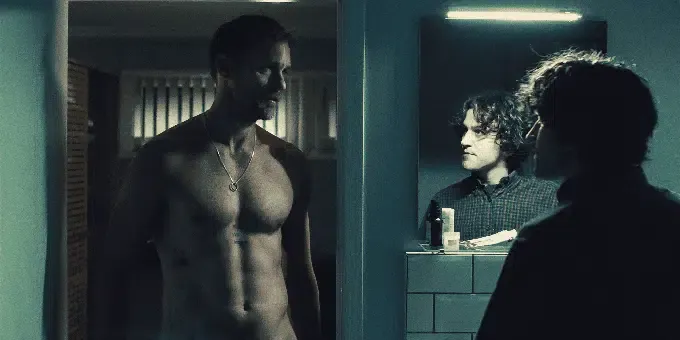
That intimacy curdles quickly. Rylee eavesdrops, follows, inserts herself. When Payton steals a car and hits her with her own vehicle, the incident feels chaotic rather than sensational. He is already in withdrawal, already unraveling. She drives him as he picks up drugs, misreading proximity as flirtation and concern as desire. The knock on his door later is childlike and tentative, loaded with confusion about sex, power, and validation. She wants to be chosen. She wants to matter.
When Rylee’s past trauma resurfaces, the film sharpens into something more dangerous. Her grief stops being background texture and becomes the engine of her logic. From this point on, Sweetness is less interested in plot than in mindset, tracking how care can become coercion when pain goes unaddressed and boundaries dissolve. This is where the film most clearly echoes Misery, positioning Rylee as a Gen Z echo of Annie Wilkes: not a caricature of madness, but a deeply wounded person who mistakes fixation for purpose and control for love.
Visually and thematically, the film leans into its psychological horror lineage. There are shades of Gerald’s Game in the physical restraint and isolation. The setting itself feels like it’s channeling the Disney Channel original movie Stuck in the Suburbs, complete with pop-star mythology and the false promise that access is intimacy, before quietly dismantling that fantasy. The childlike nature of Rylee’s reasoning, filtered through grief and idol worship, becomes increasingly dangerous the longer it goes unchallenged.
Music plays a crucial role in reinforcing this collapse. The sound design frequently blurs the line between diegetic performance and score, mirroring Rylee’s inability to separate fantasy from reality. A choral needle drop late in the film lands as both mournful and deeply unsettling, transforming a familiar pop expression of pain into something communal and hollow. It underscores the film’s central tragedy: the belief that someone can be changed without their consent and that love can justify control.
Sweetness is not subtle, but it is precise. Like Misery, it understands obsession not as sudden madness, but as something carefully built through isolation, unmet emotional needs, and the absence of intervention. It understands idol worship as a form of trauma dumping, grief misdirected toward figures who feel safer than real relationships. It understands adolescence as a fragile space where moral reasoning is still forming and easily hijacked by pain. Most unsettling of all, it understands how violence can hide behind the language of care, especially when no one is paying close enough attention.
By the end, the title feels bitterly ironic. Nothing here is sweet. What remains is the horror of recognition: a girl was hurting, no one helped her, and the fantasy was allowed to harden into something irreversible.



Comments 3