The Housemaid Made Me Realize...
General Reviews
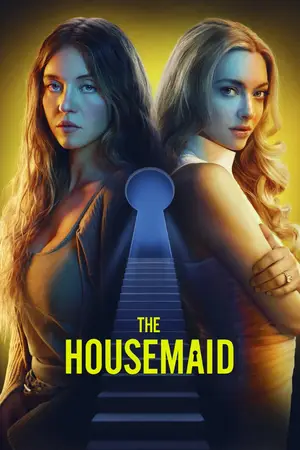
I went to see The Housemaid for the same two reasons that every other man went to see The Housemaid. I was skeptical, at first, as I waited for the steamy scenes to fog up my glasses. However, instead of the erotic romp that I expected, what I received was a somber warning, an alarm bell, regarding men's roles in today's society and why women are society's saving grace. After having a series of very serious realizations, I walked out of the theatre a changed man.
My deeper understanding of humanity began early in the film when Cece (Indiana Elle), the daughter of Nina (Amanda Seyfried) and step-daughter of Andrew (Brandon Sklenar), tells Millie (Sydney Sweeney), the new live-in nanny, that juice is a privilege. This line of dialogue sent my mind spinning like the wheels of a white 2025 Jeep Wagoneer, as I tried to understand what this clairvoyant child was implying. What I realized is that the patriarchal system Cece was raised in had turned something as innocent as juice into a weapon. This small moment commented on the twisted nature of our closest relationships, but it wasn't the last time such connections were dissected in this film.

Nina and Millie's relationship is anything but smooth, and that's largely due to Nina's unpredictable actions and Millie quickly developing the hots for Andrew. Millie, coming off a 10-year prison bid, is new to this technologically advanced world, and it takes her (and the audience) by surprise that her new iPhone, gifted to her by Nina, also acts as a tracking device. This story beat made me realize that, so long as this hard cold brick is in my pocket, I will never truly move in silence. After the film, I was ready to throw my phone into False Creek, until I thought better of it, as I realized that Nina only used the phone to advance her noble goal.
Through most of the movie, I thought that Nina was acting totally crazy, but then I realized that she is actually the film's most sane person. She had to act neurotic to get her justifiable wants. It made me rethink all the times that I called a woman crazy and how I now understood that women only act insane to reach a necessary and valid conclusion. Nina's life is a chess match where her moves may seem illogical until she checkmates the king.

Nina's mental state is just one of the many instances where looks in The Housemaid are actually deceiving. There is also the opening where Millie wears glasses, but then it's revealled that she actually doesn't need glasses — she only used the bifocals to appear smarter to her would-be client, Nina. Or the million-dollar smile of Andrew, which is disarming and surely could never hide the mind of a psycho. Then there's the gardener.
Chat, we need to stop jumping to conclusions about gardeners. Enzo the gardener (Michele Morrone) may seem standoffish at first, but don't let his aloofness perturb you until the full picture is revealled. Why does he speak English only to later claim that he doesn't speak English? Like Nina's "craziness," Enzo's inconsistencies serve a greater good, and The Housemaid made me realize that a gardener is friend not foe!

Who is definitely a foe is the man in the wifebeater. For most of the film, I thought that director Paul Feig chose to have Andrew dressed in a wifebeater for a surprising number of scenes in order to show off the actor's boulder shoulders. Although that's partly the reason, the costume choice more importantly served as a foreshadowing symbol of Andrew's evil intent. How could I have been so daft as to not realize that the man in the wifebeater was the one that I truly should've feared?
And that led me to the biggest realization I had while watching The Housemaid: Men are evil. In the world of The Housemaid, which is an allegory for our real world, men are either control freaks, crooked cops, university professors who knock up their students and then disappear, high-profile lawyers who don't understand that new mothers lactate, high-school students who rape their girlfriends, or Italian gardeners. Does this not perfectly reflect our reality? These are the boxes we, as men, fit in and, until we change our ways, we will not receive greater representation, because we do not deserve it.

Alfred Hitchcock tried to warn us in 1960 that us men must solve our mommy issues, but did we listen? Evidently, in 2026, guys still can't get out from under the shadow of their mothers. Fellas, we need to do better. If we continue to act like Andrew and bend to the will of our overly praised matriarchal figure, then we will never love our wives the way they deserve to be loved.
We should learn a lesson from the women in The Housemaid who prove that team work makes the dream work. The film is a psychological thriller, but hidden under the surface is a treatise on the power of female collaboration. Millie chooses not to resent Nina for psychologically abusing her to achieve her individualistic goal, but rather the two women work together to bring down the film's true villain. There is power in sisterhood and we (the brotherhood) must work together if we are to harness this same power for our own benefit.

What else did I realize... Oh ya! Wood doors are actually really strong. See, there comes a point in The Housemaid where Andrew, six-foot-five and all of 220 pounds, gets trapped behind a wood door. Despite bashing his boulder shoulders into the pine (maybe it's teak), he just can't get through. It made me feel much more secure living in my wood-frame house as I always azzumed that a murderer, if one was coming to get me, would be able to easily bash through my door. The Housemaid made me realize that wood doors, like gardeners, can be trusted and that you can't break through one even if your life depends on it.
I also realized that it actually wouldn't hurt that much to stab yourself in the stomach 21 times. See, there comes a point in The Housemaid where Millie must take a sharp piece of china porcelain and make 21 deep cuts into her tummy. At first, it looks super painful, but then you realize that, for one, 21 cuts to the gut actually don't bleed that much — she didn't get a drop of blood on her American Eagle jeans — and, for two, you can actually get through an entire movie climax without treating your wounds or even wincing in pain. Millie even takes time to drink a bottle of champagne, which doesn't thin her blood at all and doesn't increase her blood loss. Turns out, 21 cuts to the gut ain't that bad!

Perhaps the most useful thing I realized was that it's actually really easy to get away with murder if the person you murder is a bad guy. Despite gasoline on the floor, an alarming amount of broken china and human-shaped dents in the wall, a cop will believe your story that the person fell by accident if that cop is (a) a woman and (b) has a sister who was engaged to the bad guy prior to the events of The Housemaid. As per this film, New York detectives will take the word of the beat cop who took the witness testimony as gospel and will not bother to investigate the crime scene further — I'm sure this information will prove invaluable to Millie in The Housemaid 2.
Finally, if there is one last thing that I realized, it's that I should always, always carry a cheque for $100,000 in my pocket. As Nina and her daughter watch her husband get lowered into the dirt, she is shocked to see that Millie is off in the distance watching the funeral (love this concept; hope to see it used in more films). Nina approaches Millie and says that she wasn't expecting to see her there and then hands her a cheque for $100,000 to start life anew. It just goes to show that, if you aren't expecting to see someone, you should still carry a large-sum cheque around in case you run into them even if it's in the most unlikely places — like at the funeral for the man that she killed.
The Housemaid was a wonderful start to the new year. I expected a steamy thriller and what I got instead was an educational tale that showed me my need to change for the better. I'm not sure if my life will ever be the same, as I work to resolve my mommy issues, cut ties with every man I know, throw my phone into the ocean, get away with countless murders, and never take juice for granted again. The Housemaid made me realize that I am the problem.







Comments 8