Has Movie Club Gone Too Far?
General Reviews
It's always the person you least expect. As you may know, I host Movie Club every month where we discuss a specifically selected movie. We decide who will pick the next movie by spinning the infallible digital spinning wheel of fate. The only rule is that the person picking the next movie must pick one that they've not seen. After we discussed Mandy at the November Movie Club, the wheel was spun, and it landed on Lola. I happen to know Lola personally. She is one of the kindest, softest-spoken and sweetest people I've ever met. Naturally, she picked one of the most bizarre, triggering, controversial and cultish movies ever made.
After watching this month's pick, I couldn't help but wonder if Movie Club has gone too far. I'm all for watching bizarre films, but if we end up in a cycle of trying to out-weird the last movie, we might end up in waters we don't want to swim in.
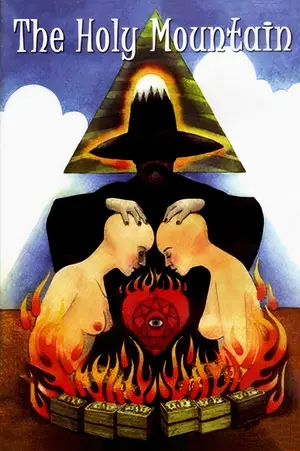
Lola picked The Holy Mountain, a 1973 film created by Alejandro Jodorowsky. The Chilean writer, director and star is famous in avant-garde circles, but this was my first time watching one of his infamous movies. I expected The Holy Mountain to be weird, and it did not disappoint. Although I like surrealism and symbolism and the avant-garde, The Holy Mountain rubbed me the wrong way. I'm always game to watch a weird movie, but this one felt more obsessed with taking things too far than offering any substance.

Doing my research for this article, I read some of Jodorowsky's extensive Wikipedia page. I found one quote from the director that I found particularly illuminating. Regarding finding success in America, Jodorowsky said, "I had to break through using the only tool I had: shock through scandalous statements." This is in reference to some heinous quotes he gave to magazines back in the 1970s, but I think that it also applies to The Holy Mountain. I felt that he used the guise of mysticism to expose his audience to intentionally provoking imagery.
Surrealist movies are often bizarre while still being thought-provoking. The Holy Mountain thinks that it is insightful, but I refute such an idea. To me, Jodorowsky seems more interested in shocking the audience to increase his celebrity and reputation. He's more focused on himself than on offering humankind a truly spiritual film.

The Holy Mountain is far from a religious experience. Indeed, it's quite sacrilegious. The opening sequence is loaded with Christian imagery that is mixed with visual profanity. Clearly, this is meant to cause a rise in the viewer. As the film continues, it delves deeper into Western mysticism, which Jodorowsky evidently holds more reverence for than Christianity. However, watching a man defecate to create gold and that being used as a spiritual teaching was a bit much for me. As was the film's common thread, Jodorowsky seems to be trying to provoke me rather than teach me.
There's a scene where The Thief (Horacio Salinas) stands in a round room with The Alchemist (Jodorowsky), and all around them are various tarot-card-like paintings. Jodorowsky has the camera evenly pan across these portraits until the camera lands on one where two people are having sex while the woman vomits. The camera's pan slows here. He cuts away and then cuts back to the grotesque painting, forcing the audience to absorb it for longer than all the others. Jodorowsky insists that we look at this unpleasantness, but he does not use this image to deepen the film's meaning.

This movie's ambition also greatly outshoots its budget. The sequence where we are introduced to these people who all represent the planets in our solar system is a prime example. Each of these stories are supposed to represent life on these different planets, but they are all so Latin American. I know it sounds like I'm not giving sympathy to the allegory, but it's glaringly evident that this film is hindered by its economic and geospatial constraints. All these different worlds feel extremely Latin American because the film was shot in Mexico and there was no real budget to differentiate the people and planets other than through dialogue. These scenes from the planets vary from ridiculous to disturbing. It's ridiculous to watch some guy with his gigantic phallic rod try to have sex with a big computer-like machine. It's disturbing to watch a cult chop the penis off its newest member.
The Holy Mountain is overly obsessed with sex. This, I think, goes back to Jodorowsky's debilitating fear of audience indifference. I think he loaded the film with sex so that people would go see it, not because it furthers the film's symbolic narrative. I think sex certainly has its place in any spiritual journey, but this obsession becomes quite one note and hinders the film from getting to any substantial insights.
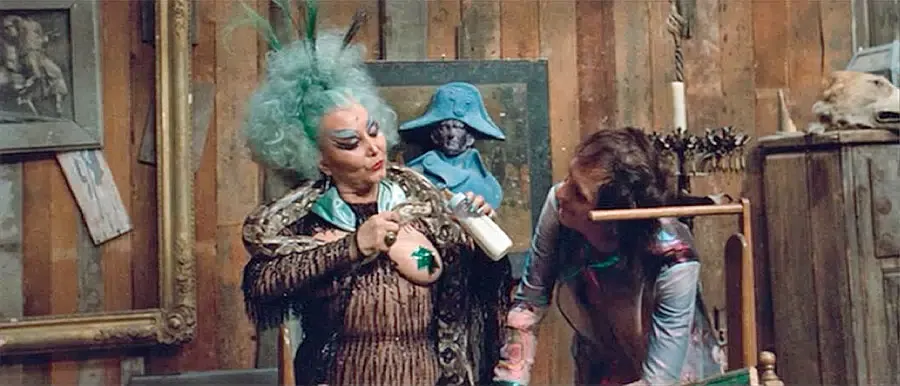
When it's not obsessing over intercourse, it's showing us the most disturbing scenes the writer-director can imagine. Nowhere is this clearer than near the end of the film when the cult-like group walks through a meadow, and we get a glimpse into each member's worst fears. There's a real dog fight, which is uncomfortable to watch, as well as way too many dead chickens. Jodorowsky shows the fear of all these people, but what does this imagery resolve? It's uncomfortable and shocking to watch, but does it lead the audience to a deeper understanding of our existence?
In truth, I felt bad for the actors in The Holy Mountain. Because of Jodorowsky's singular vision, they are victims of all sorts of uncomfortable situations. It's not uncommon for actors to push the boundaries of comfort in the name of art, but The Holy Mountain feels like it takes things too far. Like when The Alchemist has his subjects imagine letting go of everything and every person in their lives. The actors break down in visceral, unflinching tears. It's tough to watch and, from an acting perspective, I applaud these men and women for going to such depths. However, when the scene ends, there is no reward for their emotional sacrifice. The film just carries on to the next section, making this emotional breakdown feel superfluous. It was more like watching a cultish rite of passage than a film. I felt that the actors were being taken advantage of in the name of Jodorowsky's ridiculous ideas.

The ending, especially, left me wanting. Rather than provide the promised insight of the journey, Jodorowsky breaks the fourth wall, calling on the characters and the audience to leave the holy mountain and continue with their real life. This choice left me wondering why I spent two hours watching all this disturbing imagery only to get told to pack up and leave. It's absurd, and it didn't leave me feeling very good. I wasn't expecting this movie to have the secrets of the universe, but a movie this grandiose and ambitious and sure of itself, I thought, would reach some sort of conclusion.
Has Movie Club gone too far? I mean, it's not supposed to be a place with limitations. If these are the kinds of movies that fester in people's curiosity, then so be it. I hope, in the new year, that we don't feel the need to always pick the most bizarre movie on our watchlist. But, I must admit, that I'm happy Lola picked this film because it gave me a reason to finally sit down and watch it. Although I was disappointed, I admit that The Holy Mountain is unlike anything I've ever seen before. I think this film will make for an insightful conversation at Movie Club, but I don't think I'll be making another trip to The Holy Mountain any time soon.

Join us for Movie Club on Wednesday, December 17, at 6 pm PT. We will discuss The Holy Mountain in depth. To access the Movie Club meeting, join the Peliplat Discord here. Everyone is welcome to join.




Comments 6