My Top Five Spider-Man Stories (Outside of the Movies)
Recommendations
The other day, for the first time in a while, I picked up a Spider-Man comic at the library. It got me thinking about my personal history with my favourite superhero. You don’t need me to tell you that Into the Spider-Verse is great, but I thought I’d run down five stories in other mediums that endeared me to the old webhead.
If you’re a casual fan, maybe you’ll find something of interest here, and if you’re hardcore, you can make fun of me for my basic choices*. Either way, let’s jump in:
*These are all pretty recent too, would love recs for older stories if you have them!
5. Spider-Man: Life Story

(Comic Book, 2019, Written by Chip Zdarsky, Pencils by Mark Bagley)
The book that got me thinking about this list, and a very interesting experiment from writer Chip Zdarsky. Zdarsky, whom I mostly associate with the comedy genre, takes a holistic approach to Spider-Man’s story here. The hook: What if Spider-Man had actually aged since his debut? What if the teenager who was bitten by a radioactive Spider in the 60’s was growing older through the key events in the character’s history?
The results are a mixed bag, but I really admire the ambition. I love that the story is focused on Peter’s emotional headspace above all else, but I sort of wish the plot wasn’t so devoted to the Marvel continuity. I guess that was the whole point, but it’s just not something I personally care for. I’m not someone who has read every single Spider-Man comic since the 60’s, and especially divorced from their context, some of the storylines here are hard to take seriously. Plus, aging the character up through the 2010’s means we are looking at an elderly cast of characters for most of the book. Iron Man and Doc Ock are still fighting into their 80’s, and it feels a little goofy.
Still, it’s the kind of thought experiment I think mainstream comics could use more of, and the final panel is quite moving. Worth a look for spider-heads.
4. Spider-Man on PS4

Video Game, Insomniac Games, 2018
Probably not the most original pick in the world, but I was surprised by the care taken in the writing of this game.
To be honest, I don’t remember a ton about the story, just that the characters popped, the performances were strong, and I loved the ending. It was bold for a game to make a status quo change like that, but it was memorable and served the story. And the writing must have been good, because I made the extremely rare decision not to mute the audio and listen to a podcast. Gaming’s highest honour!
Of course, the real draw here is the gameplay. The combat had a unique Spider-Man flavour, and swinging around New York was a total joy. I should really pick-up the second game, which I’ve heard is even better.
3. Spider-Man: Blue

Comic-Book, Written by Jeph Loeb, Penciled by Tim Sale, 2008
I’d call this a more successful attempt at what Spider-Man: Life Story was trying to do, but maybe it’s just more to my taste.
Like Life Story, Spider-Man Blue tries to take Peter’s emotional state seriously, but it’s a shorter story that wisely limits its scope. A middle-aged Peter Parker has settled down with Mary-Jane Watson, but one Valentine's Day he finds himself thinking about the late Gwen Stacy. The book tells a more detailed vision of their love story.
The story is light on action, and heavy on emotion. I like the specific complexity of Peter lamenting a lost love while married to another woman, not something you’d typically see in a superhero comic. Tim Sale’s art deco style,* which as you might expect - foregrounds the colour blue - sells the melancholy of comic's most famous tragic romance.
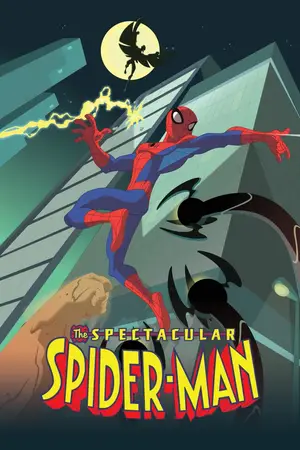
2. Spectacular Spider-Man

TV Cartoon, 2008-2009
When I was 15, I took a trip to Chile with my mother. Almost immediately, I got pneumonia, and spent most of the trip sick in bed. I still look back on the trip fondly for a few reasons, but I’m sorry to say that a big one was Spectacular Spider-Man. The series was available on Chilean Netflix, and I watched the entire thing.
Initially put off by the goofy art style, I was quickly sucked in by the quality of the series’ writing. The show had ambitious, overarching storylines, fun recurring villains, and an empathetic approach to Peter’s characterization.
According to my extensive research (Wikipedia), producer Greg Weisman described the series’ main theme as “the education of Peter Parker.” In a linked interview, he says the show covers the years where Peter is “learning the lessons that will make him Spider-Man.” The fact that a showrunner was even talking this way about a Spider-Man cartoon points to a real desire to make something special.
Spectacular Spider-Man wasn’t just the best Spider-Man show, it was a good show, period. It had things to say about growing up, and the true meaning of responsibility. Plus, that theme song was a real earworm. Too bad about the early cancellation.
1. Ultimate Spider-Man

Comic Series, 2001-2011, Written by Brian Michael Bendis, Penciled by Mark Bagley
In the early 2000’s, Marvel Comics realized that a series of high profile film adaptations had the potential to bring in new readers. The only problem: the main Marvel titles were bogged down by 40 years of complex continuity, and were completely impenetrable to newcomers. The solution? Marvel launched the “Ultimate” label.
Spider-Man, the X-Men, The Avengers, and The Fantastic Four all had counterparts in the “Ultimate Universe” , an alternate continuity that would (in theory), be accessible to new fans.
I was all in. I tried every series, and stuck with Ultimate X-Men for a while, but a clear favourite emerged. Ultimate Spider-Man did nothing less than alter my brain chemistry, and remains not only a major influence on my writing but also my worldview and personality.
Set in the “modern day” of the early aughts, and written with hip, MTV-esque dialogue from legendary writer Brian Michael Bendis, Ultimate Spider-Man felt adult without being superficially dark or edgy.
As a kid, I felt like I was getting away with something by reading storylines that dealt with dating or sex. But Bendis handled these themes maturely, especially considering the time period and medium. USM's strength came from treating its situations with a sense of emotional realism. A moment that has stuck with me for many years involved Spider-Man’s flirtation with the cat burglar Black Cat. The pair share a kiss, but when Black Cat removes Peter’s mask, she sees that he’s a literal teenager and immediately vomits. This was the Bendis approach. If these situations were real, how would people actually react?
Bendis' wry humanism set the bar through which I test every Spider-Man story: Does Peter’s prom feel just as important as fighting the Green Goblin? I loved seeing Spider-Man tangle with supervillains, but looking back I think Peter Parker’s personal life was the real draw. This was brought to life by the characterization of the supporting cast. Aunt May and Uncle Ben felt like authentic boomer hippies, Mary Jane’s half platonic, half romantic interest in Peter felt very true to life, and Gwen Stacy’s cool goth exterior believably melted away to reveal an insecure kid. Even Peter’s bullies eventually got humanized.
That reminds me of one of my favourite storylines. Dumb jock Kong figures out that Peter is Spider-Man, and decides to test it by kicking him into a locker at full strength. Kong thinks Peter will jump out of the way, but Peter figures out what’s going on and intentionally takes the hit. He breaks down crying in front of everyone, preserving his identity but humiliating himself. Then everyone turns on Kong because they’ve never seen Peter react in such an extreme way to his bullying. Again, just a very specific and detailed approach to the social dynamics at play. I recounted that from memory and I haven’t read the book in ten years.
I could go on and on about my favourite moments, and in fact I will: Spider-Man taunting Doc Ock about his bowl cut for like twenty issues before Doc Ock responds: “I like my hair.” Spider-Man catching wealthy buisnessman Kingpin on tape committing murder only for him to be exonerated anyway. Spider-Man’s fling with Kitty Pride. Daredevil’s disdain for Peter. The multi-issue build up of Kraven the Hunter, only for Peter to knock him out with one punch because he’s a regular guy with no powers. In Bendis fashion, Peter has to apologize to the assembled crowd because he didn't want to fight Kraven and didn't mean to hurt him.
This is all brought to life by penciller Mark Bagley, whose sharp, finely tuned expressions helped sell the humanity of the characters. Bagley eventually left the series (replaced by Stuart Immonen, a good artist), but by that time the magic was starting to wear off anyway. After ten years it started to annoy me that Peter was still in high school, and eventually the series introduced more and more outlandish situations to the point that both Iceman and Human Torch were living at his house.
This was the first and only comic series that I ever read month to month, and I was unused to the reality that most titles just lose steam after a while. The series eventually had a definitive ending, which I remember being okay. But I will always remember the Bendis/Bagley run. It’s my definitive Spider-Man, and I urge any fan to check it out.


Comments 3