Mamdani's Mom Is Cooler Than You
Sociocultural
When I heard that a Muslim-Indian man with a Muslim-Syrian wife was running for mayor in NYC, I was astounded. I mean, that does not happen, not in America. The news took over my life for a while; my whole family was ecstatic, and we're Muslim-Canadian, so go figure.
It wasn't just that he was Muslim (although it was a big part of it), but it was also the fact that he was so blatantly South Asian. With current politics, having such a figure pop out of nowhere like some pacifist Daredevil felt like refuge.

TikTok Won't Let Me Post It So Here's A Link: https://www.tiktok.com/@qsmpbolter/video/7569013875807407391?is_from_webapp=1&lang=en
That's, however, not why I'm here. I'm here because I recently went down a random rabbit hole and learned that the Mamdani family legacy didn't just begin with American politics. Apparently, Mamdani has super talented parents, especially his mother, Mira Nair.

So, this whole conversation started, actually, because of my mom. Apparently, when she was younger, she watched this rom-com called Mississippi Masala and absolutely loved it.
"Denzel Washington is so adorable in it. And Sarita Choudhoury looks gorgeous," she exclaimed.
Say no more, mother, you have caught my attention.
But, then, she added yet another fact, that really piqued my curiosity: "Mamdani's mom directed it."
I mean, I was already hyped for a South Asian political representative, and now we've got a woman in the creative arts who's paved the way with her own portfolio of work? Like, seriously, how much more could I admire the Mamdani family?
It turns out a lot more.
I didn't know much about Uganda's history until I watched this movie. One of the main things that I learned was how the Indian community was discriminated against and expelled from Uganda under Idi Amin's regime. A large population of Ugandian-Indians then travelled to the U.S. for refuge, which is what Mississippi Masala is about.
In its depiction of the expulsion from Uganda, one big sentiment was that "Africa is for Africans." When I first heard this quote, I was truly shocked. I'd just never seen a movie that delved into the history of an African nation, let alone one with desi protagonists. That was what made this movie so unique. It brought in an entirely different perspective to Western media in a way that felt relatable, authentic, and thought-provoking.
Mississippi Masala is about two main characters, Jay, the father, and his twenty-four-year-old daughter, Mina. When Mina was younger, she and her family lived in Uganda. However, due to political differences under the reign of the new dictator Idi Amin, the family was forced to flee.
In America, the family makes a home in Mississippi working for a family motel business. Years go by and Mina has only the vaguest memory of her time in Uganda; however, her father still grapples with the loss of his homeland.

This is a really important point in understanding the generational gap between Mina and her parents. So, Mina's parents are lowkey traditional and the family that they live with at the motel in Mississippi are also super integrated in Indian culture. Mina, however, was basically born and raised American, which situates her in this weird middleground where she doesn't quite fit in anywhere.
After getting into a minor fender bender, Mina meets carpet cleaner Demetrius who happens to also work for her family. Initially we get insight into how Demetrius' family is treated by White Americans (it's not very nice). This is how Mina's family bonds with Demetrius'. As people of colour, they recognize that there is a power hierarchy that puts them at a disadvantage. Mina's uncle even goes as far as to tell Demetrius that they are in this together, that no matter the colour, they are the same. However, this sameness ends the moment that Demetrius falls in love with Mina. I mean, think of what Jay went through in Uganda. He knows what racism feels like; he's been through it, and yet, when it comes to the African-American community, he is willing to put them through the same.
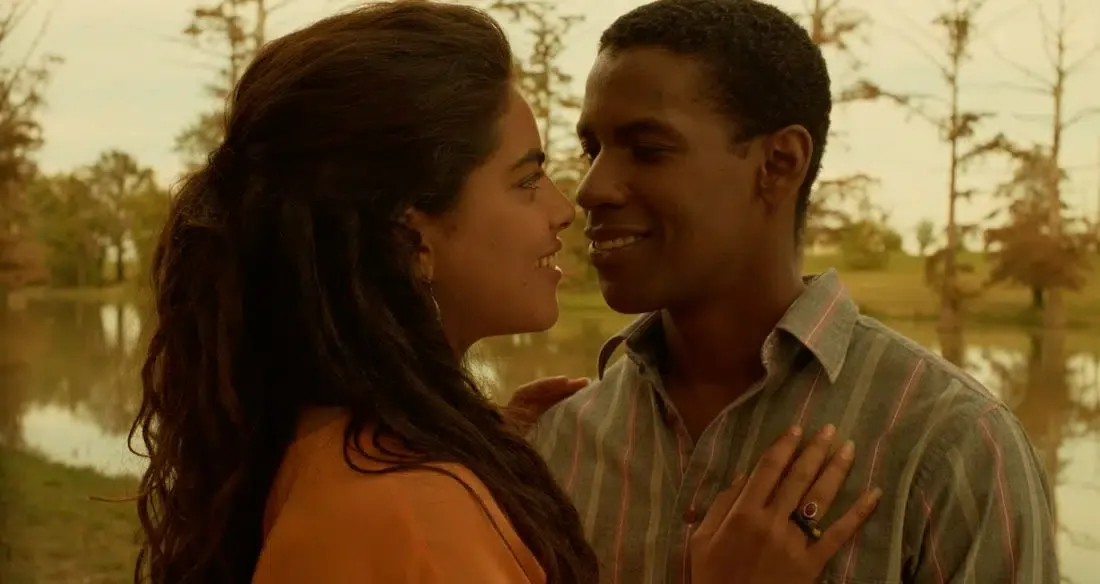
At a wedding that Mina later attends, one of the comments that the Aunties make is about Mina's skin tone being so dark and how that makes her less likely to get married. I felt that this was a really interesting point to pull out because it demonstrated a keen awareness of just how complicated race is. I mean, it was not in the least bit careful about calling out hideous double standards that exist within the Indian community, or how racism can be perpetuated within minority communities against other minority groups. It's a huge deal to be able to stand there and call out your own community for its double standards, and honestly, you can still see evidence of that mentality in desi culture (yes, I'm calling out Fair 'n Lovely). Colourism is real guys.
I mean, I've grown up hearing similar sentiments about skin colour. I've seen discrimination that exists against people within our own communities, and it was refreshing to see it being called out in this movie. I didn't think that the movie was attacking any one culture or mindset, either; instead, it simply put these contradictions into discussion. Maybe there are some viewers who watch this and feel personally attacked; in Mira's interviews, it was clear that she did receive backlash. However, I felt that this movie did what it needed to do in the most respectful way possible.

Obviously, I'm not claiming that this movie is a masterpiece. I mean, it is a 90s movie and some of the dialogue is crazy af— "Chinese don't do no hanky panky" (59:16); however, the narrative targets a huge complex social issue in a really mindful way (comparatively). We not only get intergenerational trauma, but diaspora culture in America, racism, classism, etc. In the most intersectional manner, the movie examines how these prejudices embed themselves into culture, specifically within the Indian community. Intersectionality in the 90s? That's a huge ask, to be honest.
The coolest part about Nair is that her entire filmography consists of projects that critique, challenge, and open discussion on various social issues around the world. Honestly, as I was reading her various articles and interviews, I was astounded by her desire to use her platform to raise awareness despite the backlash from her movies.
As I went down the rabbit hole of learning about her, I came across this interview on Harper Bazaar, and fell in love with what she had to say:
I never was here to become a part of an A list that was heading to Hollywood. I’m here to do what I want to do as an artist.
Like, oh my god. That is a statement. That is standing resolute in your values. I read that and I was immediately swept away by her convictions. If you look at her filmography, you'll see that it is true; she follows her word.
What I admire most about her is that she is unafraid to tackle these thematically ambitious works, even if the general public is not ready for it. The greatest example of pushback she received is with her debut film, Indian Cabaret (1985), which tackled conversation around Indian sex workers. Still, Nair was adamant about opening spaces for these marginalized communities.
Even to say “it makes us look bad” implies that you’ve got the point of view of the outsider—the American, whoever it is—looking at you. I don’t do that. I make films first and foremost about what gets under my skin and doesn’t let me go. And my skin, it was always about actually my own people. (H.B)
Now, I don't know about you, but I am obsessed. I mean, I was ecstatic for Zohran being the brown representative in America, but his mom (and also his dad— but that's another profile for later), is also prolific in her own way. Mina Nair established a whole repertoire of projects that showcase just how aware and willing she is to partake in difficult conversation. I think she's spent a great amount of time not only doing what she loves but using her medium of choice to make change.
Honestly, for a woman in film, I think she deserves way more love.
Read more about her in these interviews:
https://www.harpersbazaar.com/culture/features/a69414913/mira-nair-zohran-mother/
https://www.platform-mag.com/film/throwbackthursday-with-mira-nair.html
https://imagejournal.org/article/conversation-mira-nair/
Watch the full movie on Youtube:






Comments 3