The Color of Money is the color of Hollywood.
General Reviews
After 45 years of career and four unsuccessful nominations, Tom Cruise finally received the honorary Oscar at the Governors Awards, in recognition of his extraordinary dedication and contribution to the cinematic arts. The person chosen to present him with the statuette was Alejandro G. Iñárritu, who summed up Cruise’s legacy with a single phrase: “Tom Cruise doesn’t just make movies — he is movies.”
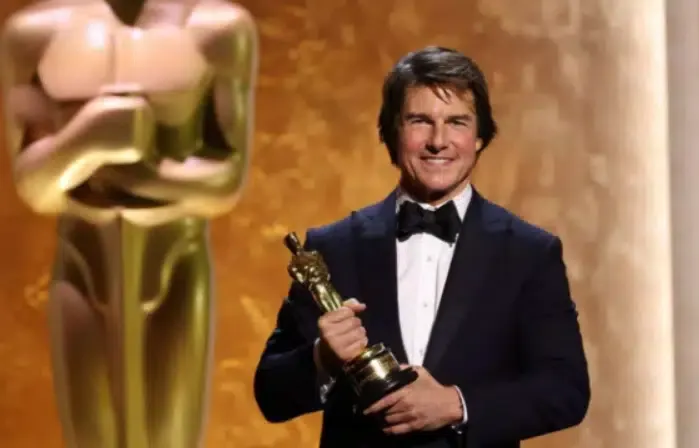
While Tom held his statuette, Martin Scorsese was celebrating his 83rd birthday. His cinema, far from fading, has grown more philosophical, more urgent, more lucid. It’s been a journey from Taxi Driver to Killers of the Flower Moon, where he has chronicled violence, guilt, and punishment in American society. Each film is not just a story, but a reckoning — a mirror held up to a culture that often refuses to look.
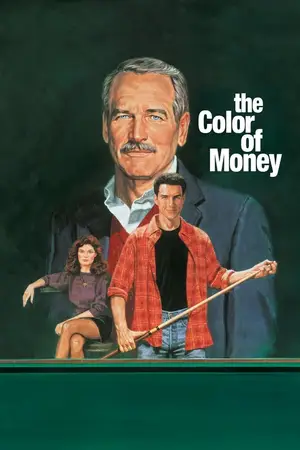
 The Color of Money
 is more than a film about pool — it’s a metaphor for the system, the spectacle, and the generational handoff. The color of money is the teal green of the table, yes, but also the gold of the statuette, the gray of ego, the red of ambition. It’s the shimmer that seduces and the wear that reveals.

In 1986, Scorsese agreed to direct a studio sequel — something that seemed far removed from his auteur-driven cinema. He takes Eddie Felson, the legendary character from The Hustler (1961), and places him twenty years later: retired, selling liquor, his gaze weary but still razor-sharp. Paul Newman portrays him with a blend of weathered elegance and restrained pride — not a defeated man, but one who has learned to read the world from a distance.
Newman’s Felson doesn’t seek redemption through glory, but through clarity. He walks into smoky pool halls not to relive his past, but to confront it. And in doing so, he becomes more than a character — he becomes a vessel for time, for memory, for the quiet dignity of those who have nothing left to prove, yet still choose to play.

The First Game
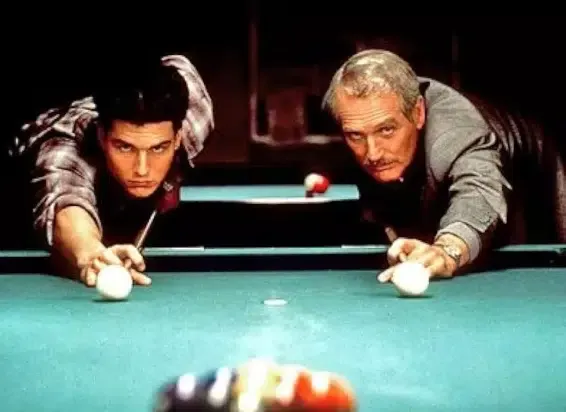
Newman builds Felson through stillness — his mere presence commands the frame; and yet, there’s a latent fragility, a quiet need to close the circle. In this sense, the first part of The Color of Money is not just an introduction: it’s a silent duel between past and present, between experience and youth, between the actor who has lived it all and the one just beginning to run.
Felson doesn’t rush. He watches. He reads the room, the rhythm, the players. And in Vincent Lauria, he sees not just raw talent, but the recklessness of someone who hasn’t yet learned that brilliance without control is just noise. The game, at this stage, is observation — and Felson, like Newman, plays it with restraint, with elegance, with the weight of time.
The Rematch
When Felson decides to play again, The Color of Money stops being a film about mentorship and becomes one about redemption. It’s no longer about shaping Vincent or hustling smoky bars. It’s about reclaiming the pulse, feeling the rhythm of the game in his hands, testing whether there’s still something of the old Eddie beneath the skin of the man who watches.
The second half is more introspective, slower, more ethical. Felson faces not just opponents, but his own reflection. The game is no longer external — it’s internal. Every shot he takes, every trick he resists, every glance he holds is a way of asking: can I still play clean? Can I win without deception? Can I close the circle without betraying myself?
Scorsese films this shift with reverence. The camera slows down, the lighting deepens, the silence stretches. Because the real rematch isn’t on the table — it’s in the soul. And Felson, like Newman, isn’t chasing victory. He’s chasing clarity.

The Referee
The bohemian aesthetic Scorsese infuses into The Color of Money creates an atmosphere of contrasts in every frame — you’re never quite sure if it’s night or day. From dimly lit bars and transient motels to pool halls filled with swirling smoke, and the silences between games, Scorsese builds a world that pulses with the cadence of what’s been lived, lost, and learned.
It’s not just visual style — it’s emotional texture. The lighting flickers like memory, the spaces feel worn but inhabited, and the rhythm of the film mirrors the rhythm of aging, of returning, of watching the game from the margins before stepping back in. Scorsese doesn’t romanticize the bohemia — he lets it breathe, lets it stain the frame with melancholy and grit.
The Final Game
Cruise, as Vincent Lauria, is everything Felson once was: raw talent, unchecked ego, energy without direction. But also — and here the metaphor folds in on itself — he is to today’s Hollywood what Paul Newman was to the old one: a figure who embodies the desire for permanence, the glow of stardom, the kind of charisma that can’t be taught, only radiated.
Newman, in the 1950s and ’60s, was the face of an elegant masculinity — rebellious yet refined — capable of inhabiting both classical drama and modern irony. Cruise, in the 1980s, inherits that place as the new body that runs, that dazzles, that sells. But while Newman was shaped by a studio system that still believed in craft and actorly formation, Cruise emerges in a Hollywood that privileges image, action, and speed. And yet, both share something deeper: the ability to hold the camera without saying a word. To turn gesture into narrative.
So Scorsese doesn’t just film a story about pool — he films the exact moment when the torch is passed. Not with ceremony, but with rhythm. Not with nostalgia, but with clarity. The Color of Money becomes a capsule of generational transition, a cinematic handshake between eras, a quiet acknowledgment that the game continues — even as the players change.




Comments 0
No comments yet.