Follow the White Rabbit: When Cinema Invites Us to Fall
General Reviews
"¡Curiouser and curiouser!” cried Alice (she was so surprised that for a moment she forgot how to speak properly). “Now I’m stretching like the biggest telescope that ever existed! Goodbye, feet!”
Lewis Carroll, Alice’s Adventures in Wonderland, Chapter II: The Pool of Tears (1865)
Of the Rabbit
Before the world unfolds and reveals itself in green lines of code, there’s a phrase that warns us of what’s to come: “Follow the white rabbit.” The phrase appears like a digital whisper on the screen of a man who still doesn’t know who he is. Is he Thomas A. Anderson, daytime programmer, or Neo the nighttime hacker? Body present, mind absent.
Moments later, a young woman knocks on his door, a white rabbit tattooed on her left shoulder. Anderson hesitates, looks at the screen, looks at the tattoo, looks at his life—and decides to follow her. That decision is the first act of disconnection, and just like Alice, he falls down the rabbit hole without knowing what he’ll find. The pill is merely anecdotal.


Down the Rabbit Hole
At least for me, that’s how I arrived at The Matrix—through a mix of conviction and curiosity. I didn’t come through a screen, but through a street. I found that extinct rabbit hole in Mexico City: Barrio Chino. It was near the end of the last century, I was 14, and I had an excessive love for action films.
And I, who was searching for a “cool” identity, found the perfect Mad Hatter: the long coat, the dark glasses, the eloquent silence, the possibility of being someone beyond the system. Someone who didn’t obey, who questioned, who moved as if the world were malleable. It wasn’t just style—it was a way of walking differently, of seeing differently, of believing that reality could bend if you dared to look behind the code.

¿The Harsh Reality?
For the youth of my generation—those who lived their adolescence between the 1990s and early 2000s—The Matrix weaves together the raw and the dreamlike, the philosophical and the sensory, creating an aesthetic that is both dystopia and lucid dream. Its visual and narrative universe draws from surrealism, film noir, and anime to build an experience that dismantles reality while making it digestible and enjoyable.
Visual revolution: The use of framing, combat choreography, and cyberpunk aesthetics offered a visual experience never seen before, both for teenagers and adults accustomed to the 1980s antihero. It was our first encounter with a kind of cinema that combined action with depth.

Accessible Philosophy: The Matrix introduced complex philosophical concepts—simulation, free will, perception of reality, and identity—wrapped in an engaging and visually striking narrative. It didn’t preach; it invited. Through action, mystery, and aesthetic depth, the film opened a door for young viewers who had never studied philosophy to begin asking existential questions. What is real? Who am I? Can I choose my path? For a generation raised between analog and digital worlds, The Matrix became a gateway—not just to cinematic innovation, but to philosophical awakening.

The Chosen One and His Apostles
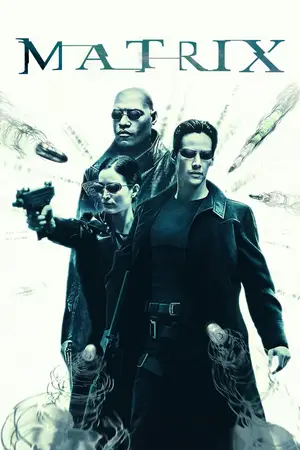
Neo, portrayed by rising star Keanu Reeves, is a silent and introspective hacker who isn’t driven by revenge, but by truth. His journey isn’t outward, like the muscle-bound heroes of the 1980s—it’s inward. His strength is born from doubt: he doesn’t know who he is, doesn’t trust the world, not even himself. His body isn’t a weapon—it’s an interface. His power awakens when he understands that reality is malleable, and that code can be bent.
And he’s not alone. He’s accompanied by his protector Morpheus, his love interest Trinity, and the pirates of the Nebuchadnezzar. The hero is no longer solitary—he is part of a network.

The Villain
In The Matrix—at least in the first film—Agent Smith is never seen in the real world. He doesn’t breathe, doesn’t bleed, doesn’t dream. He is a system entity, a programmed function designed to preserve the simulation. His presence feels like the figure from a nightmare. Hugo Weaving delivers a masterful performance, embodying a cold, calculated force that resists disruption.

Matrix as Cinematic and Sonic Revolution
The Matrix was directed by Lilly Wachowski and Lana Wachowski. With a budget of 63 million dollars, they crafted a unique aesthetic: slow-motion sequences, combat choreography inspired by Hong Kong cinema, and revolutionary visual effects like “bullet time.” The cinematography by Bill Pope and the editing by Zach Staenberg reinforced the sensation that the world could bend, freeze, be rewritten—or absorbed.
Its soundtrack, composed by Don Davis, blends tense strings, industrial percussion, and digital atmospheres. But beyond the incidental score, the film leans on a selection of tracks that define its spirit, featuring bands like The Deftones and Rage Against The Machine, amplifying what was already turbulent and electrifying.

The Matrix Doesn’t End—It Rewrites Itself
For those of us who grew up among cables, questions, and urban rabbit holes, The Matrix was more than an aesthetic experience—it was an initiation. It taught us that reality could bend, that identity could be chosen, that the system could be confronted not with muscle, but with consciousness, art, image, and words. It gave us a long coat, dark glasses, eloquent silence, rhythm, doubt, and a network.
And if the white rabbit merely points, we are the ones who choose to follow. Because in the end, The Matrix didn’t ask us to understand it—it asked us to choose.
And we chose to awaken.





Comments 2