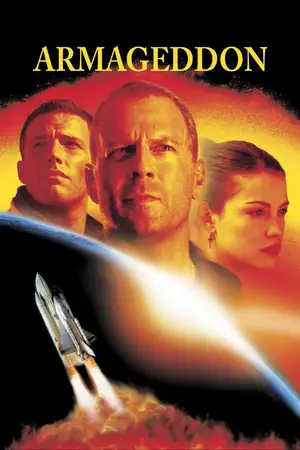
The end is not the meteorite: Armageddon and the fear of losing what we love
General Reviews
Whenever there is a void in your life, fill it with love.
—Amado Nervo.
In Armageddon, the fear of death appears as a cosmic threat—but in the style of Michael Bay and that '90s Hollywood shaped by Jerry Bruckheimer and Don Simpson: explosive cinema, hyperbolic and emotionally maximalist. It’s not a serene contemplation of the end, but a race against time where every second counts, every tear is amplified, and every sacrifice becomes a spectacle. The meteorite is just a pretext; what’s truly at stake is love, legacy, the possibility of closure.
To me… it’s pure philosophy disguised as a blockbuster.
(READ IN A '90s TRAILER VOICE).

But let’s get serious—Armageddon resonates with a millennia-old philosophical current: Stoicism. One of its pillars is memento mori—remember you are going to die. It serves as a reminder that life holds value precisely because it is finite. And in that finitude, we are urged to act. That call to action is where true virtue lies.
Thus, what turns Armageddon into an ethical capsule (if you’ll allow the term) is not technical heroism, but unexpected virtue. The astronauts aren’t scientists or trained soldiers—they’re drillers, mechanics, outcasts, almost intimidating… Men discarded by the system, misfits in the narrative of the classical hero.

The Sage
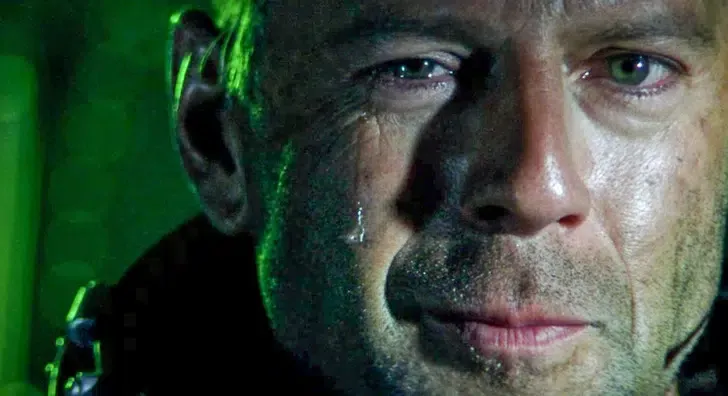
Harry Stampe, our protagonist played by Bruce Willis, is far more than an oil rig driller—he’s the ethical and emotional core of the film. His character embodies a rugged, stubborn masculinity, yet one that is deeply loving and activated by the threat of the world’s end. His relationship with his daughter Grace (Liv Taylor) is marked by an overprotectiveness that, though clumsy and at times aggressive, stems from the fear of losing her. We also see this reflected in his dynamic with A.J. (Ben Affleck), as Harry himself was once an impulsive, talented, but reckless young man. At first, he treats A.J. harshly—he scolds him, tests him, pushes him. He doesn’t want him to repeat his own mistakes.
Harry Stampe doesn’t know how to express tenderness with words, but his love reveals itself through gestures, decisions, and sacrifices.

On Romantic Love
The relationship between Grace and A.J. in Armageddon is a tale of young, impulsive, yet deeply genuine love—one that stands in stark contrast to global despair. It unfolds amid technical chaos and cosmic threat. And although it might seem secondary, trivial, even laughable in the face of planetary disaster, it is precisely that bond that makes the mission feel intimate, human, and urgent.

On Love for Cinema
The space scenes in Armageddon are pure love for cinema—not for their scientific accuracy, but for their ability to turn the end of the world into an emotional opera. Michael Bay, with his maximalist style, transforms the cosmic void into a stage for sacrifice, connection, and virtue. Every shot, every explosion, every breath-held silence is crafted so the viewer doesn’t just watch—but feels.
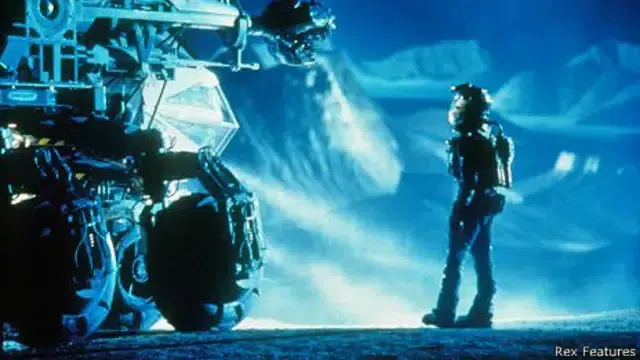
Drill It and Fill It with Love
Thus, in this odyssey of contrasts—between the outcast and the virtuous; the spectacular and the silent—Armageddon becomes a generational capsule. And as I Don’t Wanna Miss a Thing plays in the background, it reminds us that the fear of death can awaken what is most human, most luminous, even in those who’ve been cast aside.





Comments 2