Romanticizing the Past with Nouvelle Vague | VIFF '25
General Reviews
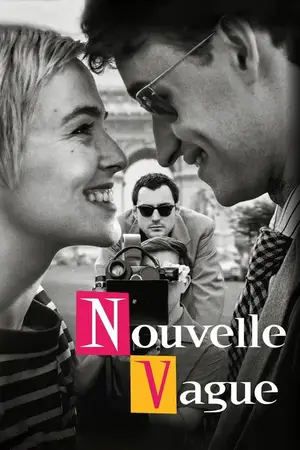
I went to watch Richard Linklater’s Nouvelle Vague, a retelling of the making of Jean-Luc Godard’s revolutionary film Breathless, at Vancouver International Film Festival (VIFF) this past week. The movie, all in black and white, could, to a viewer slightly dizzy, seem like a film right out of 1960. From the dialogue to the pacing, the film eschews contemporary expectations through its slow pacing, dialogue-heavy scenes, philosophic ramblings, and simplicity, all echoing Godard’s style.

I knew going into this film that I was its target audience. Breathless is one of my favorite movies, I'm a sucker for well-done biopics, and I find cultural/media history endlessly interesting. One main criticism against the film has been about its necessity: do we need another movie about Godard, do we need another story about Breathless, do we need a somewhat heavy-handed emulation of a film movement from 60 years ago that has been talked about exhaustively and in fact wasn’t even completely explored in this film?

I find conversations about the ‘point’ of a film sort of redundant and confusing. What was the point of making a romantic trilogy about a single day in the lives of two star-crossed lovers over the span of three decades? There have been several romantic films done already, many that followed the format of taking place in one day! Not to mention the number of films made about people falling in love while on vacation, or a meet-cute on a train. I’m of course talking about Linklater’s famous Before trilogy, which is thought of as some of the best romantic films ever made. I wonder if questioning the ‘necessity’ of an artwork is in itself necessary.
Nonetheless I kept the criticisms in mind as I watched the film. Right away the homage to artists of the French New Wave and New Hollywood movement was clear, as were the nods to modern directors such as Wes Anderson, who himself greatly emulates the aforementioned styles in his own work. At moments, the film felt Avengers-esque. Look, François Truffaut, Agnès Varda, and Jean-Luc Godard are in the same room all talking together! It’s like in Oppenheimer when he meets Albert Einstein and you half expect the theatre to burst into mad applause. As user garbaggio put it in one succinct Letterboxd review for the film, Nouvelle Vague is avengers: endgame for people subscribed to mubi notebook, and I can’t help but agree.

That said, I am not above that at all, and I find it amusing how many critics and reviewers are panning it for being ‘blatant director worship’ because certainly 70% of these people watched the movie at film festivals that took place in indie theatres surrounded by cinephiles giggling away at every 60s film reference. Not that the context of a film excludes it from criticism, but can we blame Linklater for engaging in such egregious veneration?
One thing I loved about this movie, and what I also love about movies like Babylon, Singin’ in the Rain, and Once Upon A Time in Hollywood is how much they wear their reverence on their sleeves. Artists making films about artistry, movies about movies, filmmakers filmmaking about film making….. Does it get any better than that??

All art is derivative. To get to a place of being an obsessed artist is certainly to start from a place of being obsessed with artists. Studying their arabesques, getting excited over their work, following the thread of their inspirations. Not to quote Kamala Harris but she's right, we don’t fall out of coconut trees... Certainly artists don’t! PTA’s work takes from Scorsese who took from Hitchcock who was in turn taking from German expressionist directors of the silent era.
So, why not be open about it? Why not boldly venerate, blatantly copy, and shamelessly glorify? Especially for a film like this, which to me is clearly made for the sect of film festival audiences and cinema maniacs who would even care in the first place to watch a film like this.
This film also hosts the problem that Woody Allen made a whole damn movie about: romanticization of great artists of the past. Linklater clearly loves 60s Paris. He’s clearly enthralled by a life made of endless chain-smoking and day drinking. Old-fashioned cafe-restaurants and empty Parisian streets populate much of the screen time of this idyllic film. Godard, too, is shown as we’ve rarely seen him before: a somewhat cheeky, intellectual but funny young guy wanting to make a movie, ruled by his own whims and fancies, playing pinball and impishly terrorizing his crew.
Allen’s Midnight in Paris shows us a main character accidentally going back in time and learning that living in the past through blind ideation and historic romanticization is futile, and so you must learn to be present. While I believe in the general thesis of that film, I’m also a firm believer that it’s impossible to go forward without looking back. In fact, maybe, in today's world, it's more important than ever to start looking back at the New Wave movement, and the importance of artistic communities and resisting the institution.

I saw a lot of myself reflected in Nouvelle Vague. I have a tendency to fall into adulation of great artists, often toeing a thin line between teenage fangirling and intellectual admiration, and eventually falls into a confusing gray-area which results in several TikTok edits of Paul McCartney saved on my phone. After watching Nouvelle Vague I want to explore more of Godard. His legacy is problematic in contemporary times yet endlessly fascinating. He basically changed the landscape of film then pivoted to making highly intellectual deeply Marxist films that are probably quite difficult to watch. I say probably because I haven’t seen them yet, but I certainly want to now.
Is there something wrong with performing ‘cosplay’ of other artists’ work that you love? Perhaps yes, perhaps we need originality more than ever, and one’s adoration for something shouldn’t overrule the fact that we have already seen it before. That said, there’s a way to do it with delicacy and respect, at which I believe Linklater was successful. Besides, most great artists were so shameless about their inspirations that it makes me think it’s a rite of passage to creative expression!

In fact, there’s something deeply sincere in this film that I found romantic. Don’t all creative people idealize a life of free and successful creative expression? Watching this version of Godard shooting his film in a slapdash manner while battling producers and naysayers with nothing but pure gut instinct and conviction to his name, I was immediately inspired.
Many have pointed out that this film is a bit baffling in Linklater’s already wide filmography. He is himself a revolutionary filmmaker in the 21st century and this film adds little to his name and more to Godard’s. There’s some sincerity in admitting to your source of inspiration and making a film in their name, like pagans putting on a play for the worship and amusement of their gods. It’s deeply human.
Perhaps once this film releases to wider audiences, Linklater will be successful in bringing Breathless and Godard to the forefront in cinema’s essential dialogue, where they rightfully deserve to be. Nouvelle Vague was quite a perfect film festival movie. It was made to be seen in such a space by slightly pretentious cinephiles who care to see the medium’s past and present, and anxiously anticipate its future.



Comments 3