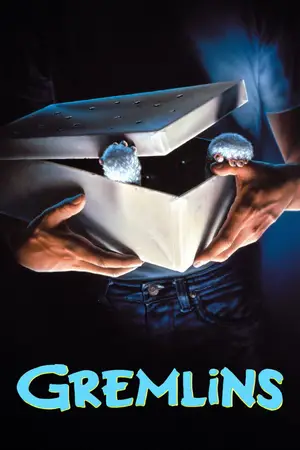
'Gremlins 2' Is a Movie Made by Actual Gremlins
General Reviews

[Warner Bros.]: Joe, please.
[Joe Dante]: No.
[Warner Bros.]: Gremlins was one of the most profitable movies we've ever done. We made back 15 times its budget. We NEED a sequel.
[Joe Dante]: No.
[Warner Bros.]: But Joe…
[Joe Dante]: No.
FIVE YEARS LATER…
[Warner Bros.]: Joe, we've been at it for five years. The sequel just isn't coming together without you. We NEED you.
[Joe Dante]: No.
[Warner Bros.]: Okay… How about this? We'll quadruple the first one's budget.
[Joe Dante]: …
[Warner Bros.]: And you get full creative control.
[Joe Dante]: Yes.
[Warner Bros.]: Okay okay, great! How many Gremlins are you gonna want, though?
[Joe Dante]: Yes.
[Warner Bros.]: Uhm… Okay. We just want to get a sense of what the movie's gonna be about…
[Joe Dante]: Yes.
[Warner Bros.]: Uhm… Like… Is it gonna be very big or more high-concept? We got a lot of complaints from how dark the first one was, so are you gonna go for something more lighthearted or keep it along the same transgressive lines? Is it gonna be funnier or scarier?
[Joe Dante]: Yes.
[Warner Bros.]: …
[Joe Dante]: And get me a vegetable Gremlin.
Joe Dante's response to Warner begging him to make a sequel to a movie he saw as a closed book, going as far as essentially giving him a blank check to do pretty much anything and everything he wanted with these little green monsters, was to make a horror sequel that laughs in the face of itself, its predecessor, and the entire genre. They asked him to make a new Gremlins film, and he delivered not only that, but also a scathing satire critiquing ‘80s pop culture, American consumerism, Hollywood’s obsession with pointless sequels, and the entire concept of taking things seriously. They asked him to make a new Gremlins film, and he delivered a giant, anarchic, live-action Looney Tunes feature overflowing with creativity. It's no coincidence that Dante would go on to direct the criminally underrated Looney Tunes: Back In Action.
It's also no coincidence that Gremlins 2: The New Batch begins and ends with two actual Looney Tunes segments which brought animated shorts legend and Looney Tunes veteran Chuck Jones out of retirement.
Why are these two shorts here? Because Dante wanted them here and so he put them here, that's why. What is their purpose? Who cares! They're fun! They perfectly set the stage for the chaotic fun that the rest of the movie will be all about, and that's all they're meant to do.
If the original Gremlins served as a somewhat subtle cautionary tale showing the potentially devastating effects of greed, Gremlins 2 throws all subtlety out the window and vomits its audience right into a world that's all about technology, “progress," and satisfying the whims of stakeholders. Mr. Wing's beautiful, mystical store is taken over by magnate and media mogul Daniel Clamp's demolition machines, pushing Gizmo out of the store and into his next adventure. If that isn't the clearest allegory for Warner pulling Gizmo out of retirement for their latest money-making scheme, I don't know what is. Dante is fully aware that what he's making is a film that was born in studio suits' heads as a brilliant cash-printing project, and he intends to poke fun at that fact every chance he gets.
Once Gizmo has been abducted and taken to Clamp Center, “the world's biggest fully automated office building,” we get to see Billy and Kate from the first film again. They're now living together, thinking of marriage, and both working at the tower. Kate is a tour guide, while Billy works in the design department, drawing gorgeous pictures of Clamp's wild new building ideas.

Clamp Center is part Trump Tower, part Nakatomi Plaza, and 100% a giant parody of ‘80s American culture and of the entertainment industry of the era. In one of the most packed first acts in all of '80s cinema, Dante:
- Makes fun of corporate lingo and of silly corporate rules. Potted plants are unauthorized, employees carry magnetic tags that their bosses scan to get their names, people are fired for taking unauthorized 5-minute smoking breaks.
- Shows how the company trumps Billy's creativity, asking him to stick to very particular design rules, like not drawing trees. Trees are bad for business.
- Shows how the entire media division of the Clamp Corporation thrives on masquerading as creative, but is actually driven by pure greed.
The building's PA system announces “on the Clamp Channel, don't miss Casablanca, now in full colour, with a happier ending.” Billy's friend, a television personality stuck doing a Mystery Science Theater 3000-style show dressed as Dracula, tells Billy that he laments not being able to do something meaningful, like being a news anchor, and is instead stuck doing cheap horror stuff. Marla, Billy's supervisor, tells him “that's what we're looking for here, Billy: people who produce." But there's one other Marla quote during these first few minutes of the film that, I believe, are the key to understanding Dante's entire intention with this extravaganza: “You know, when art and business join forces, anything can happen.”

Dante's mixed feelings are evident throughout the whole movie. He's clearly exhausted by “The System” and its obsession with churning out new cash grabs, but he seems to be saying “hey, if I have to do it, I might as well put a crazy spin on it.”
Crazy Gremlins 2 certainly is. Billy and Gizmo reunite, but through the many twists and turns of the plot, Gizmo gets wet, and the Mogwai that spawn out of him become Gremlins and take over the Clamp Center. From there, the plot ceases to matter. Everything becomes chaotic and nothing is sacred. Not Hollywood's traditional understanding of plot structure, not the fourth wall, not even Gremlins. This sequel is constantly making fun of its predecessor, from a scene where a group of security guards make fun of how stupid the Mogwai rules are (what do you mean they can't eat after midnight? Isn't all day after midnight?) to a scene where Kate gets interrupted while talking about why she hates Lincoln's birthday, referencing the surprisingly dark moment from the first film where she revealed that her father's gruesome death was why she hated Christmas.
The building is all monitored from the control room, but they can't control the proliferation of Gremlin (sequel) after Gremlin (sequel) after Gremlin (sequel). And the more mischievous green monsters start spawning, the more chaotic and absurd every element of the story gets. By the time the second act is nearing its end, the movie gets so meta that it gives even the most pretentious Jean-Luc Godard film a run for its money. There's the scene where the Gremlins kill famed critic Leonard Maltin (who notoriously hated the original movie), or the one where the Gremlins hijack the theatre where the film itself is being screened and Hulk Hogan has to threaten them into letting it run again. If by this point in the movie you're asking why the hell Hulk Hogan is in it, you're hopelessly missing the point.
This is my favourite review of the film on Letterboxd, purely because of how hilariously accurate it is:

This is a Gremlins movie that mocks Gremlins movies, a sequel that mocks sequels, a horror movie that mocks horror movies. No one is safe and nothing makes sense. There's an electric Gremlin, a spider Gremlin, a vegetable Gremlin, a Gremlin with a Warner Bros. tattoo on his chest. There's a sexy trans Gremlin, a flashing Gremlin who gets kicked into oblivion by Kate, and a Gremlin who gets acid splashed on his face in the middle of the second act, and turns up as a Phantom of the Opera Gremlin thirty minutes later. And of course, my favourite character of the entire franchise: the Brain Gremlin, who becomes the group's mouthpiece and starts demanding that humans allow them to build their own civilization. The only other film I can think of with this kind of absolutely wild, delightfully nonsensical world-building is Mad Max: Fury Road.
But of course, even a film this gleefully postmodern and crazy must come to an end. So, Billy and friends come up with an elaborate plan to defeat the whole Gremlin clan. And in his conversation with Billy after the bad guys have been defeated, Mr. Clamp tells the young man a line that I believe is the perfect way to end this film:
“It wasn't a place for people, anyway. It was a place for things. You make a place for things, things come.”

By the time the movie's coming to a close, Dante has had his fun and made his point on what he thinks of the media industry of the time. But he is, in the end the day, a humanist director, and this line encapsulates his philosophy beautifully. If you make the movie theatre a place for things—a place for algorithms, for AI, for endless pointless sequels—, things will come. But the movies are supposed to be a place for people, a space where we can congregate and share these wonderful experiences together in a dark room with the certainty that those experiences were made with us in mind.
Gremlins 3 has been stuck in development hell ever since I was a little kid who fell in love with Gremlins 2. I hope they end up not making it, but if they do, I hope even harder that Joe Dante comes out of his Gremlins retirement just to make an even goofier and more over-the-top commentary on modern Hollywood's obsession with legacy sequels. Creativity will never, ever go down without a fight.



Comments 0
No comments yet.