VIFF '25: Undressing The Modern Whore, A Conversation.
Sociocultural
When I hear the term "whore" my mind immediately flashes to Peaky Blinders when Thomas Shelby goes, "Everyone's a whore, Grace. We just sell different parts of ourselves." A loaded statement, for sure, but one that requires unpacking to understand the internalized, subconscious subtext that weighs it down.
To be honest, I hadn't much thought of the subtext until I watched Modern Whore, a feature film screened at VIFF, starring Andrea Warhun, a writer, performer, and former sex worker. That's when I was faced with a series of questions I'd never deliberated about sex work. So, I went down a bit of a rabbit hole, both educating myself on sex work as well as detangling the various beliefs that I had internalized over the years without realizing.
Which led me to a one-in-a-million opportunity to interview both Andrea Warhun and Nicole Bazuin, collaborators on the Modern Whore project, to gain more insight about their work.
Modern Whore was a story years in the making. Andrea began her story as an escort, collecting her experiences in stories that she'd written in her journal but never published. It was while she was working on an organic farm with her boyfriend that things came to life. A long conversation with her friend, Nicole, a talented photographer, led to a collaboration where Andrea debuted her career as a writer.
Andrea: And, so I guess I sort of evaluated my life and what I wanted to do and I was like "I'm an artist." Like I have a responsibility to tell the truth and I have enough privilege that I can get away with this. I have enough support from my friends and family that I think that I can actually go out there and be honest about my experiences, and so I came out not only as a sex worker but as a writer who was going to put out a book called Modern Whore with Nicole in 2018.
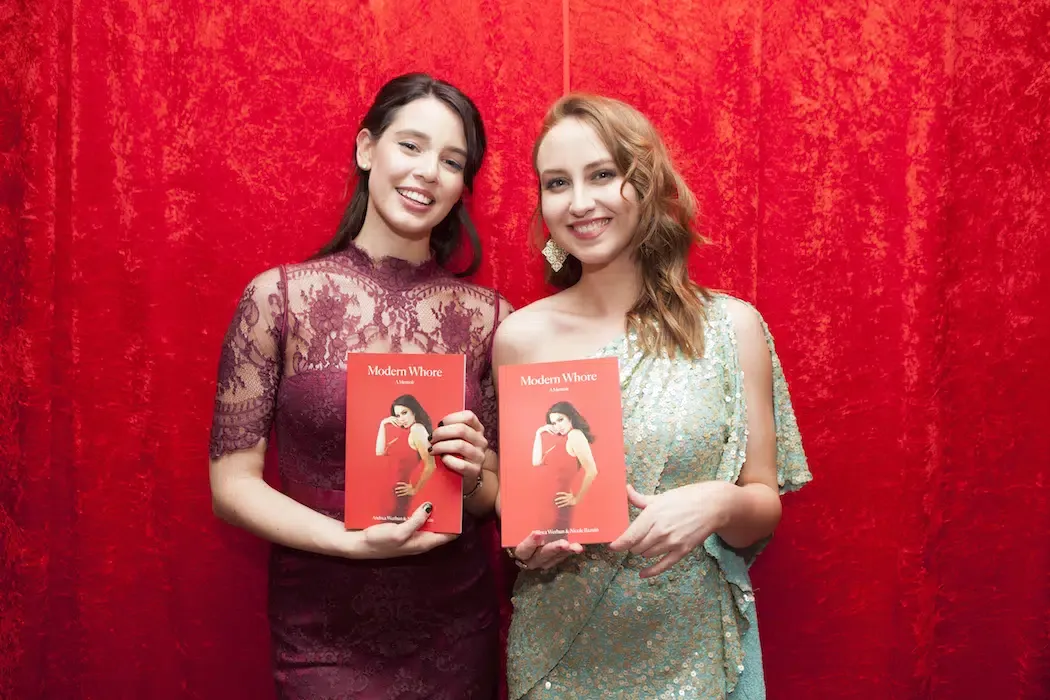
Sharing her experiences was a huge undertaking. The prospect of coming out meant risking her prospective career goals, and facing stigma and prejudice from others. Yet, the desire to be able to speak on what she believed in meant more to her.
Andrea: I thought maybe I could be ambiguous, and even that became untenable as I realized I wouldn't be able to, like, stand behind what I believed in, not only as a sex worker but as a storyteller who believes that the reason that we are so stigmatized is in large part because of the law and because of policy choices that are made that enable the silencing of sex workers.
From the original artbook, which was published under Impulse[b:], to the second edition under Penguin Random House, to a Modern Whore short film, Nicole and Andrea are excited to share their full-length feature of Modern Whore at VIFF on October 11th at 4 pm.

When meeting Andrea and Nicole, my immediate impression was how intentional they both were about the way they wanted to present this story. From the stylistic choices, colour, and camera angles to the very language being used, Modern Whore presents itself as a mirror, a confrontation of the notions surrounding sex work that we, the audience, have internalized.
Nicole: So, like you said, the design choices, the typefaces, the layout, the photography, all of that is enhancing Andrea's experiences as she's written them. Um, you know, the notion of the book was that it's Playboy if it were run by the bunnies. Andrea and I were both fans of vintage Playboys, and for me, it's like when I read them, I just feel so... my senses are so delighted, you know, by the visuals of these goddesses and, you know, the amazing retro design moments. You know, and you can read it for the articles, too. It's got a lot of interesting perspectives and literature that, you know, like excerpts from books and things that are printed is an interesting thing. And so I think our notion was, what if we did this in a way that actually speaks to what we want to accomplish, which we also thought of as a Trojan horse for a feminist and sex worker manifesto. You know, so how could we make this a sensual, enticing package for something that we know is quite potent in terms of what we want to achieve, you know, in terms of social and political change. And so I think that that sensibility is absolutely continued into the cinematic work and in the form of documentary, not being afraid to kind of explode the conventions of documentary. And in feeling free to just choose the elements that felt right to tell this story. So if that's build sets, if that's lots of candle wings and costume changes, you know, if that's lots of comedy, even though that's not gonna be, maybe, what people think of when they think of the subject matter, we knew we needed this to have comedy because it's not only important to who Andrea is as a person, but it's also important to what we wanted to put forth in terms of sex worker representation.

The term "whore," for instance, struck me the most when initially watching the film. I felt that it played into the image in order to demystify and destigmatize the world of sex work.
Andrea: I think the word "whore" is obviously very loaded and has been hurled toward women, particularly, whether they're sex workers or not, often for stepping out of line, for being challenging, for speaking their minds, for operating independently. That's not an insult that is, you know, relegated exclusively to sex workers, but certainly when, you know, we use "whore" in this context, it's very clear what we're talking about here. And so, yes, there's a reclamation going on, but I also like your pointing to, there's a confrontation going on. Like, we are, by making Modern Whore the title of our work, forcing people to say that word out loud, or to even say it internally, to force the person, the individual to confront their own relationship with that term and think about all the times that they maybe used it in describing other people, maybe even themselves. I want people to question that. Like, I, for instance... okay, so I was talking to a lawyer recently. He was like, "I'm a whore. I'm a whore, I'll do anything for money." And, I'm like, let's talk about that. Because that's fucked up, you know? And so, there's a bundle of complex and unexamined prejudices contained within a single word, a five-letter word that I think deserves examination.
That's what I think gives life to stories and art forms: intentionality. With Andrea and Nicole, it was clear that they were not simply sharing Andrea's experiences; instead, these choices demonstrated a keen eye and clear ability to weave a story that was both personal and communal. When I watched Modern Whore, I felt a little bit like a voyeur, peering behind the curtain, and then slowly stepping into Andrea's shoes as she retold her experiences. Just when I felt like I understood, the film flipped the narrative, posing a question that made me re-evaluate my own knowledge of the subject. Why are certain conceptions surrounding sex work so normalized? I think back to some of the examples Andrea posed in her movie, like trauma porn, the way sex workers are often marginalized from the narratives, living in secret, the way this marginalization prevents them from speaking out about crimes from their clients. Her story revealed the gaps in my knowledge in a way that put accountability on me to learn more about the situation, or at the very least to be aware of it.

Modern Whore puts the spotlight on this world; it draws our eyes to conversations that we wouldn't necessarily be a part of. Now, I will admit, I got a little too analytical with this film— there were just so many layers to it— and I was curious to know the way in which perspective and gaze played a role in resistance or confrontation in the movie.
Andrea: It's so funny, because, yeah, I feel like being looked at, but then on the other side of the point is like, sometimes I wish I was totally invisible, right? Like, I, you know, I do, like, I guess, uh, accept and understand about myself, that I, um, appreciate the validation and the perception, and that I think bask in the glow of, um, loving attention, of course. And I guess the way that I see it be possible as a sex worker to bask in a loving glow is binding art that essentially creates that construct and that context of loving attention. And, like, in a way, like, the film is a literal representation of the loving attention that it will give me person to person. Right? Like the, and the, if we look at the history of sexual representation on film, I don't know if you can say that the sex workers are given that loving attention, um, in that representation, by the directors, by the people that are creating the context of the film. And that, in turn, has a tremendously powerful impact on the audience's perception of sex work. Like, it actually blows my mind that the way that most people perceive sex work, because they don't know, um... When I say, like, when people don't know sex workers, what I mean is that they don't know anyone who's come out to them, because statistically speaking, they probably do know sex workers, but those sex workers don't feel like it's safe for them to come out. And so the sole representation that they have of sex work comes from TV and film. So, yeah, it is really important for me, as someone who believes that the laws need to change, is that people's perception of sex work needs to change. And I'm happy as an artist to sort of, like, offer myself and my body and my experiences to the screen as an opportunity for the viewer for a short period of time to, like, bask in my full humanity through my story. It has always been my goal through storytelling to create opportunities for the audience to relate to a sex worker even for a moment, because if they can relate to a sex worker, they can hold in their hearts that it's possible and actually right, that we should have equal access to law or to safety and protection under the law.

Andrea and Nicole's message is loud and clear:
Nicole: You know, as much as we see this film as authentic, as much as it's important to maintain this notion of it, that the documentary, that, you know, we feel like we're receiving some element of truth from it. I think at the same time, this is unabashedly a very deeply subjective documentary or film, with a very specific point of view that it is trying to get across. So, I think, stylistically, it's absolutely a very intentional film, you know, with how it's shot, and I often did want to use point of view shots. So the notion is, if there's a, you know, customer at the strip club who is asking Andrea an inappropriate question, he's actually asking that directly to the camera and the audience can put themselves in her shoes of, ooh, you know, how they would feel if they had to be confronted with that? That's the aim there. It's sort of putting you in that perspective. And that's sort of the beauty of film, is that we can use it to allow the audience to kind of see through someone else's eyes to a degree, and you know, everybody was mentioning the goal of making this film feel relatable in some way for civilians. Can they feel like they relate to a sex worker as a result of this film?
Interestingly, many of my discussions around Modern Whore felt like they were faced with a level of resistance. Many times, people had this preconceived notion of what the film might entail, and that kind of pushed them away from watching the documentary, which I think was exactly the issue that Andrea and Nicole were mentioning. Contrary to misconceptions about the film might be about, the movie isn't propagating anything, it is merely asking us to be open to re-educating ourselves, to humanize and respect the sex work community, to use our awareness to help advocate for the rights of sex workers.
You can book your tickets here: https://viff.org/whats-on/viff25-modern-whore/
Modern Whore, the book: https://www.penguinrandomhouse.ca/books/672368/modern-whore-by-andrea-werhun-and-nicole-bazuin/9780771098413


Comments 3