Totally F***ed Up: Gregg Araki’s Chaotic Mixtape of Queer Teenage Survival
General Reviews
There are movies you watch and then politely shelve away in your memory, and then there are movies that feel like they have crawled into your bloodstream. Gregg Araki’s Totally Fucked Up (1993) is very much in the second category. It is abrasive, scrappy, and deliberately messy, but that is also its power. The film does not just depict a group of queer teenagers trying to survive in 1990s Los Angeles. It makes you feel the volatility of that survival, the exhaustion and defiance, the humor and despair, sometimes all at once.
Watching it today, decades after its release, feels both like stepping into a time capsule and realizing that the struggles inside it are still painfully familiar. And maybe that is what keeps Totally Fucked Up alive as a cult object. It is not just a relic of New Queer Cinema, it is a howl that refuses to quiet down.

The Anti-Structure Structure
If you have never seen Totally Fucked Up, do not expect a neat beginning, middle, and end. Araki builds the film like a mixtape. Six queer teens, Andy, Steven, Deric, Tommy, Michele, and Patricia, float in and out of each other’s lives, chain-smoking, hooking up, breaking down, and philosophizing in snippets. The narrative is fractured into fifteen chapters, some only a few minutes long, others lingering, all stitched together like fragments of found footage.
It is jittery, handheld, sometimes resembling a home movie, other times feeling staged like a music video. That is intentional. Araki has said he wanted the film to feel like a diary, or like flipping channels on late night cable. The effect is
that we are not just watching their lives, we are embedded in their rhythm with awkward pauses, sudden blow-ups, stretches of boredom, and flashes of joy.
For audiences in 1993, this fragmentation was radical. Most depictions of queer youth on screen were sanitized, tragic, or tokenistic. Here, Araki asked what if we do not polish it up. What if we show it raw, chaotic, and unresolved, because that is actually closer to what being a queer teenager feels like.

A Portrait of Queer Youth on the Edge
What is remarkable is that these characters are not defined by singular coming out arcs or neat political speeches. Instead, their queerness is just the baseline of existence, and the drama emerges from the way the world treats them. There are scenes of being kicked out by parents, attacked in public, and stalked by police. AIDS shadows everything. Even casual conversations about dating are haunted by fear of infection or rejection.
And yet, amidst all of that, the kids keep joking, making dumb videos, teasing each other, and falling in and out of love. Their world is brutal but never devoid of tenderness. Patricia and Michele’s relationship, for example, is both messy and deeply affectionate, full of little spats but also quiet moments of real intimacy.
That is Araki’s brilliance here. He does not romanticize queer life, but he does not pathologize it either. He just lets it exist in all its contradictions. His characters are, to borrow the film’s title, totally fucked up. And that is exactly why they feel so real.
DIY Aesthetic as Political Gesture
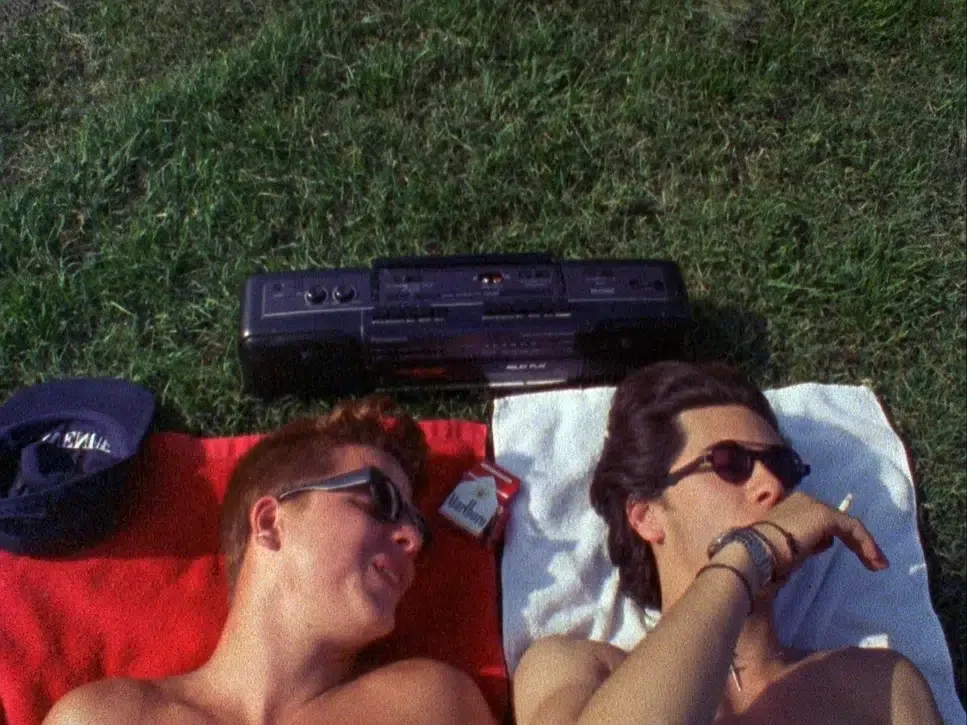
The film was made on a shoestring budget, shot on 16mm, and you can tell. The sound is rough. The lighting is inconsistent. Some performances feel amateurish. But all of that grit becomes part of its aesthetic. It looks like something your cool older sibling’s friend might have shot on weekends, but there is intention behind the sloppiness.
In fact, the lo-fi feel is the message. Queer kids in 1993 were not being handed glossy Hollywood stories. They were piecing their lives together from scraps, trying to find beauty in the margins. Araki gives them that same space cinematically.
Think about it this way. If you compare Totally Fucked Up to something like Reality Bites (Ben Stiller, 1994), which came out a year later, you can see how alienated mainstream depictions of youth culture were. While Ethan Hawke and Winona Ryder were debating corporate sellout angst, Araki’s kids were worrying about where to sleep after being thrown out of their homes. It is the difference between Gen X malaise and queer survival. Both are valid stories, but only one feels truly urgent.

The Soundtrack: Angst Set to Guitar Noise
Of course, no Araki film is complete without its soundtrack, and here it is a who’s who of early 1990s alternative culture. Think shoegaze, noise rock, indie obscurities, the kind of bands you would hear on college radio at two in the morning. The music does not just decorate the film. It pulses through it. Songs fade in mid scene, drown out dialogue, or abruptly cut off.
It is another reminder that Araki was making movies for his people, the disaffected, the queer, the kids haunting record stores and scribbling band names on their notebooks. The soundtrack says as much about identity as the dialogue does.
When the kids sprawl out on couches, smoking and listening to walls of guitar distortion, you feel that the music is as much a lifeline as their chosen family. It is a way of drowning out the world that hates them.

Why It Still Matters
So why revisit Totally Fucked Up now, in 2025? Because its urgency has not faded. If anything, the themes feel sharper. Queer youth today still face homelessness, family rejection, and systemic violence. Online discourse might make it easier to find community, but it can also amplify harassment.
What is haunting is how cyclical everything feels. Watching Araki’s teenagers joke about their futures, or whether they will even have one, hits hard when you think about the current climate of book bans, anti trans legislation, and rising reactionary politics. The film whispers that we have been here before, and we are still here now.
At the same time, it also reminds us that queer joy persists even under pressure. The laughter, the inside jokes, the stupid video camera antics, those small acts of defiance feel timeless. If you have ever found safety in a chosen family, you will recognize it instantly in Araki’s scrappy ensemble.

The Beginning of a Trilogy
Totally Fucked Up is not just a standalone. It is the first installment of what fans call Araki’s Teenage Apocalypse Trilogy, followed by The Doom Generation in 1995 and Nowhere in 1997. Each film escalates in style and chaos, but this first one is the rawest.
If The Doom Generation is the flashy nihilistic road trip, and Nowhere is the candy colored apocalypse, then Totally Fucked Up is the notebook sketch that started it all. It is the least polished, but maybe the most sincere. Watching them in order, you can see Araki refine his voice, but there is something about the rough edges of this first attempt that makes it especially powerful.

A Call for Conversation
Peliplat thrives on conversation, so here is where I will leave it open. Totally Fucked Up is a film that does not hand you answers. It does not resolve cleanly. It just immerses you in a messy, beautiful, painful slice of queer teenage life.
If you have seen it, what stayed with you? Was it the fractured structure, the characters’ banter, the stark violence of certain moments? Or was it simply the feeling of recognition, that sense that being young and queer can be this overwhelming?
And if you have not seen it yet, I would argue it is worth seeking out. Not because it is a perfect film, but because it is an honest one. Few movies capture adolescence with this much jagged truth.

Final Thoughts
Gregg Araki once said he wanted his films to be like punk rock songs: short, messy, emotional, and unafraid to be loud. Totally Fucked Up is exactly that, a punk rock movie. It is a time capsule of early 1990s queer youth, but it is also disturbingly timeless.
It tells us that survival is messy, that identity is complicated, and that sometimes the most radical thing you can do is just keep hanging out with your friends, laughing, crying, and smoking on rooftops while the world rages on below.
And maybe that is why, even with all its roughness, the film still feels vital. Because the kids in it are totally fucked up, and so are we, and so is the world. But that does not mean we stop living.


Comments 2