The Lobster Isn't As Artsy As You Think It Is
General Reviews
Everybody, and I mean everybody, sold The Lobster as this artistic masterpiece of a film. I was ready. I love close reading, and I wanted to get lost in analysis, to untangle the threads woven through the narrative. I was frothing at the mouth for it.
Now, the thing is, The Lobster carries all the components of being the perfect artsy film. From the monotonous voice, the absurd dialogue and premise, the symbols, the animals, the movie hands viewers one poetic device after the other. It is all spread out on the table, begging to be analyzed. Yet, when I was watching it, something fell flat.

It could be a me issue. I mean, the opening scene was indisputably incredible. It gave me similar vibes to the short story, "The Ones Who Walk Away From Omelas" by Ursula LeGuin, slash 1984 by George Orwell. The simple narration as the woman gets out of the car in the middle of nowhere and shoots the donkey dead was perfection. And, she doesn't just shoot it once. She shoots that donkey excessively, multiple times, while the donkey family watches. Only the sounds of windshield wipers from inside of the car disrupt the intensity of the moment, tethering us to the bleak reality of the woman's loneliness.
I blame the opening scene for my high hopes; it primed me to expect more than what the movie could give me.

Okay, we get it: there's no such thing as true love.
Now, as an avid dystopian sci-fi reader/watcher, I know that you don't want to rush world-building.
The Lobster followed that rhetoric through and through. It did not cut down a second of worldbuilding, which... was a decision. Honestly, this is what actually upset me: The Lobster started off so strong, guys, I can't even tell you, but then it just dies out.
Okay, first, a quick summary: In this world, by law, you cannot be single. Those who are single are sent to this hotel where they have forty-five days to link up with someone. If they don't, they will be turned into an animal of their choice. We have our main protagonist, David, who is sent to this hotel after his wife of twelve years leaves him for another man. David's brother had also been previously turned into a dog for failing to match with someone. There is also a community of people, the loners, who've disavowed any form of romantic relationship, and they live as outcasts in the wild. Both communities, the hotel and the loners, are authoritarian by nature.

So, we get this dystopian world where love as a concept is controlled by a larger institution. Cool, right?
The problem with artsy movies is that there is a line between enough abstractness and too much. The Lobster was teetering somewhere closer to too much, and then it leapt over that line into whatever mess that this story eventually becomes. Because it never connects the images it throws at us. And it also throws way too many images at us.

Instead, what we get is a repetitive cycle of the same sentiment: Love isn't real. There is no such thing as true love. Even, arguably, when David finds it.
What images?
Well, first of all, the animals. I mean, it's titled The Lobster, so you'd think it'd be about animals. And, it is. And, it isn't.
So, we get the main premise, which is that people who fail to find a partner turn into animals, and that this is in some ways their second chance to find someone/thing. So, here is an example where we see the way in which this society has stripped down the elements of romance to its basic survival parts. By which I mean, that romance isn't about romance as much as it is deemed for its reproductive value. I thought it was cool that they were comparing love and partnership to this animalistic, primitive part of humanity. You know, you have the humane part of society at the hotel, and then the wild part of society in the forest, yet both of them are primitive and rabid by nature. Whether it is controlling love or condemning it, both societies reveal the unsustainability of our current perception of connection (which is that it cannot be controlled; it, in itself, is wild). Then, to top it all off, we get the transformation from human to animal.
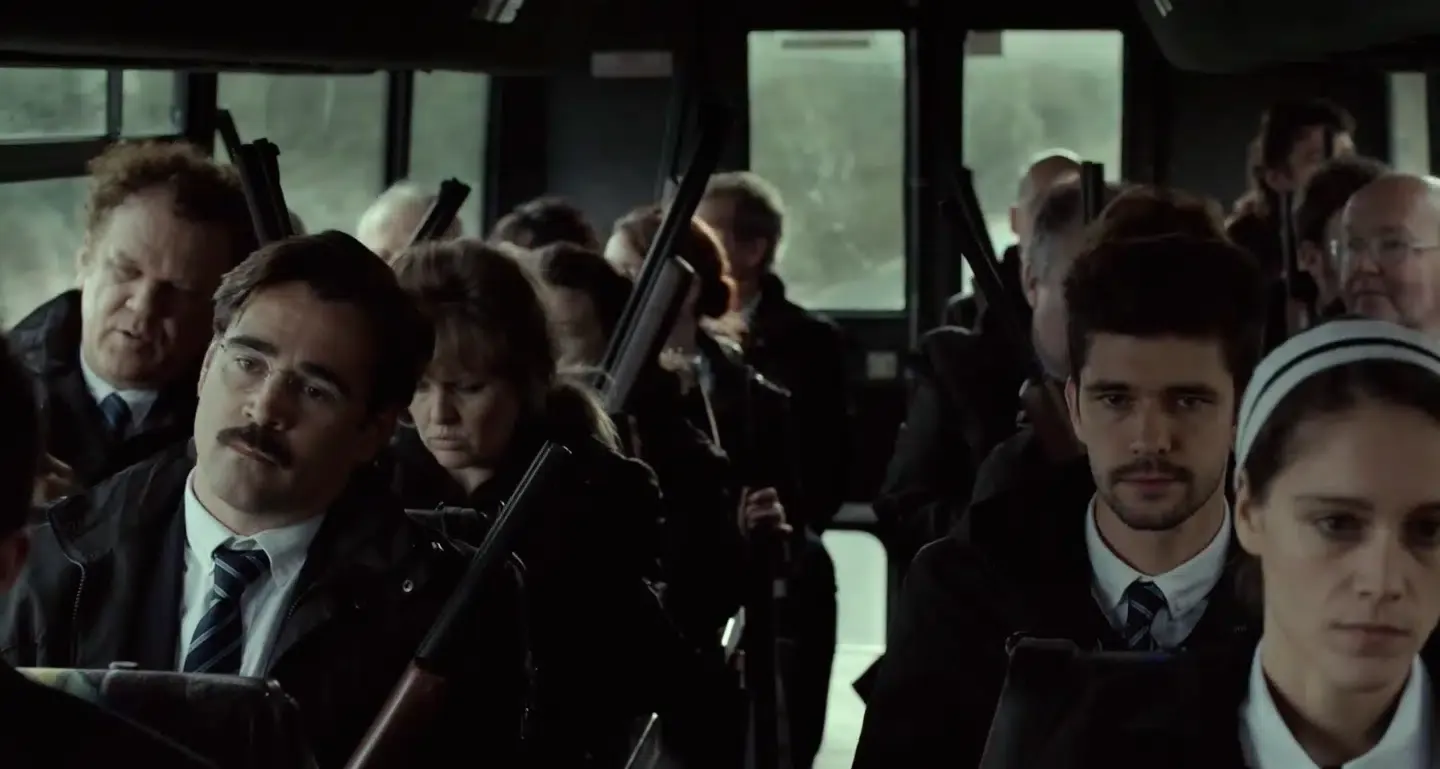
I thought the comparison between animals and humans would be further explored. The brother is a dog. The heartless woman is transformed into an animal by David. The loners are being hunted like animals. These are such pivotal symbols, but then the movie just leaves it at that. What is the significance? Where are we supposed to look? Other than the fact that love is not real, what are these threads adding to the narrative?
Instead, we are handed a loose thread and told to come up with our own interpretation.
Which is fine, except that it takes away the intentionality behind these symbols. As a result, what could have been artsy becomes muddled by an overabundance of similarly abstract storylines that all say the same thing over and over again.

The rabbits, for instance, are one of the animals that are mentioned multiple times. When David becomes part of the loners' group, the rabbit becomes a source of food but also a form of connection between him and the short-sighted woman (Rachel Weisz). It's originally transactional, but it does forge something close to resistance against both the hotel and the loners group.
Does the rabbit symbolize a stripping of innocence? Does it parallel David and his new romantic partner? The answer is never clear, and maybe that is the point, like short-sightedness and blindness. There is supposed to be an element of the unknown that keeps us all in the dark, that prevents an authentic connection from forming. I guess that's ultimately the comment the movie tries to make: an authentic connection involves an element of blindness. Or, perhaps, we are all blind to reality.

The film introduces the concept where people look for seemingly superficial traits that connect them to one another. John, the limping man, forces a connection with the girl who gets nosebleeds by forcing himself to get nosebleeds, too. He declares that his limp is a major component of his personality, the same way David carries his shortsightedness. I thought that was a really cool way to critique perceptions surrounding meaningful connections.

It gets cooler when you realize that, despite the short-sighted woman and David's connection feeling like an act of rebellion and genuine love, it also defines love the same way that the hotel has. The ending, therefore, can be read in two ways. Either David's ultimate act of sacrifice broke all bounds and defined his true love for the short-sighted woman. Or, he knew their relationship couldn't exist without the physical similarity between them both, which is why he blinded himself (although that ending is left ambiguous— we don't know if he actually follows through with it).
Yet, the issue stands. The film continues to slather more and more imagery onto the screen, from the murder of the dog, to the dance sequences, to the digging your own grave scenes, to the wolves and then the confrontation scenes to dismantle the "successful" relationships. It gets muddy, and nothing really sticks. Especially the opening scene, which ends up not really having anything to do with anything other than introducing the oppressive institutions of The Lobster. Which is kind of a waste of a scene.
You cynic, it's all intentional.
Honestly, I was with this movie, until it started oversaturating the narrative with too many symbols and images that said the exact same thing.
I mean, it became so muddied with too many loose threads that at one point, I had to step back and wonder if I was just stupid. This is one example where you could tell the movie wanted to be poetic so bad that it actually went ahead and overdid it.
Consider the monumental scenes: first, when the heartless woman kills her brother. Second, when David has his emotional breakdown, and ends up ultimately transforming her into an animal. Third, when the short-sighted woman becomes blinded and asks, "Why not him?"
The movie just throws these scenes in and then forgets about them. These are the pivotal moments which, in my opinion, require much more intentionality within the narrative; the rest of the scenes feel like they are there for the sake of killing time. The dance scenes, or even the grave scenes, with the leader of the loner group. It all seemed to verge on intentionality, and yes, they are definitely fun to close read, but they also take away space from the scenes that need more time.

The ending, in particular, is such a cool concept, but because nothing really ties together, it feels kind of anticlimactic. Here, if the beginning had something to do with David's story, if even the blindness paralleled the animal imagery... Honestly, anything, then perhaps the ending might have made the impact that it needed to.
Maybe I am just a cynic. I don't know. I think I really just wanted to feel that this movie moved with intentionality and everything landed merely by circumstance.
To be fair, I still enjoyed watching the movie. I stand by the fact that the hotel scenes were way too long and didn't add anything. They were fun, though. I get it. The director wanted to leave things open-ended, and yes, it's really cool how, in the end, we are also blinded, but in its attempt to be as artsy as possible, the movie might've sacrificed the integrity of the story.
If you are interested in hearing a really well-written piece on how brilliant the movie is, I'd recommend checking the following out:
DeCuir, Greg. “Surveillance, Resistance, and the Politics of Love: On Yorgos Lanthimos’ the Lobster.” NECSUS, Greg DeCuir https://necsus-ejms.org/wp-content/uploads/Necsus-01.png, 12 Dec. 2023, necsus-ejms.org/surveillance-resistance-and-the-politics-of-love-on-yorgos-lanthimos-the-lobster/.
If you're interested in cool dystopian stories:
The Ones Who Walk Away From Omelas:
https://shsdavisapes.pbworks.com/f/Omelas.pdf1984
1984 (Available at your public library or nearest bookstore)
Extra Reads







Comments 5