What the Eddington Poster Means
General Reviews
Left to rot. Incapacitated. Destroyed by a force he doesn't entirely comprehend. Waiting to die.
Near the end of Eddington, Joe Cross (Joaquin Phoenix) finds himself running, stumbling, falling down a cliff side, as he is chased by a group of unidentified shooters. He miraculously misses their bullets. When he reaches the bottom of the cliff, which doubles as the start of his small town, Eddington, he climbs to the roof of a small building only to fall through the roof's sheet metal.
Joe's fall is broken by a glass display case in the Eddington museum. Based on the location of Eddington, the story watched so far, and the rest of the museum pieces that he does not crush, it's easy to assume that Joe has just eviscerated a display of Indigenous artifacts. He has no time to dwell on this, for he's still chased by killers.
The town of Eddington does not handle the COVID-19 pandemic well. Ari Aster's latest movie opens with Joe, who is the sheriff of Eddington, meeting up with a couple of other police officers in one of those classic cop meetups where they're both in their cars but neither side gets out. The officers berate Joe for not wearing his mask. This is only the tip of the movie's paranoia iceberg.

Aster shies away from very little in Eddington. All the things you wish you could forget about the pandemic are on full display, for 149 minutes. Setting this movie in a small town with no confirmed cases of the disease was a brilliant move by the director, as it allowed his characters to get worked up about something that only existed on their phone and television screens. This frenzy was doubled by the racial injustice that we all witnessed during this time, and the protests that seemed to happen every other day. However, just because the town's not directly affected by these things at the start, does not mean that it remains that way.
With nowhere to go, thanks to Mayor Ted Garcia's (Pedro Pascal) lockdown mandate, the residents of Eddington fill their time with the brain-rotting wonder of the internet. Louise Cross (Emma Stone) spends her time watching clips of cult leader Vernon Jefferson Peak (Austin Butler). He's the type of guy who thinks pedophiles are everywhere, while simultaneously giving speeches on the connectivity of everything. Louise's mother, Dawn (Deirdre O'Connell), is a well of information regarding conspiracy theories. Then there's the spineless Brian (Cameron Mann), who gets deeply involved in the Black Lives Matter movement in an effort to win over the heart of Sarah (Amélie Hoeferle). The movie is a diorama of characters, and these aren't even all of them. Each one represents some part of that crazy pandemic era.

Joe Cross is at the centre of it. Through a lot of ill-advised decisions, he comes to represent the invisible fear that everyone was fighting against. As town sheriff, he's already a no-justice-no-peace-era villain. He then transforms into a killer, a racist, a fear-mongering influencer, and the kind of guy who gets COVID and continues to live his life (a superspreader). He doesn't listen to Indigenous people whose reservation borders Eddington. He even has a scene where he embodies the Alex Jones character from Waking Life, driving around in his car with a megaphone, preaching his ideas to anybody who will listen. Too bad the streets are deserted.
Everyone in the town is trying to pull everyone else in a certain direction, but none of the directions align. Everybody is filled with fervent rage over different things, but nobody is personally attached to anything that they're taking a stand for. It takes the smallest inconvenience for the charade of empathy to slip, like a mask without a string. Take Brian, the BLM super supporter, who suddenly starts having racist undertones when he is questioned by the police. Same with Sarah, whose commitment to social justice becomes just a fringe idea that she's not directly involved in when the police come knocking.
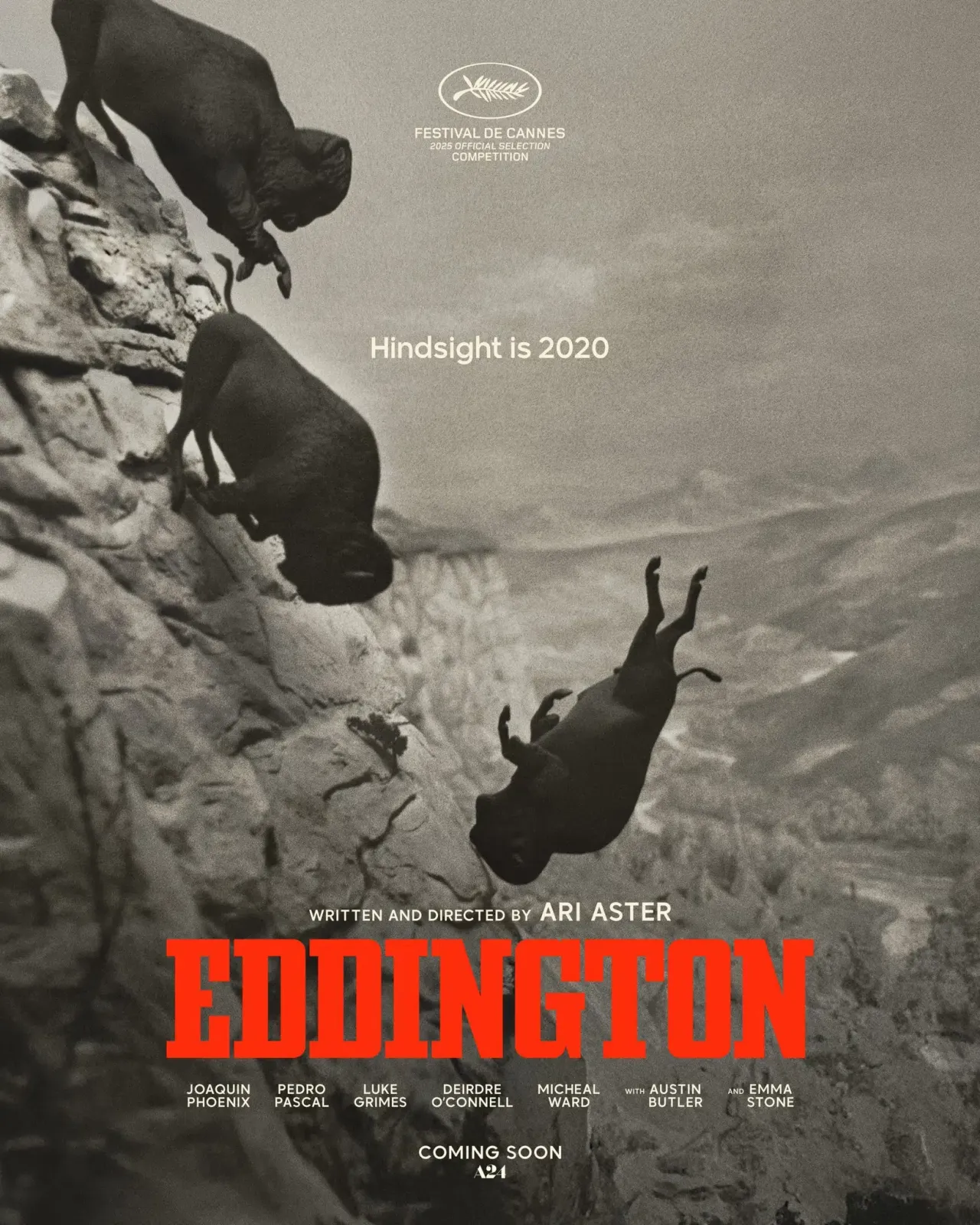
Through this long movie, my mind kept returning to the movie's promotional poster. It depicts three buffalo as they fall off a cliff. I didn't understand the poster until I saw the movie. Then I inferred that Aster was making a comment on the herd mentality that we all succumbed to during the pandemic. Remember when everyone put a black square on their Instagram in solidarity with the BLM movement, and if you didn't, then you were a racist? Aster does. Remember when we ostracized anyone who wouldn't wear a mask and denied them entry to any business, no matter how urgent their need? Aster does. Remember how we still avoid the homeless in the street and treat them like a mosquito — a nuisance that is meant to be ignored? Aster does.
The poster seems to be the visual incarnation of our inability to think for ourselves during a time of global stress. We were left feeling powerless because of a disease that nobody, at the time, could understand. As such, the people of Eddington reliably fall for anything. Without a clear truth, everything is considered possible. Thus, the townspeople get worked up into a tizzy over injustices, theories, and a sickness that doesn't make sense to them. They don't really care; they just don't want it all to be for nothing.

It's a reprint of a David Wojnarowicz photograph, which itself is a tight frame taken from a diorama at the National Museum of American History. Wojnarowicz interpreted the buffalo falling from the cliff as a metaphor for the U.S. government's indifference to the AIDS epidemic of the 1980s. Wojnarowicz was upset that more people didn't speak up about the epidemic because it did not directly affect them. I can interpret that Wojnarowicz felt that, specifically, the gay community was being left to die, tossed from a cliff, with nobody seeming to care that they were facing death. He was disturbed by the cold lack of empathy from American support systems and the general public.
The buffalo is an iconic American symbol. It represents life for many Indigenous tribes that, historically, lived off the buffalo. Their meat, hide, and everything else had a use. Conversely, it was a symbol of Indigenous nuisance to the white settlers. Buffalo were hunted to near extinction by the settlers who would kill them for sport, but would also kill the buffalo in order to cut off the food supply to these Indigenous tribes. It was the worst form of racism, nearing ethnic cleansing, that of eliminating the most used food source for certain tribes in order to starve them and force them to bend to the will and demand of the settlers.
The original diorama at the National Museum displayed the Indigenous practice of buffalo jumps. The Indigenous people would chase a herd of buffalo off a cliff, which would break the legs of the animal and incapacitate them. Then the people would kill as many buffalo as they could and harvest their entirety for food, clothes, and other uses. Due to the primitive tools used, they were often unable to harvest all of the buffalo that were mortally injured in the buffalo run. As such, many of the buffalo were left to rot. Incapacitated. Destroyed by a force they didn't entirely comprehend. Waiting to die.









Comments 5