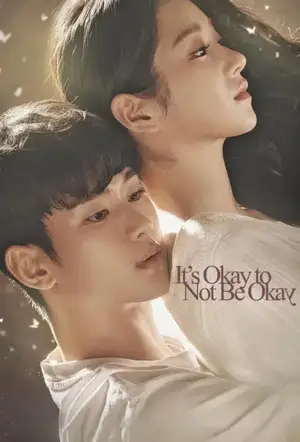
It's Okay to Not Be Okay - A lesson that we are much more than our traumas.
General Reviews
Synopsis: A path to emotional healing opens up for a children's book writer and a psychiatric ward caregiver when their paths cross.

Ko Mun-young is a renowned children's book author, but her aggressive and antisocial personality makes her a super difficult person to deal with (basically, only the owner of the publishing house that publishes her can do this). When she meets caregiver Moon Gang-tae at a book signing for one of her books in an unexpected situation—he stops her from stabbing a dangerous psychiatric patient with a knife—their worlds collide and never return to normal. Gang-tae has his reasons for wanting to stay away from her: his burden is already too heavy to bear, caring for his older brother, Moon Sang-tae, a boy with Autism Spectrum Disorder, on his own. Dealing with the mood of a temperamental author is definitely not in her plans. Furthermore, the brothers keep their own traumas secret, and this loneliness causes Gang-tae to isolate himself from the world. However, Ko Mun-young is a stubborn and obstinate woman (not to mention spoiled) and is not willing to give up on her goal.
At first, I found it very difficult to root for the main couple and get involved with the romantic proposal that the drama suggested. The reason? Ko Mun-young starts the series being extremely toxic. She is an obsessed, possessive and manipulative stalker, and if her actions were committed by a man, any sensible person would call the police. This feeling bothered me a lot and distanced me too much from the character, who has a difficult and cold personality, taking a long time to expose herself and show any other facet other than that of a woman who only looks out for her own interests. However, dramas tend to be long, and this gives the characters room to develop – which is what happens here. As the long episodes go by, the protagonist begins to see other aspects of herself. Ko Mun-young is the product of an unbalanced and toxic family, raised by a narcissistic mother who left deep scars on her. Her way of dealing with other people reveals an immense fragility and a paralyzing fear of losing the people around her. Her traumas are deep and she can't even recognize them, so thick is the shell she had to create to survive. Her closeness with the Moon brothers gradually creates cracks in this shell, and what I liked most was seeing the transformation she goes through not only by opening up to true love with Gang-tae, but by the sense of family and brotherhood that Sang-tae also offers.

However, despite being a love story, the highlight of It's Okay to Not Be Okay for me is the relationship between the Moon brothers. Autism Spectrum Disorder is worked with great sensitivity in the character of Sang-tae, but the drama also explores the difficulties that Gang-tae faces in having to take care of his neurodivergent brother. He is a boy who had to mature very early and embrace responsibilities that were not appropriate for his age, and as a consequence he does not allow himself to live experiences that are pleasurable or focused on himself. His sense of detachment is so great that it is almost an attack on his own self-preservation. In contrast, Sang-tae is not portrayed as a perfect, angelic neurodivergent person, placed on a pedestal of purity just for facing challenges. The character has virtues and defects, which are explored throughout the drama, and has a wonderful construction around his own desires, fears and challenges. It's exciting and intense to see how the plot revolves around the relationship between the brothers, with their pains and delights, revealing how they would do anything for each other while also being the ones who can get hurt the most.
The story is set in the psychiatric hospital where Gang-tae works, so there are many patients there whose stories are told. This brings a lot of emotion to the drama, as well as charisma and emotional attachment for those who are watching. You become attached to the secondary characters and root for them to find healing from their traumas, so that they can deal with their ghosts or simply find a way to live with their way of existing in the world. In addition to the characters' dramas, the drama also has a very engaging tone of mystery: Ko Mun-young's past is full of loose ends, and there is a dark aspect to the story that is very well worked. It was the first drama I watched with a typical villain and it was very interesting to see this role unfold and move the pieces of the game. Even though I had the impression that the drama could have been extended for more episodes and even seasons.

The series is moving, with the construction of strong relationships between the characters and the skillful deepening of their dramas. Few series that I have seen recently have moved me as much as this one, and much of that comes from the delivery of the main cast in each scene that required the demonstration of the pain and intensity of each character's feelings. With each episode, I hoped that their healing process would take another step forward, and with each episode I realized how the bonds they formed with each other were essential to closing the wounds and forming the necessary scars. It is an inspiring drama, visually impeccable and with incredible lessons about how we are much more than our traumas.





Comments 2