Warfare: Everything Is Based On Memory
General Reviews
It feels a tad flippant to use a pun to describe how I felt after watching Ray Mendoza and Alex Garland’s unflinching, A24-backed effort Warfare, but there truly are no better words to encapsulate my post-film state than “shell-shocked.”
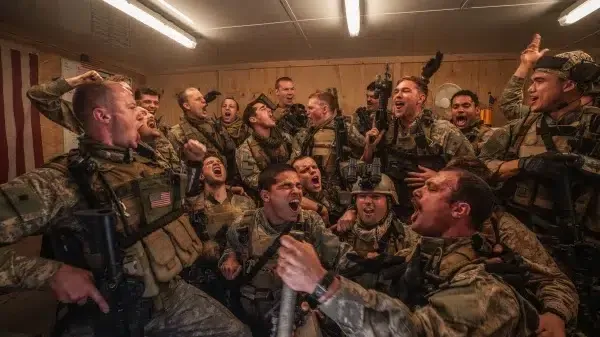
Warfare begins, somewhat improbably, with Mendoza and Garland doing their best Ashton Kutcher impersonations. From a grainy close-up of Eric Prydz’s iconic “Call on Me” music video playing on a computer in the middle of a Ramadi-based Navy SEAL outpost, the camera playfully pulls back to reveal a band of desert-camouflaged brothers huddled around the screen, singing and dancing like heavily armed children as they prepare for an upcoming mission. Tonally, the scene couldn’t be more different than what follows over the next ninety minutes — and in retrospect, it’s really the only outright, in-your-face display of “brotherhood” we get in the film (more on this later). Having said that, I think it’s an incredibly powerful way to kick things off, and it might be one of my favourite movie openings in recent memory — even if it felt like I was being punk’d at first.
From the outpost, we strafe into the house where the brunt of the film’s action takes place. Dispersed throughout the compound — which they’ve forcibly commandeered from a group of seemingly innocent Iraqi families — our “heroes” perform various reconnaissance tasks, including surveilling a group of nearby rebels and tracking their movements. Though the tasks are presented as mundane and rote, there’s a palpable sense that failing to do them — and do them well — could have life-altering consequences. Sure enough, when a grenade is thrown into the house by an insurgent — setting in motion a coordinated siege upon their location — the men must rely on the intel they’ve gathered, as well as their years of training and their instinct for solidarity, to make it out alive and as one unit.

Of the many things Warfare gets very right, chief among them is its depiction of this “instinct for solidarity” — or “brotherhood,” as I referred to it earlier. War films — and “dude-heavy” films in general — tend to bash audiences over the head with this concept, as if the notion that someone might sacrifice themselves to save a fellow brother-in-arms is a novel idea. Given the nature of what they do, I’ve always assumed that the bonds service members form are probably much deeper than the ones you and I had with our high school basketball teammates. So, personally, I don’t need to be constantly told what a tight-knit bunch they are — I would rather be shown through their actions, and Warfare excels at this better than many other films in the genre. The lengths the men in this particular story are willing to go to for one another are implicit (and sometimes explicit) in the decisions they make under intense pressure. They run out into gunfire to drag fallen comrades to safety. They treat wounds that appear untreatable in the hope that the injured might have a slightly better quality of life after the war (if they survive at all). They cross IED-riddled towns to assist other platoons that are under attack. All of this says more than any exposition or team-building montage ever could. And might I add — I never once questioned their togetherness, fictional or not.
Another thing I appreciate about Warfare is how stripped down and de-glamorized its presentation of warfare is. Mendoza and Garland don’t shy away from showing all of the unsexy details that other dramatizations omit. Bags get snagged on doors, morphine injectors get used incorrectly, and ammo has to be borrowed — basically, what they're pointing out is that war is never as smooth sailing as Hollywood has traditionally made it out to be. Nor is the glory at the end always as grand; sometimes a “victory” can be as simple as CASEVAC’ing two injured colleagues into Bradley’s just a few metres away, and even then, it doesn’t feel like a victory so much as a relief.

On a similar note, I think the dialogue the characters speak plays a large part as far as keeping the film “real.“ Of course, it’s mostly Navy SEAL jargon. But not once did I feel disoriented or out of the loop. Sure, we have to make some inferences in order to connect the dots that the filmmakers provide us with, but never does that burden feel too big to bear. On the contrary, trying to keep up with what they were saying made me feel far more invested in the story, almost as if I were a part of it.
But when it comes to making you feel as if you’re a part of Warfare, no departments deserve more credit than the sound, cinematography, and effects teams. The sound design is some of the best I’ve heard not just in a war film, but a film in general. The gunfire, in particular, is terrifying, and the way volume and distortion are used throughout the film to reflect the mental and physical states of the characters is quite clever. 2025 is already shaping up to be a competitive year for sound design, but if Warfare isn’t in the top five come awards season, I’ll be shocked. Less noticeable, but just as influential, is David J. Thompson’s cinematography. He ditches “war film” conventions like shaky cameras in favour of a cleaner, more tactical view of things. I’m a big fan of Rob Hardy’s work with Garland, but I think Thompson’s collaboration with the Brit might have surpassed anything they did together. I also don’t know how Garland manages to do it on such modest budgets (comparatively speaking), but the SFX and VFX aspects of his films always look first-class, and Warfare is no exception (those jets 😱).

Even with the authentic approach to storytelling and the amazing technical elements, a film like this is nothing without its cast, and I can say unequivocally that every member of the ensemble pitches in with something of consequence. Cosmo Jarvis and Joseph Quinn immediately spring to mind based solely on how much primal screaming they have to do (amongst other things), but I also loved what Will Poulter, Kit Connor, and D’Pharaoh Woon-A-Tai brought to the table. My favourite of the troop, however, was probably Charles Melton, whose arrival later in the film — along with his Alpha Two colleagues — signifies a glimmer of hope for the demoralized Alpha One squadron.
If I had to single out one feature of Warfare I think audiences need to be prepared for going in, it’s that the nature of the storytelling does require a certain level of patience from the viewer, especially early on. But if you can ride out the first 15 to 20 minutes — and some other moments where you’re forced to sit in the misery — I can damn near guarantee that you’ll be gripping your armrests and biting your fingernails for the remaining hour and change.
Warfare will likely be perceived as “anti-war” given the true story that inspired its creation, as well as its graphic content — which in and of itself will probably put a lot of people off from enlisting. But I don’t think Mendoza and Garland are forcing any opinions on audiences other than perhaps the idea that we shouldn’t disrupt civilian life the way we always do with each war (see “displaced Iraqi families”). As the filmmakers have stated numerous times, their mission was simply to create something — in this case, a carefully crafted collage of memories — that they could show to a wounded veteran friend who is no longer able to recall such things. I don’t think there’s anything more to it than that. I loved Warfare, whatever that means. It hit me much harder than I thought it would. Truthfully, I couldn’t believe what I was watching at times, and I don’t think that feeling of shock and awe will be leaving me any time soon.


Comments 8