THE ELECTRIC STATE: The Russo Brothers' Third Joke since Endgame
Directing

A few years ago, I read a short opinion regarding the new "source of inspiration" of the millionaire brothers who are ruining streaming and advertising audiovisual consumption as if it was a bag of chips. Yes, the Russo went into an "electric state": they left their hearts on a trunk by following Hollywood's rules to the letter and, as if they were sellers of the famous Lays, offer us something that when opened turns out to be a fraud. I sincerely apologize for this irremediable initial violence with which I may spoil the experience of reading this article, but the disappointment I feel inside surpasses any other feeling this movie—or actually "platform content"—could have made me feel. That's what triggered this exaggerated frustration. The words of the Los Angeles Times' journalist who summarized the soul of said source in a few words were literally:
"The book is dystopian '90s at its most bleak. It's the gloom of Twin Peaks and the detached alienation of Nirvana’s Nevermind with a plot that reads like The X-Files-meets-The Lawnmower Man."
When at the time it was announced that the Argentine Andy Muschietti could bear the great responsibility of adapting these still images to moving images, the enthusiasm grew tremendously. Sure, the Russo had already acquired the rights by that point and everything was permanently clouded by doubt, since Mama and It's director had as a priority taking charge of the first Flash standalone film, the bittersweet attempt to reignite the DC Universe that ultimately supposed its very funeral until James Gunn switched sides to fix everything. The war between production companies culminated with Netflix's victory which, in its new self-sabotage of wasting money, decided to leave the way open for the famous commercial brothers who, once again, didn't understand absolutely anything about what telling a good story means, even when it isn't originally a personal one.

What's the difference between wanting to be "cool" and needing your story to be "cool"? The Russo brothers probably don't understand it and, unless all production companies tell them "hey, we only have ten million dollars for your next movie," they will never change their minds. The executives—as I read a colleague correctly describe them—behind two of the best box office successes of Marvel Studios' history feel, as authors, up to par to what living legends like James Cameron or Steven Spielberg represent. Nonetheless, all that falls apart during the first minutes of the last commercial atrocity titled The Electric State, in which they got into thanks to Netflix and its insatiable thirst for self-sabotaging. This work is a clear example that many times more is less, the other way round the famous "less is more."
The platform spent a little over $300 million dollars distributed WHO KNOWS WHERE to—largely—blur the retrofuturistic vision that the graphic Swedish artist Simon Stålenhag presented in 2017 with his book, in which this adventure is based on. This new flop of the company not only entails the exploitation of creations through their cheap use and disuse to create entertainment focused on satisfying the masses, but also touched a pretty sensible string. One that probably nobody noticed until now since it basically is mine.
I have been writing a script for a few years now. I came across Stålenhag on Pinterest, as many of us may have sometime. His paintings are chaotically beautiful, full of symbolism, and present a decaying, hopeless world that, in some way and almost without any explanation, also invites us to dream. This atmosphere that combines desolation with a deep affection for analogue material transformed into my main inspiration to write a science-fiction story, which now wants to be forgotten. I found myself disappointed not only by the Russo's catastrophic vision, but also by the fact I'm aware I will probably never be able to do something similar to what I have projected in my mind and by wasting two hours of my life with this disappointing movie.

CONTEXT (SO AS TO CALM DOWN)
The graphic artist visualized an alternative United States immersed in a war between robots and humans that, literally, put almost everyone to sleep. We are in the 90s, a decade that signified prosperity and growth for the nation, but Stålenhag reimagined the era mixing memories of his childhood in a rural area with elements of the gloomiest science-fiction. This aligns with what Villeneuve presented exactly the same year of publication of this graphic book with Blade Runner 2049, to name the most significant and best executed example of the last years. A lot of fog, decay, absolute dehumanization and metallic beings that—ironically or paradoxically, however interpreted—border on humane.
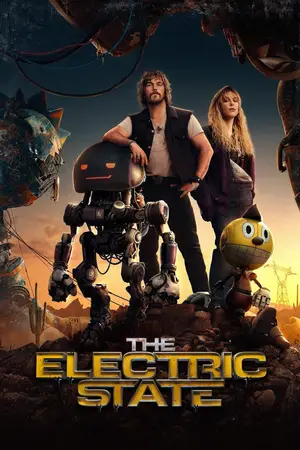
What was the Russo's best idea? Globally renowned for turning everything they touch into fun trash after Avengers: Endgame, they decided to transform this concept of fake dystopia into a two-hour journey that wants to have a heart, I REPEAT, wants to, but that ends up limiting itself in its same trap thanks to the clear, loud narrative and even—I dare to say—technical defects of its flashy structure. The thing is the magnificence and mystery of Stålenhag's images aren't reflected in—almost—any frame of this road film with hints of adventure/social critique. In the story, the protagonist, a young woman called Michelle Greene, embarks on an adventure to find her brother through the length and breadth of a North America destroyed by human stupidity and crowded with scavengers and even "fossilized" robots.
Once again, Millie Bobby Brown plays herself as the "rough girl" who cries for everything. A kind of powerless Eleven that after—MASSIVE SPOILER ALERT!—finding out her brother is alive but disconnected from his body decides to team up with the robots forgotten in the desert to destroy Sentre. This is a huge company led by Ethan Skate (Stanley Tucci playing the Russo's most forgettable villain on call), which created the Neurocaster, a virtual reality device that's automating everyone with its whimsical idea of freedom, as Skate proposes. Along the way, she meets Keats (Chris Pratt as Chris Pratt), a former soldier of the war between humans and robots whose only friend is the metallic, fun Herm.

Recycled music from Marvel's two latest epics, many dull visuals and a heart that beats shily and halfway are what could easily characterize this comic adventure that isn't funny nor remotely accomplishes what it promised. To be honest, I even forgot everything that happened in it. I know that Michelle discovers her brother didn't die in a car accident as she thought, that Sentre currently put him to sleep due to his extreme intelligence, that a doctor who used to work for the company transferred his brother's brain to a robot just like Cosmo and that the brother is the key to end the war between humans and metallic beings. When did the rebellion start? In the early 90s, robots realized they could think for themselves and decided to make their own team. According to the Russo, robots have been working for us since Walt Disney's golden era—let's say the 50s—but they decided to rebel forty years later. Why? The same illogical reasoning is applied to everything that happens from this delusional beginning until the final seconds.
In the ending, Millie Bobby Brown talks about the most real connection of all: the human one. "Real life is contact. It's you and me. We're flesh and bone, yeah, but we are also electricity. And when we hug and laugh and hold hands and argue, my particles stay with you, and yours stay with me. And maybe we stay together forever." But what's the point of all this excessively cheesy—and unsurprising clichéd—ending when the same feelings the protagonist tries to convey don't even make it through the screen to actually reach the audience?
Published on ABRIL 4, 2025, 13:23 PM | UTC-GMT -3
If you liked this article remember to give it a 👉 LIKE, put it in your FAVORITES, COMMENT 🗣️ , and FOLLOW ME for more movie and series content 📽




Comments 2