Saltburn (& Promising Young Woman); The Twist That Wasn’t There
General Reviews

In an industry that is extremely dominated by men, it seems more wrong than ever to criticize one of the more prominent female filmmakers of the decade, especially as in just the past five years she has joined the ranks of Greta Gerwig, Chloe Zhao, Jane Campion, and Sofia Coppola as female directors who have made major breakthroughs and comebacks in the past decade, yet despite Emerald Fennell’s short filmography already becoming prolific, I can’t help but feel like her efforts have left me cold.
Fennell released her debut film, Promising Young Woman, in late 2020, and—perhaps as a result of low competition due to the COVID pandemic—garnered several high-profile awards and nominations, most notably an Academy Award for Best Original Screenplay. Despite this and a good critical reception, the film was more polarizing with audiences, in large part due to its mishandling of its rape-revenge plotline, with its main point of contention being its ending where the main vigilante protagonist’s plan backfires and she doesn’t get to exact payback on her assaulters. This bold narrative move is immediately undermined a few minutes later by the reveal of a secret backup plan where she relies on the police to figure out the truth themselves. This unnecessary twist dilutes the message by robbing the protagonist of her agency; it’s an ending that is neither hard-hitting nor satisfying.
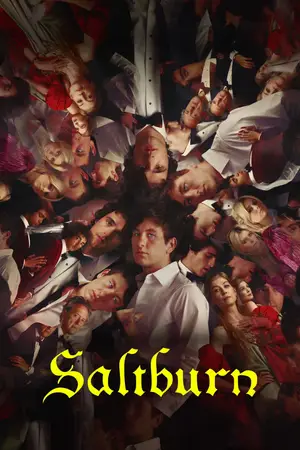
In late 2023, Fennell released her follow-up, Saltburn, centered on Oliver Quick, a lower-class college student who befriends the wealthy Felix Catton, as they stayed in the latter’s summer mansion. From a filmmaking and visual standpoint, Saltburn is a considerable step up from Fennell’s previous effort, as the cinematography is not only much more refined, but at times striking—several shots already seem primed to become film student moodboard staples. Jacob Elordi keeps proving himself as a compelling actor to look out for, as he delivers in a more subtle performance as Felix, the main love interest. Rosamund Pike and Richard E. Grant deliver fun supporting performances as well as Felix’s eccentric, wealthy parents.
Where the film loses me, however, is with Oliver Quick himself, our mysterious protagonist played by Barry Keoghan. I’ve tended to really enjoy Keoghan in movies such as The Banshees of Inisherin and The Killing of the Sacred Deer, but his performance in Saltburn feels strangely miscast. Oliver is initially presented as this awkward, shy type, yet despite his best efforts, Keoghan—perhaps because he’s already known for playing off-putting weirdos in other works—can’t help but stick out like a sore thumb. Once we move on to the titular Saltburn mansion, Oliver’s quickly shown to be more sexually disturbed. This is most notably exemplified through him drinking Felix’s fresh bathwater straight from the tub, the first of several scenes that come off more as shock value to generate further online discussion rather than as proper character development or for any reason that services the story. If anything, perverse scenes like these feel more gratuitous as they take away the mystery from the viewer; the film is essentially showing its whole card deck from the get-go instead of letting the audience connect the dots.
Despite my criticisms, I would still say the narrative mostly works fine, even nearing the end: a well executed twist regarding Oliver’s backstory is revealed, Elordi and Keoghan share some powerful exchanges about it, and we get a death scene that showcases some of the best acting from the whole cast. It feels like the film is heading to a natural, grim conclusion, but then comes a time skip in the last 15 minutes where the plot really unravels and falls apart.
“Is there ever such a thing as an accident?”, our lead character ponders as a montage reveals that all of the events of the film were orchestrated by Ollie, from major character deaths to seemingly insignificant little coincidences that by the end of the movie you already forgot about. I’m not sure what led Fennell to make this choice: perhaps she didn’t trust the audience to piece the plot together, despite its simplicity, or maybe she felt compelled to tie up every loose end, no matter how easy to infer – we didn’t need to see that Oliver’s wallet had bills inside it or that he put razorblades near the bathtub; it's better if we don't know all the details. Not only is everything revealed to be perfectly calculated, but Oliver now gloats, openly admitting he always despised Felix and his family, which undermines much of the emotional weight that had been built up earlier. Paired with over-the-top orchestral music, it is painfully obvious the film believes that this is a massive reveal that ties up all loose ends, yet if anything, it hurts itself in its confusion, as the point of the story becomes more muddled than before.
Oliver Quick could have been a deeply complex, emotionally driven character, who ends up over but the final moments of the film reduce him into a one-dimensional psychopath, capable of generating a master plan by predicting every outcome that’ll help him become a millionaire, which is about the most boring and underwhelming way you can write your focal character. The most frustrating aspect is that the ending could be very easily fixed: removing the montage and letting the viewer infer Oliver’s motivations through Keoghan’s still-effective performance, rather than relying on shock value sex scenes and winding monologues that muddle the plot would’ve been much more effective.
Saltburn, just like Promising Young Woman, showcases growth in Emerald Fennell’s directorial skills, but continues to frustrate in the writing department, as even outside her ending twists falling completely flat, she is still struggling with what the tone of her scripts should be. Both of these films should’ve been either way more campy or way more serious, but instead they feel like dull, self-important camp. A silver lining is that, unlike her first two which were original scripts, Fennell’s next film will be an adaptation of the novel Wuthering Heights, which hopefully gives her an opportunity to avoid falling into the same trappings in the near future.


Comments 4