"The Zone of Interest": Understanding Aesthetics
General Reviews

The political correctness surrounding Jewish suffering is an inescapable topic in this film. Many of the comments I've seen come from a context formed by existing historical texts or from a political standpoint. This may deviate from the film's potential.
In "The Zone of Interest," the film's aesthetic style plays a crucial role, characterized by its intense, severe, and institutionalized aesthetic. This approach creates a sense of anthropological observation or reconstruction, serving as a form of accusation and subversion of Nazi crimes.
The film's unique cinematography includes the use of 45° wide-angle and fixed shots to portray family life. These shots create a sense of "family surveillance," yet they also offer a deeper, more pure depiction compared to conventional "family images." The purpose of these shots goes beyond simple observation, providing a unique perspective on family dynamics.

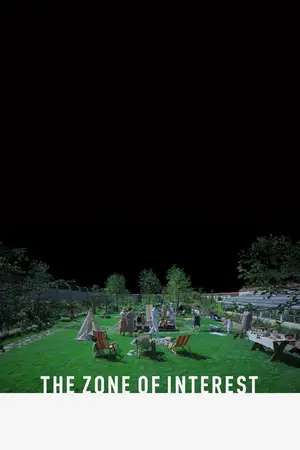
The scenes of Nazi officers' family life in "The Zone of Interest" are highly pure, warm, and harmonious. Even with contradictions and conflicts, they seem to be insignificant episodes in life: Rudolf Höss discovers bones in the water, his daughter can't sleep at night, Rudolf Höss needs to transfer, and he has conflicts with his wife and family. Finally, he feels uncomfortable in his stomach and vomits on the stairs. Compared to these episodes, the fixed shot and the 45° wide-angle shot showing the mansion near the Auschwitz concentration camp almost reach a "VR-style" experience. This immersive experience not only comes from the regular, harmonious, and warm images brought by the screen but also comes from the blood relationship emotions presented in the family life of Nazi officer Rudolf Höss, which strongly infects us.
Using horizontal scheduling and multi-camera cross-cutting, the film provides a detailed view of Rudolf Höss's family life, presenting every moment and aspect of their interactions and surroundings. This approach goes beyond a mere voyeuristic observation; instead, it offers a comprehensive portrayal of the family. While viewers may not necessarily seek such exhaustive detail, the director's choice of shots and editing reveal every aspect of Rudolf Höss's family life. As a result, the film blurs the line between anthropological reconstruction and natural history, creating a deeply immersive experience for the audience.

However, the historical film is optional because anthropological observation can be achieved even with just visual materials. The problem lies in why the director wants to show these scenes. The director almost expresses Rudolf Höss's deep emotions and the harmony of the Nazi army in a way that approaches humanism, showing that everyone is faithfully working for a "zone of interest."
Of course, the "zone of interest" represents this "pure land," the harmonious and united Aryan family land. However, the parts about the girl's dreams, the firelight from the crematorium, the bones in the water, and the sky over the concentration camp that appear in the film cannot compete with this "zone of interest." They need more space and more dialogue. Similarly, the sky over the concentration camp occupies the screen with pure white, and the flowers occupy the screen with pure red. Although these sudden inserts are essential, they cannot compete with the carefully designed external family struggles.
At this juncture, one might question the director's political stance: Is the film praising this Nazi family? Is it attempting to revive the Nazi ideology? In reality, the film employs extreme irony within the framework of the politically correct "Auschwitz concentration camp" narrative. Some may view this as a clever yet lazy approach to creating a politically charged topic. However, this perspective fails to recognize the film's self-sufficiency. While the portrayal of the Nazi family is indeed ironic, attributing the film's impact solely to external factors is inadequate. Despite its clever intertextuality, the film also showcases unique innovations. Therefore, the defence of the film's intent should centre on its autonomous qualities.
Are these details disturbing us? The smoke over the Auschwitz concentration camp, children playing with Jewish teeth, the red light from the crematorium, the sound of the train whistle, and the ghost-like, low-pitched background music that keeps appearing. As an audience member who already holds a sympathetic knowledge position towards Jews and accuses Nazis, the first thing we do is to use these to blame the Nazis for their crimes. However, the historical traces are insignificant because we don't see the direct crimes.
Because we didn't see the crematoriums, the piles of corpses and clothes, these images themselves have no power, no words; this is a profound reversal. The more we want to speak for the Jews, for justice, the more we find that this kind of defense is impossible. Instead, the warm Aryan core family, the loving parents, the children playing together, the blond boys and girls enjoying love. From time to time, the family goes out for picnics until the sunset, when the sky turns purple... These highly beautified scenes are occupying our eyes.

This aesthetic attempt may be what Walter Benjamin mentioned as an attempt to "Aestheticize Politics." In "The Work of Art in the Age of Mechanical Reproduction," Walter Benjamin cited the "Aestheticize Politics" achieved by the Nazis through film, which refers to the fact that through film, individuals can enjoy the collective values achieved by the nation in war, highly mechanized troops, and exquisite and heroic military uniforms, which attract the masses to choose a path with higher "aesthetic value" - war.
However, "The Zone of Interest" doesn't just portray the Auschwitz concentration camp as a rational and efficient killing machine; it also superficially depicts the camp. The meeting and subsequent dinner of Rudolf Höss in Oranienburg in the latter part of the film align directly with Walter Benjamin's example. The meeting demonstrates strict discipline and efficient work; the most captivating part of the dinner is the ice sculpture carved into the shape of a swastika, crystal clear and dazzling. These scenes are stunning, and the shot design continually immerses us in the scene because, fundamentally, these are aesthetically designed scenes. This is the aestheticization of politics, a complete aestheticization of the ecological film that conceals the original purpose and achieves complete aestheticization.

Similarly, the portrayal of the warm Aryan family rowing together, tending to the garden, and raising children is also an aestheticization. The director attempts to recreate an aesthetic experience of Nazi values to reaffirm their aesthetic worth. This suggests that, compared to the grand military system, the core family values may be more appealing and can aesthetically captivate people. It almost entirely achieves this: when the firelight illuminates the mother's face, we are not preoccupied with the Jews but are enchanted by the beauty of the scene, and we are concerned about whether the mother is still prioritizing her family.
This aesthetic portrayal has almost achieved perfection. This is a Nazi aesthetic hidden in peacetime, a Nazi aesthetic belonging to the mind, which not only represents a pure pursuit of aesthetics but also a power of aesthetics that dominates and exploits us. Therefore, the aesthetic presentation of the Nazis, instead of the traditional direct uglification/demonization of the Nazis, is a bold attempt at subversion. To occupy all possible images in an aesthetic sense to achieve the "rationalization" of the Nazis.
In this portrayal, the irony doesn't lie in using Jewish suffering to evoke our sympathy and reflection. Through techniques like invisible voices, reversed colors, empty shots, pure colors, and the time-space reversal at the film's end, our thoughts are forced into a challenging position when we revisit the Auschwitz exhibition. The subdued, painful, background voices, devoid of rhythm, convey an unspeakable message. The implied freedom disrupts the carefully constructed organic unity within the Nazi family. Even if it's just a few cracks, it's enough to awaken our vigilance against the Nazis' beautification. The key here is "vigilance," not outright opposition, because the Jewish community in Auschwitz itself was powerless. Beyond the walls, we're unaware of how many similar groups might exist, being dominated, exploited, oppressed, and crushed by Nazism in everyday life. This holds particular significance for our heavily aestheticized present.
We also need to consider the images themselves. These images that break through reality can be categorized as "impulse-images." According to Gilles Deleuze, an "impulse-image" implies a naturalism, a natural decay of primitive forces, a natural impulse. The film often alludes to a destructive force on the original environment because it transitions from emotion-image to movement-image, which refers to a strong impulse when action is not initiated. This point also applies to those "out-of-place" parts of the film. The originally beautiful flowers, representing the aesthetic sense and harmony of the core family, completely fill the screen, as if the next second, there will be a reversal, as if the power to accuse the Nazis that we long for will come. But it doesn't.
At the film's beginning, there is a long black screen, in which we hear a sad, low hum. Still, it is replaced by birds and flowers, something that has not yet begun as a ghost wandering in the quiet and irregular background sounds. The occasional gunshots and screams also apply.
This natural force can be embodied as resistance to the Nazis, as seen in Steven Spielberg's "Schindler's List." However, once concretized, the meaning of the "impulse-image" in its process is dissolved. "Schindler's List" forms a cohesive whole, relying on "The Movement-Image" to convey a direct truth, achieving what appears to be a complete redemption for Jews or persecuted vulnerable groups, and an accusation against the Nazis.
When Auschwitz concentration camp is transformed back into a museum, the staff meticulously wipe and clean it. This cleanliness and presentation are not ironic but a continuation of the pursuit of Nazism in peacetime. Everything inside appears beautiful, clean, and tidy, creating an intoxicating effect. However, there is always an image that remains unclear, like a ghost implying an extreme impulse. This awakening is continuously emphasized and sharpened by the director.


Comments 0
No comments yet.